Faustus: Good Angel, Bad Angel, Parma and Politics

Ken Eckert's photo of Huntingdon Library's (huntington.org) 'Faustus' manuscript. (2008)
(From Ken Eckert, via Wikimedia Commons, used w/o permission.)

A year and three weeks ago, I started writing about Marlowe’s “Faustus” play: “The Tragical History of the Life and Death of Doctor Faustus.”

Three months later, I’d finished three more. Then in May, 2021, “Faustus” moved to my mind’s back burner; before falling off the metaphorical stove.

My “Marlowe’s Faustus” series isn’t the only project I’ve let slip. I talked about that and other pandemic-prompted perturbations last Tuesday.

Last April, I said I’d probably look at Faust’s GOOD ANGEL and EVIL ANGEL,” the prince of parma,” and maybe grapes next time; so that’s where I’ll pick up.

Taking those items in reverse order —

Faustian Grapes and Groceries

From the 'Faust' collection, central library, German Classic, National Research and Memorial Sites, Weimar.After giving the Duke of Vanholt an enchanted castle in the air, Faustus had Mephistophilis fetch out-of-season grapes for the Duchess.

That’s a little past the play’s halfway point, I don’t remember why I said I would discuss grapes next time. Which is now this time. Never mind.

These days, I could get ripe grapes in winter at a grocery; but this was the late 15th century, so those grapes impressed the Duke more than the floating castle.

Late 15th century? Marlowe’s play opened in the 1590s, but it’s based on legends inspired by Johann Georg Faust’s colorful career, about a century earlier.

By the way, about “Mephistophilis:” today’s usual spelling is Mephistopheles, but in Marlowe’s play it’s Mephistophilis, so that’s the form I’m using.

And the moral of the Faustus-Vanholt affair is that grocery grapes are a Satanic snare, so we should boycott Safeway.

With what seems like 57 varieties of crisis du jour in my news feed, and a mix of impassioned agreement and denial in my corners of social media — a disclaimer may be in order.

I don’t hate grocery grapes. I’m not anti-Safeway. Really!

Scott Adam's 'Dilbert' strip: Dogbert's Good News Show. ('We'll all die!')But I remember the days when communist threats were rampant.

Then everything caused cancer, all the fish in the sea were gonna die, and global warming became climate change. Meanwhile, wannabe prophets were selling End Times Bible Prophecies at odd intervals.

With a little encouragement, and an appalling lack of hope, I could assume that folks are so gullible that they’ll believe anything.

On the other hand, I’ve yet to hear or read faith-based denunciations of produce. Maybe some bogeymen are simply too silly for effective fearmongering.1

And that’s another topic.

An Impressive Wish List

A frontispiece for 'Historia Mundi Naturalis,' by Pliny the Elder, published Sigmund Feyerabend, Frankfurt am Main. (1582) via Wikimedia Commons, used w/o permissionFaustus delivers his first speech after GOOD ANGEL and EVIL ANGEL make their first appearance.

More about them later.

Faustus is giddy — he says “glutted with conceit,” since this is an Elizabethan soliloquy — at what he expects from using “that damned book.”

It’s an impressive wish list. Faustus sees himself “resolved…of all ambiguities;” with spirits fetching him gold and pearls, searching “all corners of the new-found world for pleasant fruits and princely delicates.”

There’s more, including “strange philosophies” and what we’d call state secrets these days.

Then, after imagining himself ordering all-new silk wardrobes for students, Faustus turns his attention to national defense.

“…I’ll have them wall all Germany with brass,
And make swift Rhine circle fair Wertenberg….
…I’ll levy soldiers with the coin they bring,
And chase the Prince of Parma from our land,
And reign sole king of all the provinces;
Yea, stranger engines for the brunt of war,
Than was the fiery keel at Antwerp-bridge,
I’ll make my servile spirits to invent….”
(“…Faustus…,” Marlowe (1604, From The Quarto Of 1616) Edited by The Rev. Alexander Dyce (1870))

Marlowe wrote “Faustus” for an English audience.

But, although Marlowe kept his title character’s German roots in mind, he re-imagined the setting as contemporary Europe. Or maybe decided that anachronisms didn’t matter.

J. G. Faust was earning his reputation in the early 1500s, so he’d have known about Amerigo Vespucci’s confirmation of the Columbus reports and subsequent scramble for territory and wealth in the “New World.”2

The “fiery keel at Antwerp-bridge” is another matter.

Names, Labels and History

'Pontis Antwerpiani fractura' illustration from Famiano Strada's book (possibly 'De bello Belgico decas secunda'). (1647)) via Wikimedia Commons, used w/o permissionJ. G. Faust had been dead for decades when England’s Elizabeth I unofficially subsidized Federigo Giambelli’s design and construction of hellburners.

This was a little under two decades into the Eighty Year’s War. Or Dutch War of Independence, depending on who’s talking.

At any rate, what we call Netherlands, Belgium and Luxembourg were the Habsburg Netherlands; held by the Holy Roman Empire’s House of Habsburg.

Then, in 1549, they were rebranded as the Seventeen Provinces. Starting in 1556 the Spanish branch of the Habsburgs were in charge, so they were the Spanish Netherlands.

At least some residents revolted in 1568, which led to the Seven United Provinces and the Dutch Republic. Then the Spanish Southern Netherlands became the Austrian Netherlands and the French First Republic got its slice of the pie in 1795.

1566 propaganda print, celebrating faith-based vandalism. FromRijksmuseum, via Wikimedia Commons, used w/o permission.At some point, we started saying the Eighty Years’ War was one of the European wars of religion.

Again depending on who’s talking, these religious wars started with the Knights Revolt in 1522.

They included the German’s Peasant War (1524-1526), Tudor conquest of Ireland (1529-1603), Thirty Years’ War (1618-1648) and the Düsseldorf Cow War (1651); before ending with the Toggenburg War (1712).

“European wars of religion” is a catchy label, and fits nicely with the era’s faith-based propaganda; but I’m impressed at how often religious fervor just happened to support the upper crust’s territorial and/or economic ambitions.

Or, in the German Peasant War fiasco, for example, had been inspired by grass roots dissatisfaction with the status quo.3

The Fiery Keel at Antwerp-Bridge: Hellburners

Destruction of a pontoon bridge during the siege of Antwerp, llustration from Famiano Strada's 'Histoire de la guerre des Païs-Bas.' (1727 edition) via Wikimedia Commons, used w/o permission
(From Famiano Strada/Romeyn de Hooghe/Lamberecht Causé, via Wikimedia Commons, used w/o permission.)
(Siege of Antwerp, 1584-1595, destruction of pontoon Bridge.)

Antwerp was and is a city on the River Scheldt, linked to the North Sea by the river’s Westerschelde estuary.

Alexander Farnese blocked Antwerp’s access to the sea with a pontoon bridge.

And now, finally, getting back to hellburners, Faustus and anachronisms.

Bankrolled by England’s Elizabeth I, Italian engineer Federigo Giambelli built two hellburners for the Dutch defenders: fire ships packed with massive explosive charges. Fire ships, expendable vessels set ablaze, had been used for centuries. Packing them with explosives was, I gather, an innovation.

The first hellburner fizzled, doing little damage; but when the second exploded, it disappeared: along with a fair fraction of the Farnese’s soldiers, a block house and part of the bridge.

So, that’s “the fiery keel at Antwerp-bridge.”

Alexander Farnese was Duke of Parma; but there was an Alexander Farnese, Prince of Parma: A. Farnese’s grandson, and other Dukes of Parma.

Since Alexander Farnese, Prince of Parma, was born after Marlowe wrote “Faustus,” he couldn’t have been the play’s Prince of Parma.

My guess is that Marlowe didn’t particularly care whether or not he got A. Farnese’s title right, as long as that first soliloquy sounded right. In any case, A. Farnese, Prince of Parma, was what an OpenLearn resource called “an Elizabethan hate-figure.”

Invading England was on the “prince of Parma’s” to-do list, but after several storms, battles and a royal speech, what was left of the Spanish Armada returned to Spain.4

Several ships from that fleet went down not far from where a number of my Irish forebears lived, and that’s yet another topic.

Angels, Real and Imagined

Unknown artist's copy of Matthaeus (Matthäus) Merian the Younger's illustration for Ezekiel, chapter 1's 'chariot vision.' (1670)To begin with, angels aren’t human: at all.

Sometimes they look human, like the two who told Lot to head for the hills. (Genesis 19:129)

Sometimes they look sort of human, like the ones in Ezekiel’s vision: aside from having four wings, four faces, hooves like a bull’s and being covered with eyes. (Ezekiel 1:421, 10:12)

The “figures in the likeness of four living creatures” are Cherubim, the same sort of angel represented on the Ark and in Solomon’s temple. (Ezekiel 1:5, 10:110:19; Exodus 15:18; 1 Kings 6:23; 2 Chronicles 3:10; Catechism of the Catholic Church, 2130)

Their descriptions don’t exactly tally, which could bother me; but doesn’t, since I realize that angels — again — aren’t human. Not even close. So, given given their nature, literally “accurate” physical representations aren’t possible.

On the other hand, angels are more like us in some ways than, say, rocks.

We’re both free-willed creatures, persons who can decide what we do or don’t do. But we humans are free-willed creatures who are body and soul, matter and spirit, made “in the image of God.” (Genesis 1:2731; Catechism, 355-373, 1730-1742)

Angels are free-willed creatures, too; but they’re made with spirit, not spirit and matter. One more point: “angel” is their job. They’re servants and messengers of God. “Spirit” is their nature. (Catechism, 328-336)

The spirits we call angels are the ones who decided that serving God is a good idea.

Others, including and particularly the one we call Satan, decided that they’d oppose God. That’s a ‘down’ side to free will. Even the best free-willed creature can decide to opt for evil. (Catechism, 391-395)

Cherubim, Putti, Space-Time and Language

James Tissot's 'Vision de Zacharie (The Vision of Zacharias).' (ca. 1890) via Brooklyn Museum, Wikimedia Commons, used w/o permission.Finally, a few points about angels in general, how they’re imagined and how I talk about them —

One of the cherubim is a cherub. So one of Ezekiel’s figures “in the likeness of four living creatures” is a cherub.

That sort of cherub is not the overweight kid with wings occasionally appearing on Valentine’s Day cards and sentimental 19th century prints.

Cupid and company are putti, ancient Rome’s visual symbol for groovy passions like having an adolescent crush on someone.

One Putti is a putto, Donatello’s generally implicated in reviving and rebranding putti in the 14th century; and although I recognize their appeal, I’m glad that artists like James Tissot didn’t join several fashionable bandwagons.5

Earlier, I said that “angels decided,” past tense: which reflects where their decisions began affecting us.

But I live in space-time, and my native language has three or a dozen tenses, depending on who’s talking. None of them adequately express an act performed by creatures who, although they can interact with those of us who are currently in space-time, don’t live here.

I suppose I could say “angels decide,” but using present tense strikes me as implying an existence in time, and that’s yet again another topic.

Good Angel, Bad Angel: Dichotomous Duos, Dramatic Dialog and Comic Relief

Animated GIF derived form Walt Disney Pictures/Feature Animation's 'The Emperor's New Groove.' (2001) via tenor.com/used w/o permission.Now, at last, GOOD ANGEL and EVIL ANGEL!

They’re only onstage four or five times: depending on whether or not I count “Re-enter GOOD ANGEL and EVIL ANGEL” as a separate appearance.

Anyway, the dichotomous duo show up after Faustus talks about becoming a demigod and sends his servant Wagner to bring his “dearest friends” Valdes and Cornelius. With friends like those, he doesn’t need enemies, but I’ll leave that for another day.

FAUSTUS: “A sound magician is a demigod:
Here tire, my brains, to gain a deity.”

GOOD ANGEL. “O, Faustus, lay that damned book aside,
And gaze not on it, lest it tempt thy soul,
And heap God’s heavy wrath upon thy head!
Read, read the Scriptures:—that is blasphemy.”

EVIL ANGEL. “Go forward, Faustus, in that famous art
Wherein all Nature’s treasure is contain’d:
Be thou on earth as Jove is in the sky,
Lord and commander of these elements.”
(“…Faustus…,” Marlowe (1604, From The Quarto Of 1616) Edited by The Rev. Alexander Dyce (1870))

Then, having offered Faustus strongly contrasting advice, GOOD ANGEL and BAD ANGEL leave.

Four centuries later, GOOD ANGEL/EVIL ANGEL analogs are often played for laughs. Even when they’re actually delivering dramatic dialog; advocating long-term survival on the one hand, and attractive immediate outcomes on the other.6

This is where I could mourn the decline and fall of practically everybody, the imminent collapse of civilization, and at least imply that everyone should be as miserable as I am.

But I won’t.

Partly because I’ve noticed that even comic-relief shoulder angels sometimes do their dramatic duty.

Shoulder Angel Origins and Tying Up Loose Ends

'Reefer Madness' (1936, released 1938-1939) theatrical release poster. (1972)And partly because I think making points with the ham-handed anvilicious moralizing of such dramatic works as “Reefer Madness” is a bad idea.

Assuming, of course, that the author isn’t writing with tongue firmly in cheek, with intent to either entertain or mock.

I’m pretty sure Marlowe didn’t have comic relief in mind with his GOOD ANGEL and EVIL ANGEL. I’m also quite sure that he didn’t invent that dramatic convention.

The idea of folks having two angels with very different agendas goes back at least to “The Shepherd of Hermas,” written in the second century; or maybe the first.

The author was St. Paul, or a brother of Pope Pius I, or someone else.

“The Shepherd of Hermas” was popular in Christian circles from the second through fourth centuries.7 But these days it’s mostly nerdy folks like me who talk about it.

Here’s the “two angels” line in “The Shepherd….”

“‘…There are two angels with a man–one of righteousness, and the other of iniquity.'”
(“The Shepherd of Hermas,” Second Book: Commandments, Sixth Commandment HOW TO RECOGNISE THE TWO SPIRITS ATTENDANT ON EACH MAN, AND HOW TO DISTINGUISH THE SUGGESTIONS OF THE ONE FROM THOSE OF THE OTHER, CHAPTER II. (probably second century A.D.) Roberts-Donaldson translation, via earlychristianwritings.com)

We meet Valdes and Cornelius right after Faustus talks about a brass wall for Germany and “the fiery keel at Antwerp-bridge,” so that’s where I plan on picking up next time.

Now the usual links: my Marlowe discussions to date, plus a ramble about hubris, storytellers, cautionary tales and — weather control, of all things.


1 Making sense, more or less:

2 People and current events, a half-millennium back:

3 “Faustus” in context:

4 A little history:

5 Art, mostly:

6 A dramatic convention:

7 Making a point:

Posted in Discursive Detours, Marlowe's Faustus, Series | Tagged , , , , , | 3 Comments

COVID-19 and People Who Need People, Another Year

Brian H. Gill's 'Internet Friends.' (2017)

Fred Barnard's 'Discussing the War in a Paris Café,' Illustrated London News. (September 17, 1870)It’s been a year and a day since I talked about socializing, the pandemic and individual differences.

“…I can sympathize with folks who really do need people: people who are physically close, not ‘close’ only in a virtual sense. I’m also willing to accept that not everyone is like me. For which we should all be thankful. And that’s another topic.

“That said, COVID-19 pandemic restrictions haven’t cut into my social life all that much.

“Before ‘social distancing’ — a poorly-chosen phrase, and that’s yet another topic — started becoming a cliche, most of my social life was online….”
(“People Who Need People — and the COVID-19 Pandemic” (January 24, 2021))

Somewhere during the last year, I noticed that I’d been enjoying my research and writing routines less. And had let some projects drop off the back burner.

Pandemic-Prompted Perturbations?

Left: W. Spooner's 'I feel a fit o'them curst blue devil coming across me again.' (ca. 1835) Right: Vincent van Gogh's 'Sorrowing Old Man (At Eternity's Gate). (1890)Not unexpectedly, the situation got worse as Christmas approached. That’s always a bad time of year for me.

“…As my wife once noted, I ‘get weird’ during each Christmas season. That’s not surprising, since something very traumatic happened around Christmas when I was 12. Memories of the incident are lost. Not accessible, at least….”
(“The Magi, Meds and Me” (January 7, 2018))

But I think this year’s weirdness has roots in pandemic-prompted perturbations. There, I made that alliterative, and that’s another topic.

At any rate, at a Mass last summer, I felt a strong urge to start chatting with some folks who were sitting near me. Now, as someone at Walmart said, comparing me and my son; “you always talk, he never talks.” But I seldom feel that eager to strike up a conversation.

So, despite living near the ‘people who need people’ continuum’s low end, and being generally satisfied with online social interactions; I figure the pandemic’s starting to bug me.

And, if I’m starting to feel something akin to cabin fever, then folks with more 50th percentile social needs — well, I can sympathize with them more easily now.

Although I’d appreciate it if everyone would turn the hysteria down a few notches. It’d be nice if news media and politicos would stop doing what they do with a real health issue, but that’d be like asking for the moon.

Liberal, Conservative, Libertarian: But Not Moderate

Brian H. Gill's results from a polquiz.com quiz, which uses the Nolan Chart. (September 2017)Speaking of politics, it’s been a while since I talked about beliefs, politics and me.

I’m a Catholic and take my faith seriously, so online ‘which side are you on’ polls say I’m a liberal; a conservative or; in one case, a libertarian.

But not a moderate.

I think they’re all accurate, as far as they go; since I think human rights and human life matter, and I think subsidiarity makes sense.

The quiz that pegged me as a libertarian displayed its results on a Nolan Chart, developed by a libertarian activist.1

Since ‘which side’ tests I’ve taken focus on only a few ‘political’ topics, I figure I’m ‘liberal’ on those which ask me if I think employees should be treated like people; and ‘conservative’ when the focus is on whether I think humans are people, no matter their age. And that’s yet another topic.

Glitches, Unexpected Issues: But Other Than That, a Good Day

Brian H. Gill's 'Meet Norbert Nerdly.' (2015)
(“Meet Norbert Nerdly” — my frustrations, personified. (2015))

That picture, “Meet Norbert Nerdly,” is available as prints and posters (from $6.71) at my Norski’s Shop on DeviantArt.com. Okay, self-promotion having been accomplished, a partial explanation for this journal entry.

I was working on this week’s ‘Saturday’ piece, it’ll be about Marlowe’s Faustus, this morning. Then I experienced a maelstrom of glitches, or technical difficulties, or frustrations.

Whatever I call them, I called the company that hosts this site. And a good thing, too, since I discovered a number of other issues I’d missed.

Long story short, the glitches aren’t gone; but I’m pretty sure they won’t affect your experience with A Catholic Citizen in America.

And the issues I’d missed are now resolved. After only a few hours and two broken telephone connections.

I may even get that “Faustus” thing finished by Saturday.

More of how I see life, the universe and making sense:


1 Charting attitudes:

Posted in Journal | Tagged , , , , , , | Leave a comment

Light Show in Washington; Law and Life; Masks Back On

CNS/Ashley Wilson's photo of a slogan projected on the Basilica of the National Shrine of the Immaculate Conception in Washington. (January 21, 2022) via The TabletI’d expected to hear about charisms during Mass this morning.

I did, in the Bible readings. But the homily was about why killing innocent people isn’t a good idea, even if it’s legal.

And why we should see killing innocent people as a bad idea.

And help folks who maybe felt pressured into ordering a hit because it’s ‘for their own good.’

At any rate, The last-minute topic change was due to Saturday’s Friday’s light show outside the National Basilica in Washington, DC., which wasn’t part of the prayer vigil happening inside.

So far, Saturday’s Friday’s light show doesn’t seem to be a hot news item. Not for national-level traditional news media, anyway.

I’m not happy about the light show.

That’s partly because I think human beings are people even if my country’s laws limit their “…unalienable Rights, that among these are Life, Liberty and the pursuit of Happiness….”

Which I’ll grant is “unconstitutional.”

It’s in the Declaration of Independence’s preamble.

Meanwhile in Minnesota, Masks Back On

The Masked Minnesotan.The other surprise at Mass was a letter from our Bishop.

It’s a response to “…the fast-spreading omicron variant….” Seems that this particular iteration of the COVID-19 virus is expected to peak in central Minnesota in the next two to six weeks.

Bishop Kettler says we’ll be wearing masks during Mass again.

I’m not ecstatic about that, since it’s cold outside, and my glasses will fog up if I’m wearing them and a mask.

But I see the ‘masks back on’ rule change as a common sense response to a very real threat to public health. And one way I can act as if loving my neighbor is a good idea.

I’ve talked about this sort of thing before.

Posted in Being a Citizen, Being Catholic, Journal | Tagged , , , , , , | Leave a comment

Exoplanets, Iron, Evolution and Strange Geochemistry

Science stories and topics have been piling up in my ‘to do’ list for more than a year.

This week, I’m catching up on what we’re learning about life here on Earth; and developments in the ongoing search for extraterrestrial life.


Life and Chemistry

Part of the trick in looking for extraterrestrial life is knowing what to look for.


Iron, Oxygen, Evolution and Life

Jon Wade et al.'s figure 3, 'Adaptation to low iron availability....' (December 21, 2021)
(From Jon Wade et al., used w/o permission.)
(Fig. 3, strategies for dealing with an iron shortage. Jon Wade et al. (December 21, 2021))

Temporal variation of planetary iron as a driver of evolution
Jon Wade, David J. Byrne, Chris J. Ballentine, Hal Drakesmith; PNAS (Proceedings of the National Academy of Sciences of the United States of America)
(December 21, 2021)

“Iron is an irreplaceable component of proteins and enzyme systems required for life. This need for iron is a well-characterized evolutionary mechanism for genetic selection. However, there is limited consideration of how iron bioavailability, initially determined by planetary accretion but fluctuating considerably at global scale over geological time frames, has shaped the biosphere. We describe influences of iron on planetary habitability from formation events….”

Earth is uninhabitable, and has been for about 2,000,000,000 years. Apart from a few pockets in the deep ocean, fens, bogs; and in vertebrate digestive tracts. Uninhabitable, that is, for critters that can’t tolerate oxygen.

That’s because cyanobacteria started making oxygen as a waste product, some two to two and a half billion years back. Probably.

We can’t live without oxygen, but it’s lethal for critters we call obligate anaerobic organisms. And before cyanobacteria came along, Earth’s ocean was a fine place to live. For them.

Cyanobacteria and Fun with Words

NASA's photo, taken by an ISS Expedition 7 crewmember while the Station was over the Pacific Ocean. The atolls of Tabiteuea and Onotoa are near this image's right side. ISS007-E-07304 (June 13, 2003)Scientists are pretty sure about cyanobacteria’s role in the environmental disaster, but aren’t sure about the details.

For one thing, cyanobacteria multiply like, well, like bacteria. Fast.

So they should have flooded Earth’s ecosystems with oxygen in far less than a half-billion years.

For another, there’s still debate over whether oxygen releases happened fast, on a geologic timescale, or slowly.

Then there’s the matter of not knowing how Earth’s oxygen cycle worked back then; and how much it was affected by the abundance or lack of iron, nitrogen, phosphorus and maybe nickel.

Then again, maybe Earth’s oxidation had to wait for tectonic triggers and our planet’s first continental shelves.

“Tectonic triggers.” Alliterative. I like that.

I suspect the authors had a little fun with Figure 3’s caption, too.

They said that cells use biotic iron sources with “…behaviors that can be mutually beneficial, piratical, or more efficiently self-sufficient.”1 I wouldn’t have expected “piratical” in yesteryear’s pedantically professorial prose.

Adapting to an Ancient Iron Shortage

Royroydeb's photo of a museum's model of an animal cell model; Kolkata, India. (2014)Basically, there’s very strong evidence that life on Earth started without oxygen, and that atmospheric oxygen peaked about 300,000,000 years back.

Eukaryotes, critters whose cells have a nucleus inside a double-walled lipid membrane, showed up around the time oxygen became part of Earth’s environment. Some scientists think that the earliest eukaryotes developed in part because of the oxygen. Other scientists aren’t sure.

Animals, plants, fungi and critters with long names like glaucophytes, are eukaryotes. That’s assuming that algae aren’t, or aren’t quite, plants. And that’s another topic.

Cyanobacteria are, well, they’re bacteria. Bacteria are critters that aren’t eukaryotes and don’t have a nucleus. They’re single-celled organisms, except for the ones that aren’t; or aren’t all the time.

Bacteria are also prokaryotes. That was before the 1990s, when scientists noticed that “bacteria” came in two very different models. Some bacteria are now called archaea.2

Wade, Byrne, Ballentine and Drakesmith say that iron is the main ingredient for many of Earth’s earliest metabolic processes: nitrogenases, hydrogenases, sulfate reduction, methanogenesis and anoxygenic photosynthesis.

All of which use oxidoreductase enzymes.

Glaucophytes? Nitrogenases?? Anoxygenic??? Don’t worry about those words. There won’t be a test on this: for which I, at least, am grateful.

Wade et al.’s point is iron was abundant in Earth’s early ocean; more abundant that it is today, at any rate. And that besides killing obligate anaerobes, oxygen directly and indirectly put a big dent in the oceanic iron supply.

That, in turn, gave critters that used iron more efficiently a big survival edge.

Planetary Chemistry

'Journey to Mars:' NASA's Perseverance rover's caching strategy.If all planets were pretty much like Earth and life could only work the way it does here, then we might have found life on Mercury, Venus and Mars.

Make that Venus and Mars, since Mercury is so close to our star.

But we’ve learned that the Solar System’s inner planets each have a different chemical mix on their surfaces.

Wade et al. say that how much of a terrestrial planet’s silicate mantle is iron very likely affects how likely it is that life can get started there.

It’s not the only factor, but they give what I think is a pretty good case for thinking that iron matters when it comes to looking for extraterrestrial life.

So, all we have to do is concentration on rocky planets around Earth’s size, but without Venus’s over-dense atmosphere, right?

It’s not that simple. And the question of habitiability goes far beyond whether or not oxygen’s in the atmospheric mix.


Unearthly Rocks

No two planets in the Solar System are exactly alike. Looks like “terrestrial” planets orbiting other stars may be even more diverse than those in our planetary system.


PWDs, Polluted White Dwarfs: Stars Eating Their Planets

NASA/JPL-Caltech/GSFC's artist's impression of G29-38, a dusty disk and a comet that's come too close to the star.
(From NASA/JPL-Caltech/GSFC, used w/o permission.)

How polluted white dwarfs expanded what exoplanets are possible
“Studies of white dwarf stars eating their planets suggests the types of rocks and minerals making up exoplanets are stranger than scientists thought possible.”
Jon Kelvey, Inverse (November 2, 2021)

“Generally, geologists like Keith Putirka spend their careers peering down at rocks and pondering the rules of planetary evolution, not looking up at the stars.

“But when Putirka, a professor of volcanology at California State University, Fresno, learned of a certain kind of star known as a ‘polluted white dwarf,’ he realized there was a way to do both.

“Polluted white dwarfs are dense, compact stars that have recently digested one of the rocky planets that formerly orbited them, and the mineral composition of those planets can be seen, for a time, in the spectral information from the star’s light. By examining polluted white dwarfs in our Solar System’s neighborhood, Putirka could learn what those exoplanets had been made of, and how similar they were to Earth or other rocky planets around our Sun.

“The answer, as Putrika and his colleague Astronomer Siyi Xu detail in a paper published Tuesday in Nature, is not very similar at all….”

Actually, Putrika and Xu found one familiar chemical profile, so make that mostly “not very similar at all.”

They found traces of a planet similar to earth on one white dwarf, WD1145+ 017.

That’s one out of the 23 PWDs, polluted white dwarfs, they studied.3

Where is WD1145+ 017?

's IAU and Sky & Telescope magazine (Roger Sinnott & Rick Fienberg))WD1145+ 017 is about 570 light-years out, in the general direction of the M61 galaxy.

A probe to the white dwarf would pass Ross 128 and Beta Virginis on the way out, not that we’ll be planning interstellar missions like that any time soon.

Beta Virginis may or may not have planets, but Ross 128 does: Ross 128 b, a rocky world not much more massive than Earth.

We figure that WD1145+ 017 was an A-type main sequence star until recently. Recently on a cosmic timescale.4

Light Curves and Numbers

CfA/Vanderburg, et al.'s graph, showing light curve of a hypothetical transiting Earth-size planet and a tiny disintegrating planet with its comet-like tail, with data points from WD1145+ 017 observations. (2015))
(From Cfa/A. Vanderburg et al., used w/o permission.)
(Expected light curves: a transiting Earth-size planet and a tiny crumbling world with a comet-like tail. Black dots are WD 1145+017 observations. Vanderburg et al. (2015))

Earth-like debris littering WD1145+ 017’s surface may be from WD1145+ 017 b. It’s about as big as the Solar System’s Haumea, a Kuiper Belt object.

Whipping around the white dwarf every four and a half hours, WD1145+ 017 b is apparently inside WD1145+ 017’s Roche limit — where tidal forces will pull apart things held together by gravity. Like planets.

WD1145+ 017 b’s orbital radius is 750,000 kilometers, 465,000 miles. So WD1145+ 017 b is a hot place: at least 4,000 K (3,730 °C; 6,740 °F), enough to boil minerals. Scientists figure WD1145+ 017 b will be gone in another 100,000,000 to 200,000,000 years.5

Valid Data, Debated Analysis

Earth's inner and out er core, mantle, crust, ocean and atmosphere. From Science Photo Library, via BBC News, used w/o permission.
(From Science Photo Library, via BBC News, used w/o permission.)
(Earth’s structure.)

Other scientists studying WD1145+ 017 had found either high levels of calcium (Ca) and aluminum (Al), or high ratios of those elements with alkali metals like lithium (Li).

They published what they’d found in 2011, 2018 and 2021, and said that this was was evidence that a planet’s granitic crust had fallen onto the star.

Putirka and Xu agree that evidence showing that some exoplanets had a granitic crust would be “spectacular finds.”

But they also said that none of the studies had looked for Silicon (Si), and that their results likely showed that exoplanets in this galaxy reflect this galaxy’s menu of elements.

So Putirka and Xu looked for calcium (Ca), iron (Fe)magnesium (Mg), Silicon (Si), and other elements in nearby polluted white dwarfs, PWDs.

Only one of the 23 PWDs Putirka and Xu studied had debris similar to what’s inside Earth.

That one is WD1145 + 017.6

More-and-Less Terrestrial Planets

CfA/Mark A. Garlick's impression of a small planet's rock boiling away as it orbits a white dwarf. (January 15, 2009))
(From CfA/Mark A. Garlick, via Wikimedia Commons, used w/o permission.)
(Artist’s impression of a small world boiling away in a white dwarf’s light.)

At least one of WD1145 + 017’s planets was very likely “terrestrial:” a world made of silicate rocks or metals.

Putirka and Xu say its mantle had been mostly olivine websterite, same as Earth.

Table 1 Mantle mineral modes and rock types,
calculated from bulk silicate planet compositions.

[Excerpt from “Polluted white dwarfs reveal exotic mantle rock types on exoplanets in our solar neighborhood”
Keith D. Putirka, Siyi Xu]
White dwarf Olivine (Mg, Fe) 2SiO4 Clinopyroxene Ca(Mg, Fe) Si2O6 Orthopyroxene (Mg, Fe) 2Si2O6 Mantle rock type
WD1145 + 017 25.7 13.5 60.8 Olivine Websterite
Sol-BSP 34.3 10.5 55.2 Olivine Websterite

Well, not exactly the same; but close. “Sol-BSP” in Putirka and Xu’s Table 1 shows the mineral fingerprint of a hypothetical Earth-like rocky planet. Whatever fell to WD1145 + 017’s surface had less olivine, but more clinopyroxene and orthopyroxene than our world.

Putirka and Xu didn’t necessarily expect to find core material, since a study published in 2020 said that a planet’s mantle and crust were more likely to get torn off by tidal forces than its core

Anyway, they found this one white dwarf littered with Earth-like debris.

But the other 22 were — different.

Take these two, for example.

Table 1 Mantle mineral modes and rock types,
calculated from bulk silicate planet compositions.

[Excerpt from “Polluted white dwarfs reveal exotic mantle rock types on exoplanets in our solar neighborhood”
Keith D. Putirka, Siyi Xu]
White dwarf Olivine (Mg, Fe) 2SiO4 Clinopyroxene Ca(Mg, Fe) Si2O6 Periclase MgO Mantle rock type
HS2253 + 8023 75.6 18.0 6.4 Periclase Wehrlite
WD1232 + 563 64.5 4.2 31.2 Periclase Dunite

Periclase Wehrlite and Periclase Dunite don’t exist on or in Earth. They’re names Putirka and Xu suggest for these “exotic” rocks.7

Igneous Rocks Have Names

Rhodes and Mueller's igneous rock classification diagram; from U. of Mass, Amherst's GEO-321 class.)
(From University of Massachusetts, Amherst’s GEO-321 Igneous and Metamorphic Petrology; J. M. Rhodes,instructor, used w/o permission.)
(Classification of igneous rocks, from U. of Mass, Amherst’s GEO-321 class.)

Before saying why finding granite on an exoplanet would be “spectacular,” a quick look at words like olivine, clinopyroxene, orthopyroxene and websterite. They’re names for assorted types of igneous rocks: the stuff we get when lava or magma cools.

If I’d stuck with my plan to minor in geology, then I’d probably know more about why the IUGS illustrates rock types with a double ternary diagram QAPF diagram, and other geologists settle for a single ternary.

But when I was an undergrad, my college’s geology department was a married couple and their protege; and all three didn’t believe in continental drift or plate tectonics. I’d been keeping up with published research, so that didn’t impress me. And that’s yet another topic.

Briefly, most of Earth’s upper mantle is oviline. It’s a magnesium iron silicate that weathers easily, so we don’t find much near Earth’s surface.

Websterite is a mix of orthopyroxene and clinopyroxene. I put links to more than you may want to know about this stuff near the end of this piece.8

Let’s see. One more thing. Why would finding granite on an exoplanet be a big deal?

Granite: It’s Important

T. Pyle's impression of Kepler-186f. (2014) via NASA
(From NASA Ames/JPL-Caltech/T. Pyle, via NASA, used w/o permission.)
(Tim Pyle’s impression of Kepler-186f, a maybe-habitable planet. (2014))

Basically, granite is a big part of Earth’s continental crust. It’s formed when magma reaches the surface, and that’s an oversimplification.

We’ve been learning that Earth is habitable in part because our world’s geologic processes form new crust at mid-ocean ridges and volcanoes, recycling old crust in subduction arcs. That’s also an oversimplification.

So if scientists found an exoplanet not much larger or smaller than Earth, with granite on its surface, an atmosphere and liquid water; we might be looking at a habitable planet.

Oddly enough, some scientists have started thinking that maybe planets can be more habitable than Earth: worlds that are better for life as we know it than our home.

If they’re right, we’ve found more than a dozen potentially super-habitable worlds. Maybe.9

On the other hand —

Seeking Extraterrestrial Life: Pulp Fiction to Serious Science

Putirka and Xu's figure 1, comparison of bulk planet (core + crust + mantle) compositions. (November 2021))
(From Jon Wade et al., used w/o permission.)
(Putirka & Xu’s fig. 1, comparing bulk (core + crust + mantle) composition. (November 2021))

Frank R. Paul's 'Man from Mars.' (1939) Amazing Stories Annual and Quarterly, via David S. Zondy's Tales of Future Past, used w/o permission.Spotting extraterrestrial life seemed simple, at least in yesteryear’s pulp fiction.

The job was straightforward, since life on Earth either absorbs sunlight, carbon dioxide and minerals, with oxygen as a byproduct; or absorbs oxygen and organic material, with carbon dioxide and processed organic material as byproducts.

Obviously, all we had to do was go someplace with oxygen in the atmosphere and look around for someone with the standard tetrapod body plan.

Even back in 1939, of course, scientists knew that terrestrial life wasn’t that simple.

But it wasn’t until recently that we started realizing just how many different forms terrestrial life takes.

And learned enough for geobiology to become scientific specialty.

What we’re learning has encouraged some scientists to see life as a freakishly rare thing. And think that Earth is either the only place in the universe where life exists, or among the very few habitable spots.

They may be right, although I’m not convinced. One book I’ve read came close to demonstrating that Earth can’t support life. Which seems unlikely, at best.

Collage of Frank R. Paul pulp science fiction magazine covers. (ca. 1930)In any case, we’re not in a pulp science fiction universe: with big-eared Martians, steamy Venusians and weird space alien visitors from the stars.

If we had neighbors in the Solar System, folks with technology like ours, then we’d have noticed them by now.

Depending on who’s talking, we’re Type I civilization, or maybe a 0.9, on the Kardashev Scale; although I suspect there’s more to civilizations than technology.10 And that’s yet again another topic.

“…A Much Wider, Potentially Weirder Menagerie of Exoplanets….”

JPL/NASA's Figure 6. Mars 2020 flight system in the Launch / Cruise Configuration. (2014-2017)We’ve sent landers, orbiters or at least a flyby mission to every major Solar System destination from Mercury to Neptune and Pluto, and so far we’ve found no life: intelligent or otherwise.

Meanwhile, back on Earth, scientists have found life in unexpected places: like hydrothermal vents and nuclear waste. And we still don’t have a consensus on what “life” is, and what it isn’t.

Saying that a living thing is a physical entity exhibiting signaling and self-sustaining processes doesn’t leave out critters we think of as being “alive.” But our newer robots, like the Mars 2020 Perseverance rover, are next door to being “alive” by that definition.

Anyway, life here on Earth is always water with dissolved carbon compounds contained in one or more cells. Except for virusus and viroids, so maybe they’re not alive. Terrestrial life is also very modular on the sub-cellular level.

And, although scientists have started taking life not-as-we-know it seriously, the only sort of life we know about needs water and minerals that exist on Earth. And Mars.

If extraterrestrial life must be chemically similar to what’s around here, then Putirka and Xu’s research suggests that Earth may be the only place where we’ll find life. Or at least among the very few habitable spots.11

“…’They’re not Mars-like, they’re not like the Moon, they’re not like Mercury,’ Putirka tells Inverse. ‘They look like stuff that is not anything like what is in our inner Solar System.’

“It’s a finding that could change how geologists and astronomers understand planet formation and evolution and send scientists back to their labs to envision what a much wider, potentially weirder menagerie of exoplanets might look like….”
(Jon Kelvey, Inverse (November 2, 2021))

Then again, maybe not.


Stars

Stars aren’t all alike, but they do fall into distinct categories.


Stellar Evolution

NASA's 'Stellar Evolution' infographic. (Posted July 9, 2012, image created October 13, 2009)I haven’t talked about stellar evolution since last October, so maybe it’s time for a recap. But even if it’s not, here, here’s that review.

Stars form when part of a molecular cloud/nebula collapses. Depending on how much stuff collapses, that bit of the nebula becomes a blue supergiant, brown dwarf, or a star somewhere between those extremes.

Brown dwarfs aren’t massive enough to start hydrogen fusion in their cores, so they don’t do much other than gradually cool off. And maybe they should be reclassified as planets.

In contrast, supergiant stars burn through their hydrogen fast: fast on a cosmic timescale, that is.

When hydrogen in a supergiant’s core runs out, the star collapses. Then it explodes as a supernova, and/or keeps on collapsing until it’s a black hole. The process is complicated, and depends at least partly on how massive the star is.

Between those extremes, stars become white dwarfs after burning through their hydrogen. That includes our sun.

Arcturus has burned the last of its core hydrogen and ballooned into a red giant.

At this point, its core has collapsed into degenerate matter. Helium fusion will continue around the Arcturian core for a while. But then, with nothing to keep its interior hot, Arcturus will collapse again, becoming a white dwarf.

Arcturus is about as massive as our star, so we’re looking at a preview of what will happen here in several billion years. Assuming that the nebular hypothesis and what we’re learning about physics is anywhere near accurate.12

Which seems like a pretty safe bet, since we’ve found nebulae and stars all along the various development paths.

Planets (Sort of) Resemble Their Stars

Mark Garlick's space art: exoplanet and star. From Science Photo Library/Getty Images, via Inverse, used w/o permission.
(From Mark Garlick/Science Photo Library/Getty Images, via Inverse, used w/o permission.)
(“Exoplanets and their orbiting stars share the same founding material.”
(Inverse))

To find out what an exoplanet is made of, look to its star
“This could help scientists find habitable exoplanets.”
Passant Rabie, Inverse (October 14, 2021)

“A swirling disc of dust surrounds young stars. That dust turns into pebbles, pebbles turn into rocks, and rocks form planets like Earth.

“The host star and its surrounding planets are bound together through more than just gravity — leftover material from the star’s formation goes into molding its orbiting worlds….

“…The team of researchers behind the new study first selected 32 roughly Earth-size exoplanets to examine. They then narrowed it down to 22 exoplanets that they knew for sure to be rocky planets so that they could be somewhat confident of their composition….”

A takeaway from this article is that Vardan Adibekyan, Caroline Dorn, and other scientists have noticed a “strong correlation” between the mix of elements in stars and on planets orbiting those stars.

That’s hardly surprising, since we’ve found strong evidence confirming that planets and stars both form from the same collapsing bit of a nebulae.

But now there’s a data set, changing ‘we think there should be’ into ‘we have evidence that there is.’

I’d like to dig into this study, but it seems to be behind a paywall. Happily, folks like me are allowed access to the abstract.13

Ingredients for Habitable Worlds

M. Kornmesser's concept of Proxima Centauri b's surface. (2016) ESO/M. Kornmesser, via BBC News, used w/o permission.

Besides, after reading and discussing the “polluted white dwarf” paper, I’m running out of time. If I’m going to have this thing ready by Saturday, that is.

So I’ll just quote another excerpt.

“…WHY IT MATTERS— A planet’s habitability depends largely on the elements that make up the planet.

“Carbon, hydrogen, oxygen, and nitrogen are considered vital elements for life on a planet. Scientists often look for these elements when they discover a new exoplanet to find out if it has potential for habitability….

“…’With the relationship that we found between the composition of the planets and the stars,’ [study lead author Vardan ] Adibekyan says. ‘By looking at the composition of the star, in a way, we can guess the composition of the planet.’…”
(Passant Rabie, Inverse (October 14, 2021))


Weird and Wonderful Worlds

(Almost) finally, a quick look at science items I’ve meant to discuss, but didn’t.


WD 1856 b: Bigger than its Star; Wider, Anyway

NASA/JPL-Caltech/NASA's Goddard Space Flight Center's illustration of WD 1856 and WD 1856 b. (2020)
(From NASA/JPL-Caltech, used w/o permission.)

NASA Missions Spy First Possible Planet Hugging a Stellar Cinder
Felicia Chou, Claire Andreoli, Calla Cofield; JPL (September 16, 2020)

“‘WD 1856 b somehow got very close to its white dwarf and managed to stay in one piece,’ said Andrew Vanderburg, an assistant professor of astronomy at the University of Wisconsin-Madison. ‘The white dwarf creation process destroys nearby planets, and anything that later gets too close is usually torn apart by the star’s immense gravity. We still have many questions about how WD 1856 b arrived at its current location without meeting one of those fates.’…”

WD 1865 b is about 10 times Earth’s diameter, so it’s considerably larger than the white dwarf it orbits. How it got to where it is now is still a puzzle.

Since WD 1865 is part of a multiple-star system (probably), maybe gravitational interaction with the other stars resulted in its close orbit. As I said, it’s a puzzle.14

TOI 700 d: Habitable?

NASA's Goddard Space Flight Center. Illustration of TOI 700 d and the TOI 700 planetary system. (2020)
(From Caltech/R. Hurt (IPAC), used w/o permission.)

NASA Planet Hunter Finds its 1st Earth-size Habitable-zone World
Jeanette Kazmierczak; NASA’s Goddard Space Flight Center, Greenbelt, Md.​ (January 6, 2020)

“TESS monitors large swaths of the sky, called sectors, for 27 days at a time. This long stare allows the satellite to track changes in stellar brightness caused by an orbiting planet crossing in front of its star from our perspective, an event called a transit.

“TOI 700 is a small, cool M dwarf star located just over 100 light-years away in the southern constellation Dorado. It’s roughly 40% of the Sun’s mass and size and about half its surface temperature. The star appears in 11 of the 13 sectors TESS observed during the mission’s first year, and scientists caught multiple transits by its three planets….”

TOI 700 d is one of three, maybe four, planets orbiting a red dwarf that’s just over 100 light-years away.

It’s roughly 1.7 times as massive as Earth, and about an eighth again as wide. Mathematical models say it could have an atmosphere. It could very likely be a habitable world.15

Kepler 22 b: Not Habitable?

NASA/Ames/JPL-Caltech's Artist's depiction of Kepler-22 planetary system. (2018)
(From NASA/Ames/JPL-Caltech, used w/o permission.)

Kepler-22b — Comfortably Circling within the Habitable Zone
NASA (November 2, 2018)

“…This diagram compares our own solar system to Kepler-22, a star system containing the first ‘habitable zone’ planet discovered by NASA’s Kepler mission. The habitable zone is the sweet spot around a star where temperatures are right for water to exist in its liquid form. Liquid water is essential for life on Earth.”

A planet like Earth, in Kepler 22 b’s orbit, could be habitable; but Kepler 22 b’s diameter is about two and a half times Earth’s. We don’t know its mass, so scientists can’t be certain about what its made of.

But what we do know about planets and how they’re formed suggest that Kepler 22 b is the smallest gas giant we’ve found yet.

Or maybe an ocean world, with a great deal more water than Earth. If Kepler 22 b is an ocean world, and if such planets are habitable, then we might find live there.

Another possibilty for habitiability was an Earth-size moon orbiting Kepler 22 b. Scientists looked for evidence of such a satellite. But they learned that if Kepler has a moon, its mass is about half Earth’s or less.16

Upsilon Andromedae A’s Oddly-Orbiting Planets

NASA, ESA, and A. Feild (STScI). Artist's depiction of Upsilon Andromedae planetary system. (2010)
(From NASA, ESA, A. Feild (STScI); used w/o permission.)

Out of Whack Planetary System Offers Clues to a Disturbed Past
Holly Zell, Brian Dunbar; Hubble Space Telescope, NASA (May 25, 2010)

“Astronomers are reporting today the discovery of a planetary system way out of tilt, where the orbits of two planets are at a steep angle to each other. This surprising finding will impact theories of how multi-planet systems evolve, and it shows that some violent events can happen to disrupt planets’ orbits after a planetary system forms, say researchers.

“‘The findings mean that future studies of exoplanetary systems will be more complicated. Astronomers can no longer assume all planets orbit their parent star in a single plane,’ says Barbara McArthur of The University of Texas at Austin’s McDonald Observatory….”

Upsilon Andromedae is a binary star 44 light-years out, give or take 0.1; a red dwarf orbiting an F-type main sequence star, hotter and more massive than ours.

Four planets orbit Upsilon Andromedae A: b (Saffar), c (Samh), d (Majriti) and e.

Majriti’s orbit is eccentric, but inside Upsilon Andromedae’s habitable zone. It’s a gas giant with 10 times Jupiter’s mass, so it’s not habitable.

But a rocky Earth-size moon of Majriti might support life.

That’s assuming that Majriti’s eccentric orbit isn’t too extreme for habitability.

Scientists figure that maybe Majriti and a now-lost outer planet of Upsilon Andromedae A got too close; throwing the lost world out of the system and sending Majriti into its eccentric and tilted orbit.17


Appreciating God’s Creation

Now, finally, beliefs, assumptions and making sense.


Viewpoints

Survata's 'do you believe in extraterrestrial life' survey results. (ca. 2013)
(From Survata, used w/o permission.)

I don’t “believe in” extraterrestrial life, but I don’t not believe either.

Either life exists on Earth and nowhere else in the universe; or we will, eventually, find life that’s not from our home. Right now, we don’t know.

The Copernican principle — a 20th century label for the idea that Earth isn’t at the center, or bottom, of the universe — suggests that since there’s life here, we’ll find life elsewhere.

I could get upset because we’re learning that not all rocky planets are just like Earth. But that doesn’t make sense, not to me.

Besides, I don’t see that what we’re finding violates the Copernican principle. We’re just collecting data from a larger sample.

Or I could get upset because scientists are learning stuff that we didn’t know a hundred years ago. That doesn’t make sense either.

And I’m sure not going to say that God can’t arrange for life to grow on other worlds, or that God must restrict life to the planet we’re on.

God’s God, I’m not. And neither was Aristotle.

“Our God is in heaven and does whatever he wills.”
(Psalms 115:3)

I’ve talked about Aristotle’s fanboys, the Condemnation of 1277, and appreciating God’s creation before.18


1 Earth, oxygen and life:

2 Microbes, biochemistry and speculation:

3 One of 23 polluted white dwarfs:

4 Stars and the universe:

5 background:

6 WD 1145+017 b and Earth:

7 Rocks, exotic and otherwise:

8 More about geology:

9 Worlds and looking for life:

10 Miscellany:

11 More miscellany:

12 Stars; old and new, big and small:

13 Stars and their planets:

14 The planet is real, how it got there is a puzzle:

15 Habitable, maybe:

16 Not habitable, maybe:

17 Focus on Upsilon Andromedae A’s planetary system:

18 Getting over Aristotle, making sense:

Posted in Exoplanets and Aliens, Science News, Series | Tagged , , , , , , , , | 2 Comments

My Week that Was, and Wonderfully Weird Worlds

South Ash Street in Sauk Centre, Minnesota. Monday afternoon, January 10, 2022

Monday afternoon was sunny and warm. For central Minnesota in January. The high was around 32° Fahrenheit, 0° Celsius. Our sidewalk and driveway were free(ish) of snow, with a bit over a half-foot covering the yard.

Sauk Centre Municipal Airport aerial view. From saukcentre.govoffice2.com, used w/o permission.The weather station at Sauk Centre Municipal Airport was back online Thursday afternoon, and then the National Weather Service posted a Winter Weather Advisory for this area.

Sauk Centre Municipal Airport isn’t in the Chicago O’Hare class.

But with two runways, hangar space for 11 private aircraft, a fuel pump and a private airplane maintenance facility, it meets our needs.

Granted, one of the runways is a grass surface marked with yellow cones. I don’t know if it’s usable in winter. And that’s another topic.

Weather This Week

National Weather Service forecast map. (January 14, 2022 1806 UTC) From National Weather Service, used w/o permission.

Where was I? Monday sunny and warm. Local weather station back online. Winter Weather Advisory and Sauk Centre’s airport. Right.

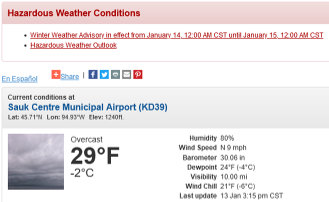
Sauk Centre, Minnesota; local conditions. (January 13, 2022; 3:36 p.m.)Technically, Friday’s weather was “Hazardous Weather Conditions.”

We got a little snow and a little wind. That makes “slow down and use caution while traveling” good advice.

Particularly, maybe, for folks who didn’t grow up around here. In any case, I don’t mind having access to weather advisories and warnings – along reviews of why frostbite and hypothermia are bad for us, and to avoid both.

More Weather This Week, and Taking Care of Tech

South Ash Street in Sauk Centre, Minnesota. Friday afternoon, January 14, 2022

Anyway, Friday afternoon it was 15° Fahrenheit, -9° Celsius. The sun was shining, above the clouds, but down here we enjoyed nature’s own indirect lighting.

There wasn’t as much snow on the sidewalk as on the rest of the yard, but it needed to be cleared before we would be in compliance with municipal standards.

Sauk Centre’s plows went by more-or-less regularly, so streets were clear. Around here, at any rate. Well, clear-ish. There’s still packed snow and ice between pavement and tires, so engaging situational awareness while driving is prudent.

Speaking of which, the household van is back from the garage, after minor maintenance.

That’s good news.

On the other hand, the van’s steering jerked to the right a few times on Wednesday on my way back from the Adoration chapel. But I got home without incident. Even so, I’ll want to drive it more to see whether or not we’ve still got issues with the steering.

More good news. At least one of the furnace’s replacement parts arrived. Next step(s) will be swapping them out with the worn tech.

My computer’s been frustrating me. Make that I’ve been feeling frustrated because my computer hasn’t been running quite right. My son and I talked about it, and he’s planning on replacing my hard drive with an SSD — technospeak for Solid State Drive.

Sounds like a good idea.

I’ve long since passed the ‘computer guy’ mantle on to my son. It’s nice, having a computer technician in the family.

Meanwhile, COVID-19 is Still Around

Minnesota Department of Health's COVID-19 Situation Update. (January 15, 2022)

The COVID-19 pandemic is headline news every day: so I’ve been seeing headlines about the pandemic, with plenty of politics and pathos. And, arguably, bathos. I’ve also touched base at the Minnesota Department of Health’s COVID-19 Situation Update page.

Those four charts are from Friday’s display. Upper left shows how many folks are sick with COVID-19, upper right are how many died from the disease each day, and lower left shows how many were hospitalized. Finally, there’s the total cases by age.

None of it’s exactly good news. But the situation could be worse. This winter’s death count is substantially less than last year’s. Again, that’s not good news.

However, I’m still pretty sure that we’re looking at a serious health issue: not an apocalyptic calamity brought about by [insert ‘bad guy’ label here]. I’ve talked about life, death, health, and making sense, before. And probably will again. Eventually.

And that’s yet another topic.

Wonderfully Weird Worlds

NASA/JPL-Caltech/NASA's Goddard Space Flight Center's illustration of WD 1856 and WD 1856 b. (2020)So, how come I’m talking about the weather, my town’s airport and the like?

Basically, because otherwise I’d have written a woefully inadequate rush job about exoplanets.

Between technical issues and an unexpected abundance of new material, there’s no way I could finish what I’d planned for this week.

There’s a backlog of exoplanet-related items I’ve been intending to discuss, including WD 1856 b: a planet that’s roughly nine times as massive as Jupiter. And considerably wider than the white dwarf star it orbits.

Then on Friday I saw this:

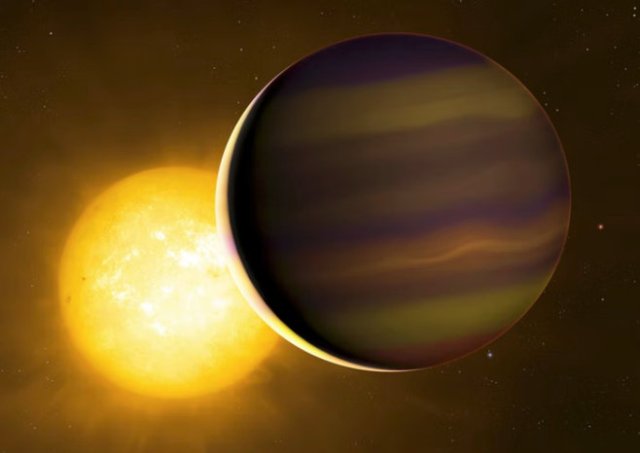
Seems that scientists confirmed that WASP-103 b is shaped like an egg. Or rugby ball. it’s described both ways.

Meanwhile, here in central Minnesota, I’m enjoying tropical comfort: thanks in part to wearable technology we call “clothing.” Meanwhile, outside, water is a mineral.

And I see that someone’s cleared our sidewalk. That’s good news, too.

Finally, links to more-or-less related stuff:

Posted in Being a Writer, Journal | Tagged , , , , , | Leave a comment