Faustus, Valdes and Cornelius: With Friends Like These…

From the 'Faust' collection, central library, German Classic, National Research and Memorial Sites, Weimar.
(From Jürgen Ludwig, via Wikimedia Commons, used w/o permission.)

I talked about angels, real and imagined, last month; mentioned Doctor Faustus’ big plans, including putting a brass wall around Germany, and said that I’d talk about Valdes and Cornelius next month.

Then I got sick. I’m still running a fever; but considering that this is COVID-19, it could be worse.

“Next month” is now this month, so I’d better introduce Valdes and Cornelius: “friends to Faustus,” Marlowe calls them in the dramatis personae.

Magic, Multiple Bacons and a Bit of Greene

Liebig's Extract of Meat Company Trading Card, 1929
(From Chemical Heritage Foundation, via Wikimedia Commons, used w/o permission.
(Albertus Magnus: as imagined on a 1929 trading card.)

Seems that Valdes and Cornelius have been promoting “magic and concealed arts” as keys to fame, fortune, and enchanting women.

Since this is an Elizabethan drama, Faustus takes 114 word to say ‘I’m convinced!’

Then Valdes and Cornelius speak at even greater length on what their “demonstrations magical” can do for Faustus.

[Faustus] “…Know that your words have won me at the last
To practice magic and concealed arts….

“…CORNELIUS. The miracles that magic will perform
Will make thee vow to study nothing else….
…Then tell me, Faustus, what shall we three want?

“FAUSTUS. Nothing, Cornelius. O, this cheers my soul!
Come, shew me some demonstrations magical,
That I may conjure in some bushy grove,
And have these joys in full possession.

“VALDES. Then haste thee to some solitary grove,
And bear wise Bacon’s and Albertus’ works,
The Hebrew Psalter, and New Testament;
And whatsoever else is requisite…”
(“…Faustus…,” Marlowe (1604, From The Quarto Of 1616) Edited by The Rev. Alexander Dyce (1870))

Maybe Marlowe had Sir Francis Bacon in mind when he wrote “wise Bacon,” but I’m guessing that he didn’t.

Sir Francis Bacon was roughly 30 years old when Marlowe’s “Faustus” opened. Bacon’s “Novum Organum” wouldn’t be published for another three decades.1

Even if Marlowe somehow guessed that Sir Francis Bacon’s ideas would eventually get credit for inspiring the scientific method, I doubt that he’d risk assuming that a London theater audience would make the same guess.

Will the Real Bacon Please Stand Up?

Friar Bacon's brazen head and Miles, from James Baldwin's retelling of 'Friar Bacon and Friar Bungay.' (1905) Illustration by A.J. Keller, E.J. Meeker, H.C. Edwards, Victor Perard, or Malcom Fraser.
(Illustration from James Baldwin’s “Thirty More Famous Stories Retold,” via Wikimedia Commons, used w/o permission.)
(Friar Bacon’s servant and a magic brass head. (1905))

Another possible Bacon is Robert Greene’s Friar Roger Bacon, one of two title characters in “Friar Bacon and Friar Bungay.”

Although Greene’s play shares features with Marlowe’s, including plans for encircling the wizard’s country with a brass wall, Greene’s Friar Bacon finally renounces magic.

“…Conjuring and abjuring devils and fiends,
With stole and alb and strange pentageron…
… and Tetragrammaton;
With praying to the five-fold powers of heaven,
Are instances that Bacon must be damn’d
For using devils to countervail his God….
“…Bungay, I’ll spend the remnant of my life
In pure devotion, praying to my God
That He would save what Bacon vainly lost….”
(“Friar Bacon and Friar Bungay,” Robert Greene (ca. 1588-1592) transcribed by Risa Bear (2007) from G. B. Harrison’s edition (1927)

Another Greene/Marlowe parallel is that Marlowe and Greene based their magicians on real people. More accurately, on folklore involving real people.

While Marlowe’s Doctor Faustus draws from stories inspired by Johann Georg Faust, a Renaissance con man, Greene’s Friar Roger Bacon is based on Franciscan friar Roger Bacon.2

A Scientist Who Wasn’t

Roger Bacon, as imagined in James Baldwin's retelling of 'Friar Bacon and Friar Bungay.' (1905)Friar Bacon, the real one, is a 13th century philosopher with a posthumous reputation for wizardry.

But Friar Roger Bacon wasn’t a scientist. Nobody was in the 13th century. Natural philosophers weren’t “scientists” until William Whewell coined the word in 1834.

Friar Bacon described a cycle of observing, hypothesizing, experimenting and verifying. Whether or not that was “scientific” depends on who’s talking.

I suspect quite a few folks still believe that medieval Europe was just simply awash in superstition, stupidity and stinky peasants. And that’s another topic.

I’ll grant that Roger Bacon didn’t use gamma matrices, and that calculus didn’t exist until Newton and Leibniz developed math that describes continuous change.

Then there were ideas discussed by Eudoxus, Archimedes, Liu Hui, Zu Chongzhi and maybe some Babylonian geometer before all of them.3

Monasteries, Medical Texts and the High Middle Ages

Dominican doctor taking a pulse. From LJS 24, Lawrence J. Schoenberg Collection, Penn Libraries. (1225-1275)Friar Roger Bacon — the real one — wasn’t the only medieval philosopher who’s occasionally given credit for systematically studying this universe.

Since monasteries served as hospitals for nearby communities and were centers of learning, monks and nuns studied ancient medical texts.

They also compared old assumptions with clinical data, removing useless information, adding results from their own practical experience and experiments. They’d even reorganize the ancient texts, adding tables of contents.

That was the High Middle Ages, the 11th to mid-13th century, roughly. Then the Renaissance happened, and by the 14th century non-monastic doctors were respectfully following ancient medical texts, unsullied by monkish machinations.

And that’s yet another topic.

Or maybe not so much.

Folks like Roger Bacon, Albertus Magnus, Hidegard of Bingen, and Robert Grosseteste weren’t scientists and couldn’t be, since that word didn’t exist until 1833.

But they paid attention to natural phenomena, recorded their observations, analyzed the data, drew conclusions and observed some more.

Maybe that’s not “scientific,” since they didn’t use mathematics that wouldn’t be invented for nearly another millennium. But I’m willing to think that they and natural philosophers like them were laying groundwork for today’s sciences.

Some, like Albertus Magnus and Hildegard of Bingen, are recognized Saints.4

That’s neither because they were “scientists” nor despite their willingness to study God’s creation; and that’s yet again another topic.

“…Who Need Enemies?”

'Radio Theater Break: Small Problems,' 'Girl Genius.' Illustration by Christopher Baldwin, colors by Cheyenne Wright, based on a radio play by Phil and Kaja Foglio, Foglio Studios. (January 13, 2014) Used w/o permission.Or maybe not so much.

I’ve yet to hear someone actually denounce “tampering with things man was not supposed to know.” Not in so many words.

But I’ve run into the attitude often enough. Too often, actually, for my taste.

I don’t know why Saint Albertus Magnus and Friar Roger Bacon are credited — or accused — with practicing wizardry.

Or why occasionally-demonic brass heads figure so prominently in European folklore.

Or why Marlowe’s Dr. Faustus and Greene’s Friar Bacon planned specifically brass walls as defensive perimeters. I’d have thought that non-conductive materials would work better, although concerns regarding EMP and directed energy weapons wouldn’t be issues for another half-millennium.5

And that’s — you guessed it — still another topic.

I could blame playwrights like Marlowe and Greene for leading the masses astray with such cautionary tales as “…Dr. Faustus” and “Friar Bacon….” But I figure they were tapping into existing beliefs and fears.

And I’m forgetting something. Let me think. Marlowe’s “…Dr. Faustus.” Sir Francis Bacon and a medieval monk’s posthumous reputation. Medicine and mathematics. Right.

Valdes and Cornelius: friends Marlowe’s Dr. Faustus could have done without.

Maybe this fictional Faustus would have negotiated himself into Hell anyway, but Valdes and Cornelius arguably get credit for revving up his enthusiasm for conjuring “in some bushy grove.”

I’d planned on talking about more this week, including “whatsoever else is requisite.”

But I’m running out of time. And besides, I’d prefer being a bit less feverish when discussing the Tetragrammaton/Tetragram.

So I’ll stop here, add the usual links and call it a day. Or, rather, a week.

Stuff that’s related, and maybe some that’s not:


1 Two famous Englishmen:

2 Faust and fictional friars:

3 Philosophers, mathematics and a new(ish) word:

4 Mostly medieval medicine:

5 Miscellany:

Posted in Discursive Detours, Journal, Marlowe's Faustus, Series | Tagged , , , , | Leave a comment

Opulence in Miniature: Coleen Moore’s Fairy Castle

Colleen Moore's Fairy Castle: the great hall.
(From Museum of Science and Industry, Chicago; used w/o permission.)

That’s the great hall in Colleen Moore’s Fairy Castle, a 13-room dollhouse in Chicago’s Museum of Science and Industry.

The museum’s online exhibit page for the great hall opens with something that’s not in the room: “…the good fairy welcoming you to Fairyland….

But I’ll start with that sweeping staircase: which has no railing.

It’s not a design flaw. Colleen Moore and the folks who created this dollhouse imagined that fairies lived there. The tiny little winged fairies that became my culture’s default version of the fair folk in Victorian times, and that’s another topic.

Having wings, Moore’s fairies presumably had better balance than humans. And were arguably about as afraid from falling from that staircase as we would be of walking across a room.

At any rate, the Science and Technology Museum’s online tour of the Fairy Castle showcases the great hall in its fourth of 12 stops; after the kitchen, dining room and Cinderella’s drawing room.1

So, what’s a dollhouse doing in a museum, why am I talking about it, what’s the 13th room, and who’s Colleen Moore?

“…The Space Inside Your Mind….”

Colleen Moore and her Fairy Castle.
(From Museum of Science and Industry, Chicago; used w/o permission.)
(Colleen Moore in her Fairy Castle’s Magic Garden: holding Cinderella’s silver coach)

The Original Tiny House
Colleen Moore’s Fairy Castle
Museum of Science and Industry, Chicago

A Hollywood movie star built herself a gorgeous dream home, sparing no expense on the details. The one big difference? She thought small.

“One of the most popular film actresses of her time, Colleen Moore assembled a legion of her industry colleagues to help craft this miniature home of fantastic proportions. She shared it during the Great Depression, touring the country to raise funds for children’s charities. Then this one-of-a-kind castle was welcomed into its new home at MSI, where it has enchanted children of all ages since 1949.

“…The Fairy Castle’s inhabitants are left to your imagination, as Colleen Moore always intended.

“…How does the Fairy Castle feel so alive? Every room looks as if someone had just left it. Perhaps you’ll imagine what it would be like to live in something so lavish, or wonder how things can be made that are so tiny yet realistic. The real secret of the Fairy Castle is that the space inside your mind is also part of the experience.”

Colleen Moore was America’s second-biggest box office draw in 1927, with Clara Bow in third place. But Clara Bow successfully transitioned to sound pictures. On the other hand, Coleen Moore become a partner of Merrill Lynch and was married four times.2

Someone’s probably done a compare and contrast piece on Moore and Bow, but I won’t. Not this week, at any rate.

But Seriously

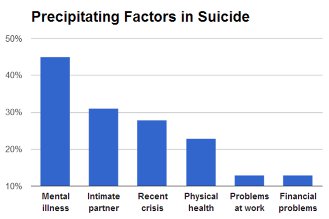
Suicide risk factors. (2015) From Wikipedia, used w/o permission.About Moore’s four marriages; two ended in divorce, two with death.

On the other hand, Clara Bow was married once and tried to kill herself.

Taking those biographical details as proof that divorce leads to partnerships in financial firms and not divorcing causes suicide is possible, but strikes me as silly. Maybe not the silliest notion I’ve run across, and that’s yet another topic.

I’ve talked about suicide before, and at least mentioned marriage, but it’s been a while; so here’s a quick review.

Marriage, the Catholic version, is a sacrament: an important one. When my wife and I married, I wasn’t a Catholic, but I recognized that we were married; in a lifelong relationship. There’s more to it, of course. (Catechism of the Catholic Church, 1601-1617, 1621-1658)

Now, about suicide. It’s a bad idea and I shouldn’t do it. Even if I experience another suicidal impulse.

Each human life is sacred, a gift from God. Killing myself would be a poor way of showing appreciation: and would certainly hurt others, directly or indirectly. But the Church recognizes that grave psychological disturbances or fear exist. Finally, as a Catholic I “should not despair of the eternal salvation of persons who have taken their own lives.” (Catechism, 2258, 2280-2283)

That last is a comfort to me, since a woman who meant a great deal to me killed herself. And that’s yet again another topic.

Designing an Enchanted Castle

Coleen Moore's Fairy Castle, front view: Magic Garden behind the wall and gate, and I think the Great Hall behind the Garden.
(From Museum of Science and Industry, Chicago; used w/o permission.)

The Story
Colleen Moore’s Fairy Castle
Museum of Science and Industry, Chicago

“…Horace Jackson, an architect and set designer who worked for First National Studios, created the floor plan and layout of the castle with the basic idea that ‘the architecture must have no sense of reality. We must invent a structure that is everybody’s conception of an enchanted castle.’

Moore also enlisted the help of art director and interior designer Harold Grieve. Grieve had designed the interiors for Moore’s actual mansion, so he was a natural to create the interiors of her fantasy castle.

By 1935, approximately 100 people worked on the Fairy Castle. The price tag for this 8’7″ x 8’2″ x 7’7″ foot palace, containing more than 1,500 miniatures, was nearly $500,000….”

The Great Depression was in progress while Horace Jackson, Moore and about a hundred other folks spent time and money designing, building and furnishing a huge doll house.

I could focus on the allegedly appalling misuse of resources. Or on the selfless generosity Moore showed, providing employment for a hundred folks and using the result of their labor to raise money for children’s charities.

Instead, I’ll express my appreciation for the creative work of those folks; and for the circumstances which make it possible for folks to enjoy Moore’s Fairy Castle today.

The 13th Room

Coleen Moore's Fairy Castle, 'wide side.'
(From Museum of Science and Industry, Chicago; used w/o permission.)

I haven’t found floor plans for Colleen Moore’s Fairy Castle, but have worked out the relative positions of eight rooms, shown in that photo from the Museum of Science and Industry, Chicago.

At the top, under part of the roof: the attic, “filled with all the things that were left over from the different rooms that belonged to the ancestors of the prince and the princess.”

Colleen Moore's Fairy Castle: Ali Baba's cave. From 'Classic Movie Travels: Colleen Moore's Fairy Castle,' Annette Bochenek, Classic Movie Hub Blog. Used w/o permission.On the second floor, left to right: prince’s bedroom, prince’s bathroom, princess’ bedroom, princess’ bathroom. That’s your left to right. The prince’s bed and bath suite is over Cinderella’s drawing room.

Ground floor, left to right again: Cinderella’s drawing room, dining room, and kitchen.

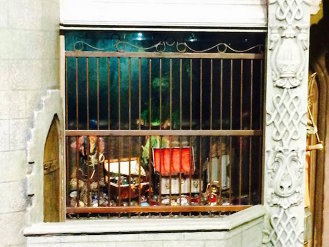
Placing eight of a dozen rooms, or rooms and a garden, is fine; but leaves me one room shy. I still don’t know exactly where the 13th room is. But I know what it’s called: Ali Baba’s Cave, filled with gems from Coleen Moore’s collection.3

Science, Technology, Priorities and a Video

Colleen Moore's Fairy Castle: the great hall, detail. From Museum of Science and Industry, Chicago; used w/o permission.I saw Colleen Moore’s Fairy Castle once, years ago, when my son-in-law arranged a family trip to Chicago.

The Fairy Castle is an impressive piece of miniature art and sculpture.

It may seem like an odd sort of thing to find in the Museum of Science and Industry: but I suppose one justification would be that it represents the sort of fine detail work that goes into making small models. Lots of small models.

And that brings me to the motto over the Museum of Science and Industry’s rotunda: “Science discerns the laws of nature. Industry applies them to the needs of man.”

It’s been a month since I explained why I don’t see a problem with using our brains, so here goes: science and technology, studying the universe and using what we learn, is part of being human. (Catechism of the Catholic Church, 2292-2296)

Ethics matter, just as with everything else we do. (Catechism, 2294)

Making science and technology the center of my life would be a bad idea. The same goes for art, health, family, money or anything else that’s not God. They’re not basically bad. But my top priority should be God. (Catechism, 1723, 1852, 2112-2114)

That’s it for me this week. Except for a Museum of Science and Industry, Chicago, video and the inevitable links.

Not-entirely-unrelated stuff I’ve written:


1 Fairies, a museum and a doll house:

2 Yesteryear’s stars:

3 A movie star’s dollhouse:

Posted in Being Catholic, Discursive Detours, Journal | Tagged , , , , , | Leave a comment

Experiencing COVID-19: It Could Have Been Worse

Another week has passed, and I still haven’t written about fusion power experiments on both sides of the Atlantic. It’s on my to-do list, but I’m putting it off until I’m less distracted and more clear-headed.

Besides, this has been a distracting week.

Or I’ve been distracted. Which isn’t quite the same thing.

So – Tuesday I saw a doctor, who told me that I’ve caught COVID-19: along with about 80% of all Minnesotans.

I decided to skip getting a blood test to verify my COVID-19 status: partly because it wouldn’t make a difference on how I deal with the situation. And partly because I didn’t see a point in expending resources just to satisfy my curiosity.

I also left a urine sample and got an antibiotic prescription. The latter wouldn’t do a thing for COVID-19 or any other viral ailment: but was a good idea, since part of what I’ve been feeling looked like a bacterial infection.

Lab results came in Friday. Good news, it’s a bacterial infection. Not-so-good-news, this particular microcritter is resistant to the prescribed antibiotic. So I spent a few very cold minutes Friday afternoon, picking up a new antibiotic.

It’s a new one to me: ciprofloxacin. I looked it up, of course, learning that it’s a quinolone antibiotic. And, like every other pharmaceutical, it is not 100% safe and utterly risk-free.1

But I figure that it’s much less risky to try using an antibiotic to deal with a urinary tract infection, than ignore what’s happening and hope for the best.

Prayer and Making Sense

Sb2s3's photo of a foggy road near near Baden, Austria. (2015) via Wikimedia Commons, used w/o permission.If you’ve been reading my stuff, then you’ve read why I think prayer is a good idea.

And why I don’t think prayer and medicine aren’t an either/or situation.

I don’t remember how long it’s been since I talked about this, so here’s how I see life, health and using my brain.

Being healthy is okay. Being sick is okay. What matters is how I act. It’s even okay to help others get or stay healthy. Life and physical health are “precious gifts.” Taking care of both is a good idea. Within reason. Obsessing over either isn’t. (Catechism of the Catholic Church, 1509, 2288-2291, 2292-2296)

Prayer isn’t always easy, but it’s always possible. Which is a good thing, because living as a Christian without prayer doesn’t work. Prayer is what makes sharing the love Jesus has for us possible. (Catechism, 2742-2745)

Happily, I’ve kept up my daily prayer routine this month. Although one day I didn’t do my ‘noon’ set until around 4:00 p.m. Maybe there’s some deep spiritual significance there, but I figure being feverish and mentally fogbound was a factor.

Part of a Majority? Me?!

Brian H. Gill, me, at my desk. January 23, 2021. I do not usually wear a mask at my desk.I’ll admit that going along with 80% of everyone in the state feels a bit odd.

Back when my number-two daughter and son-in-law were jumping through the bureaucratic hoops of adoption procedures, she picked three words to describe me:

  • Eccentric
  • Scholarly
  • Eclectic

Maybe it was “academic” instead of “scholarly.” But that’s basically what she meant.

And she’s right on all three counts. I don’t do “conventional.” And haven’t tried since I was in my teens. I’m simply not good at it.

So, like I said, being part of an 80% majority feels a bit different. On the other hand, it took me about two years to catch COVID-19. And that’s not quite another topic.

Anyway, here’s the seemingly-inevitable list of stuff that may or may not be related:


1 An antibiotic:

Posted in Journal | Tagged , , , , | 6 Comments

Appearance, Ancestry, and Me at the Grand Canyon

Erin Whittaker, U.S. National Park Service's photo of the Grand Canyon in fog. (29 November 29, 2013) via Wikimedia Commons, used w/o permission.
(From Erin Whittaker, U.S. National Park Service; via Wikimedia Commons, used w/o permission.)

I stopped for several hours at the Grand Canyon on my way back from San Francisco. This was about five decades back. The massive gulch wasn’t on the the most direct route, but I’d decided that seeing the Grand Canyon and Meteor Crater on the way was a good idea.

I haven’t been back since then, which suggests that I was right.

I’d bought a big topographic map of the Grand Canyon while living in San Francisco, and had it with me when I was there. At the Grand Canyon, that is. Near where the South Rim Visitor Center is now, probably.

I revisited the place via Google Street View this week.

Quit a bit has changed during the last half-century. Not the Canyon so much, since on a geologic timescale that’s a ‘blink and you’ll miss it’ interval. But I don’t remember nearly as many services being near the visitor center.

I can’t even be sure that today’s South Rim Visitor Center is at the location I was at.

A Beard, a Cap and an Unsolved Puzzle

Pescaiolo's photo of the Grand Canyon in winter. (February 23, 2008) via Wikimedia Commons, used w/o permission.
(From Pescaiolo, via Wikimedia Commons, used w/o permission.)
(The Grand Canyon in Winter, photo by Pescaiolo. (February 23, 2008))

At any rate, I’d been thoroughly enjoying myself, spreading out the map at intervals to see what I was looking at, and taking photos.

I was flattered, and surprised, when two tourists from Thailand asked me if I was Jewish. I explained that I’m a gentile — although I don’t remember my exact words.

We chatted a bit, which is how I learned they were from Thailand, and then I went back to enjoying the magnificent views.

I hadn’t asked them what suggested that I was a Jew, so that remained and remains a puzzle. A minor one, but a puzzle nonetheless.

After mulling it over, I strongly suspect they’d noticed that I had a full beard and never took my cap off.

Quite a few gentiles in America wore caps indoors and out at the time, and still do: but not many American men have a ‘haven’t shaved in years’ beard. The plain black jacket I wore probably helped, too.

Although I enjoyed being mistaken for one of my Lord’s closer relatives, my ancestors are about as gentile as it gets, west of the Urals. They probably hadn’t even heard of Abraham or Isaac until missionaries arrived, and that’s another topic.

Norwegian, Yes; Nordic, No

Watson Heston's 1896 political cartoon, warning against 'Single Gold Standard,' 'Interest on Bonds' and 'Wall Street Pirates.'I’ve only been asked if I’m Jewish once.

But a fair number of forms I’ve filled out over the years have asked, in general terms, who my ancestors were.

I’m a Euro-American with roots in southern Norway and the northern British Isles, so I generally check off whatever the current euphemism for “white” is.

There’s almost always a ‘prefer not to say’ option, happily, and that’s almost another topic.

Family records don’t say, but my Norwegian ancestors almost certainly lived near folks who are “Nordic:” tall, pale, blond and all. Now, I’ve got blue eyes, and the congenital melanin deficiency common to northwestern Europeans.

But I’m like most of the rest of my Scandinavian family: short, with black hair. We’re not, as far as I can tell, Saami. I’ve no idea “who” we are, or if anyone’s gotten around to labeling our particular stock.

I’m Not Arisch, Either

Popular Science Monthly's 1896 cephalic index map. (1896) Interesting, maybe not all that generally useful. From Popular Science Monthly, via Wikimedia Commons, used w/o permission.I suspect one reason there’s a ‘prefer not to say’ option in forms asking what ethnic group I’m in is how many folks reacted to a 20th-century effort to purge humanity’s gene pool.

One of these days, I’ll probably get back to ideas like cephalic index, eugenics, genetics, bioethics and why I’m not keen on preventing people like me.

But not today.

I’m still getting over whatever’s been ailing me since the end of January. So I reigned in my impulse to start discussing post-Enlightenment notions regarding “race,” “species” and why folks in Europe’s upper crust were better than anyone else.

Instead, here’s how one of the 20th century’s major writers — my opinion — responded to a ‘race/ethnicity’ question from a German firm:

“Thank you for your letter … I regret that I am not clear as to what you intend by arisch. I am not of Aryan extraction: that is Indo-Iranian; as far as I am aware none of my ancestors spoke Hindustani, Persian, Gypsy, or any related dialects. But if I am to understand that you are enquiring whether I am of Jewish origin, I can only reply that I regret that I appear to have no ancestors of that gifted people.”
(Tolkien, The Letters of J. R. R. Tolkien, #30 (1938) (Emphasis in original) via Wikipedia)

Politics and Acting Like Love Matters

Illustration from the H. Strickland Constable's 'Ireland from One or Two Neglected Points of View.' (1899) From H. Strickland Constable, via Wikimedia Commons, used w/o permission.
(From H. Strickland Constable, via Wikimedia Commons, used w/o permission.)

Sporki~commonswiki's (?) photo taken during World Youth Day, Rome. (2000) via Wikimedia Commons, used w/o permissionI’m no fan of race/ethnic politics.

Partly because I think today’s assorted ‘good guy’ and ‘bad guy’ labels, based on ancestry, make as much sense today as yesteryear’s “Anglo Teutonic” and “Irish Iberian” categories.

And partly because I like living in a world where everyone doesn’t look pretty much like me.

That attitude makes it easy to accept two basic points the Church makes.

I should love my neighbor, and see everyone as my neighbor. No exceptions. (Matthew 5:4344, 22:3640; Mark 12:2831; Luke 6:31, 10:2537)

Accepting those ideas was easy, once I worked through implications of believing that human beings are people, no matter what we do or where we’re from. (Catechism of the Catholic Church, 355-361, 1701-1706, 1928-1942, 2258-2283)

Consistently acting as if I take ‘love my neighbor’ seriously can be anything but easy. And that is another topic.

Finally, the usual links to allegedly-related stuff:

Posted in Family Stories, Journal, Series | Tagged , , , | 3 Comments

Feverish, Weak; But Other Than That, a Pretty Good Week

Minnesota Department of Health's Situation Update for COVID-19, Minnesota Case Overview. (3/5/2020-2/3/2022)

I spent part of Monday morning making notes for a talk with our parish priest. Then I called the Parishes on the Prairie office — P. on the P. are six parishes and a school in central Minnesota.

I left a message, asking our priest to call me back. So far, he hasn’t. Which is probably just as well.

A bit after noon Monday, I ran an errand: picked up meds. After that, I — actually, I don’t remember just what I did. But I do remember feeling cold. Unaccountably cold.

Good news, the furnace was working fine, and inside temperatures were normal. A little below normal in some spots, since my wife was baking. But well within the normal range.

Decades of experience told me that checking my temperature was prudent. So I did.

Here are the numbers:

  • Monday 103.3
  • Tuesday 104.2
  • Wednesday 102.5
  • Thursday 99.5
  • Friday 100.4

More good news: temperatures, blood sugar counts and other items stayed below ‘I ought to see a doctor’ levels. Thursday’s blood sugar was reaching ‘talk to a medico’ level, but was lower on Friday.

And Friday I wasn’t feeling as weak and ‘I gotta lie down and sleep’ as I’d been from Monday afternoon on. All of which is good news. Although not lying down and getting some sleep Friday may explain my fever going up that day.

Not-so-good news, I’ve been in no condition to write about a remarkable development in fusion. Scientists at the National Ignition Facility (NIF) in California started and maintained a fusion reaction.

What makes this effort remarkable is that they got marginally more energy out to the reaction than they put in.

This is, I think, a big deal. I also think that I want to be much more clear-headed when I write about it.

Doing What I Can, Not Doing What I Can’t

COVID-19 Vaccination Record Card. (June 11, 2021)

As for what sort of bug I’ve been experiencing, I don’t know. It could be some flu variety, COVID-19, or something else.

Knowing the bug’s name would be nice, but isn’t necessary. And testing? Unnecessary medical expenses aren’t an option.

I’ve had two COVID-19 shots and a booster, plus my annual flu shot. So ranting about vaccinations being useless, an affront to the Almighty, or some kinda plot is an option. But not, I think, a reasonable one.

Whatever the bug is, I seem to be getting better. That’s nice.

I’ve been sleeping downstairs since Monday night: on a bed we set up in the north room, in case we needed to lower upstairs temperatures to ‘keep the pipes from freezing’ levels.

It’s been an interesting experience. I mentioned I’d been feeling weak, right? Well, I’ve been getting into and out of that downstairs bed by using a walker as an anchor/support. It’s the one my father-in-law used. We miss him, and that’s another topic.

“I Thank You, Lord, For Preserving Me During the Night”

Brian H. Gill's 'We Survived Thanksgiving, Right?' (2017)I don’t enjoy feeling the way I have this week. But I woke up each morning: and that’s ALWAYS a good thing.

Which is why I thank our Lord for “preserving me during the night” each morning.

Being alive for another day is a big deal.

A definite ‘up’ side to this bug is that I’ve been sharp enough to do my daily prayer routine.

Being at the Adoration chapel this week wasn’t an option, obviously. I’m not sure about Mass this Sunday. With Friday’s increased temperature, I’m really not sure.

We’ve been told to use our brains, and keep both our health and the common good in mind. I’m pretty sure that someone, somewhere, is offended and repulsed by that example of common sense.

But I’m not. I’ve talked about that, and a mess of other stuff, before:

Posted in Being Catholic, Journal | Tagged , , , | Leave a comment