Climate, Neighbors, Bogeymen and Responsibility

Getty Images, via BBC News: 'Many of the protesters in Hamburg were demonstrating against Donald Trump's position on climate change' (BBC News; 2017) used w/o permission.
Fancy dress protest at G20. (2017)

Last weekend I started re-reading “Laudato si’, on care for our common home,” AKA the “environmental encyclical” and the “Green Encyclical,” by Pope Francis.

Calling the 2015 encyclical “green” and “environmental” isn’t mere marketing. But there’s more to “Laudato si'” (“Praise be to You”) than that aspect of today’s political slogan-slinging.

Anyway, I’d gotten a few paragraphs into the introduction when this got my attention:

“More than fifty years ago, with the world teetering on the brink of nuclear crisis, Pope Saint John XXIII wrote an Encyclical which not only rejected war but offered a proposal for peace. He addressed his message Pacem in Terris to the entire ‘Catholic world’ and indeed ‘to all men and women of good will’….”
(“Laudato_si’,” 3, Pope Francis (May 24, 2015))

I’ll be talking about a few points raised by “Laudato si'” and “Pacem in Terris.”

But first, a disclaimer. Or maybe a reassurance.

I’ll talk about issues with political angles, but this isn’t a political post. I’m not out to demonize or deify any candidate or party.1

Elections, Politics and Making Sense Anyway

Political cartoons: Homer Davenport's version of Mark Hanna in 1896; Karl Kae Knecht's 1912 Roosevelt mixing 'radical' ingredients in his speeches. From Wikipedia, used w/o permission.
Political cartoons of yesteryear: 1896, 1912.

My country’s midterm elections will strike next Tuesday.

So my news feeds are showing fewer than the usual number of headlines about climate catastrophe and cute but doomed critters.

On the other hand, I’m seeing more warnings against one party’s dangerously delinquent disciples and praise for the other party’s paragons.

I will be very glad when the election’s over, and that’s almost another topic.

Completely ignoring current issues isn’t an option. Neither is rabid support for or reviling of some person or cause.

Since I’m a Catholic, paying attention and thinking is a must-do. So is being a good citizen, even when I might prefer ignoring the whole brouhaha.

Loving God and my neighbors, and seeing everyone as my neighbor, comes with being a Catholic. That’s everyone. No exceptions. (Matthew 5:4344, 7:12, 22:3640, Mark 12:2831; 10:2527, 2937; Catechism of the Catholic Church, 1789)

So is doing what’s possible in public life. That includes recognizing humanity’s solidarity and respecting authority. Within reason. (Catechism, 1778, 1915, 1897-1917, 1939-1942, 2199, 2238-2243)

Loving my country is a good idea. Again, within reason. But letting love of country slop over into worship of country is a bad idea. A very bad idea. (Catechism, 2112-2114, 2199, 2239)

In any case, an adolescence spent in the 1960s helps me take politics with a grain of salt: or a few pallets, sometimes.

“…Beatniks and politics, nothin’ is new
A yardstick for lunatics, one point of view….”
(“Incense and Peppermints,” Strawberry Alarm Clock (1967) via Genius.com)

Climate and Weather, Change and Responsibility

Glen Fergus's graph: 'Temperature of planet Earth,' global average temperature estimates for the last 540 MY. (2015) based on Veizer et al (1999), as re-interpreted by Royer et al (2004); Hansen et al (2013);  Lisiecki and Raymo (2005), using Hansen et al (2013) prescription; EPICA Dome C ice core from central Antarctica.
Earth’s global average temperature estimates for the last 540,000,000 years.

“Laudato si'” discusses climate change, so I’d better at least mention how I see that issue.

Yes, Earth’s climate is changing. It’s been changing since long before we’ve been around.

Changes happen on different scales. Some are cyclic.

In the short term, here in central Minnesota, we’ve been experiencing a downward temperature trend and runaway defoliation.

We call it autumn, and it happens every year around this time.

I suppose I should be grateful that so many folks know about Earth’s annual climate cycles. Maybe that’s why they’re not packaged as crises on the nightly news.

Seasons happen, and I don’t think winter is anybody’s fault.

On the other hand, I’d be astonished if we hadn’t contributed to some of our weather- and climate-related problems.2

But I am quite certain that many weather and climate events have natural causes: that we do not have full control over Earth’s seasons and storms

Which may be just as well.

Harnessing Hurricanes: Seemed Like a Good Idea at the Time
WikiProject Tropical cyclones/Tracks' storm track for 1947 Atlantic hurricane 8, 1947 Hurricane Sable. (October 9-16, 1947; original storm track plotted 2006, revised 2014)
Hurricane Sable returned to the Atlantic coast after a weather modification experiment. (1947)

In 1947, Hurricane Sable had crossed southern Florida and was safely headed out into the Atlantic. That’s when Project Cirrus researchers seeded it with dry ice. The idea was that the modified hurricane would weaken.

The experiment was partially successful. Hurricane Sable slowed, turned around and headed for North America’s east coast. Then, after doing property damage to the tune of about $2,185,000 (1947 USD) and killing one person, the hurricane fizzled.

Understandably, my nation’s government didn’t admit that Hurricane Sable had been seeded until years later. And anyway, the seeding couldn’t have made it turn around because the experiment’s premise was incorrect. That’s what some experts said, anyway.

Undaunted, researchers kept trying to control hurricanes. And thunderstorms.

The last I checked, courts had decided that available evidence hadn’t proven a cause-effect link between a weather modification experiment and the 1972 Black Hills flood.3

Dominion, Stewardship and Thinking Ahead

Brian H. Gill's 'Totally Depressing News Network' logo. (2018)
TDNN: Totally Depressing News Network. It’s fictional. The attitude, maybe not so much.

So, should I denounce weather modification as an affront to the Almighty, along with lightning rods and smallpox vaccines? I’d be following an established tradition.

“Smallpox is a visitation from God; but the cowpox is produced by presumptuous man; the former was what Heaven ordained, the latter is, perhaps, a daring violation our of holy religion.”
(A physician’s reaction to Dr. Edward Jenner’s experiments in developing a vaccine for smallpox, (1796) via Psychological Sciences, Vanderbilt University)

“I have read in the Philosophical Transactions the account of the effects of lightning on St. Bride’s steeple. ‘Tis amazing to me, that after the full demonstration you had given, of the identity of lightning and of electricity, and the power of metalline conductors, they should ever think of repairing that steeple without such conductors. How astonishing is the force of prejudice even in an age of so much knowledge and free enquiry!”
(Letter, To Benjamin Franklin from John Winthrop, 6 January 1768, via founders.archives.gov)

Uh, no.

Even if I wasn’t a Catholic, I’d agree with Pope Pius VII: and see what we’re learning and the technologies we’re developing, as ‘precious discoveries.’

“…In contrast, many village priests in Italy, Germany, Switzerland, and England not only urged parishioners to seek the preventative treatment, they became wholesale vaccinators themselves. Pastors in Bohemia charged parents with responsibility ‘before God for neglecting the vaccination of their children.’ In 1814, the Pope himself endorsed vaccination as ‘a precious discovery which ought to be a new motive for human gratitude to Omnipotence.’…”
(“Deliberate Extinction: Whether to Destroy the Last Smallpox Virus,” David A. Koplow, Georgetown Law Library, Georgetown University Law Center (2004))

Besides, I don’t see much difference — apart from scale — between weather modification and older activities like crop rotation, recycling, and waste management, as sketched out in the Bible. (Genesis 1:2628, 2:5; Leviticus 25:3; Deuteronomy 22:67, 25:4 …)

Like it or not, we are in charge here: with authority to make reasoned use of this world’s resources, for ourselves and for future generations. We also have the responsibility that goes with our authority. Taking care of this place is part of our job. (Catechism, 16, 339, 356-358, 2402, 2415-2418, 2456)

We have “dominion,” but not ownership. We’re like stewards, or foremen.

I think weather modification is a good idea. I also think field experiments should be made very cautiously.

That goes double, at least, for having a go at changing Earth’s climate. Even if we think we’re “fixing” it. Maybe we should hold off large-scale experiments until field testing on another planet is an option: one where unexpected results won’t kill people.

Finally, I think discussions of weather modification, climate issues and anything else would be much easier if assorted activists, experts and media would turn down the hysteria a notch.

“Pacem in Terris” and Remembering the ‘Good Old Days’

Branford Clarke/Pillar of Fire Church's 'Saint Patrick's Day in America - 1926.'
Self-identified patriotic American Christians defending their country from people like me.

Pope Saint John XXIII’s “Pacem in Terris” runs to over 14,600 words in my language. There’s no way I can discuss the whole thing this week. Not adequately.

So I’ll pick a few points, and leave it at that.

First, about the encyclical’s language.

The version I’m reading is a translation from the original Latin.

There’s nothing magic about Latin, by the way. It was a widely-understood language when we got started, sort of like English is today. Plus, there’s some wisdom in having official documents in a standardized language.

Second, about how the English translation of “Pacem in Terris” uses “men” where I might say “people.”

The document I’ve been reading is — again — a translation from a Latin original, and both are nearly six decades old. My native language — and culture — have changed since then.

Another point: “Pacem in Terris” means “Peace on Earth.” That’s something we didn’t have then, and don’t have now.

But I still think it’s a worthwhile goal. And a long-term one. Very long-term.

Now, here’s a excerpt from “Pacem in Terris:”

“39. There are three things which characterize our modern age.
“40. In the first place we notice a progressive improvement in the economic and social condition of working men.
“41. Secondly, the part that women are now playing in political life is everywhere evident. … Women are gaining an increasing awareness of their natural dignity. … they are demanding both in domestic and in public life the rights and duties which belong to them as human persons.
“42. Finally, we are confronted in this modern age with a form of society which is evolving on entirely new social and political lines. Since all peoples have either attained political independence or are on the way to attaining it, soon no nation will rule over another and none will be subject to an alien power.
(“Pacem in Terris, on Establishing Universal Peace in Truth, Justice, Charity and Liberty;” 39-42; Pope St. John XXIII (April 11, 1963) [emphasis mine])

Not everyone has gotten the message, obviously.

Whoever’s running the show in Russia is still trying to “annex” Ukraine. The powers that be in Iran are having conniptions because women are acting like people. For many folks, working conditions and pay need improving. And old hatreds still fester.4

But I remember the ‘good old days.’

Quite a few changes have been for the better. Some weren’t, or weren’t entirely.

But I am profoundly glad that the ‘good old days’ aren’t coming back.

“Minority” is In the Eye of the Beholder
Brett Weinstein's photo: George Floyd protest in Washington DC. Vehicle burning, protestors protesting. (May 30, 2020)
Protestors protesting, car burning. Washington DC. (May 30, 2020)

One more excerpt, a long one.

A Cautionary Note
“97. It is worth noting, however, that these minority groups, in reaction, perhaps, to the enforced hardships of their present situation, or to historical circumstances, frequently tend to magnify unduly characteristics proper to their own people. They even rate them above those human values which are common to all mankind, as though the good of the entire human family should subserve the interests of their own particular groups. A more reasonable attitude for such people to adopt would be to recognize the advantages, too, which accrue to them from their own special situation. They should realize that their constant association with a people steeped in a different civilization from their own has no small part to play in the development of their own particular genius and spirit. Little by little they can absorb into their very being those virtues which characterize the other nation. But for this to happen these minority groups must enter into some kind of association with the people in whose midst they are living, and learn to share their customs and way of life. It will never happen if they sow seeds of disaffection which can only produce a harvest of evils, stifling the political development of nations.”
(Pacem in Terris, on Establishing Universal Peace in Truth, Justice, Charity and Liberty; 97; Pope St. John XXIII (April 11, 1963) [emphasis mine])

What is and isn’t a culturally-recognized “minority” varies with time and place. So does how culturally recognized minorities get treated.

I suspect that craziness exhibited by folks like the self-identified patriotic American Christians in that 1926 cartoon came partly from the horror of realizing that they were becoming a minority in ‘their’ country. That’s not an excuse.

But I think knowing what’s behind crazy ideas makes sense. If for no other reason than helping me notice and avoid similar but not identical psychological glitches.

For descendants of the 1926 lot, conditions in today’s America may seem even more dire.5

I don’t see it that way, but I wouldn’t. I’m a Norwegian-Irish-Scots-American who married a German-Dutch-English-American.

My Norwegian ancestors aren’t those blond giants. I don’t miss the days of “No Irish Need Apply,” and I’m drifting off-topic.

Or maybe not so much. I look “Anglo,” but I’m not. That’s been an advantage.

Human nature being what it is, wearing drab clothing, adopting dull mannerisms and dropping our accents helped my Irish forebears pass for ‘real Americans.’

So, I think, did a habit of not setting fire to our neighborhoods.

Well, not often setting fire to our neighborhoods. Metaphorically, at least.

Bogeymen, Dignity and Acting as if Neighbors Matter
From Harper's Weekly, via Chicago History Museum and Wikimedia Commons, used w/o permission: Haymarket riot (May 15, 1886)
Death and drama in Haymarket Square, Harper’s Weeky’s version. (1886)

Or throwing bombs. Allegedly. The last I checked, we still don’t know who turned the Haymarket rally into a shooting gallery.

The Haymarket bogeymen were anarchists, not the Irish. But I think there’s a parallel of sorts with ethnic angst. And generally with the problem of dealing with folks who aren’t ‘the right sort’ for one unreason or another.6

Folks whose social, ethnic or economic backgrounds make them outsiders still have their share of humanity’s transcendent dignity. Acting as if everyone matters is a good idea. (Catechism, 1928-1942)

Everyone means everyone: including folks who don’t look, act or think just like me. It’s that ‘love my neighbors’ thing I talked about under Elections, Politics and Making Sense Anyway.

Making sense is a whole lot easier when none of us act like jerks. But it’s a good idea, even when it’s not easy.

Finally, really finally for this week, my experience strongly suggests that nobody’s got a monopoly on virtue or vice.

I’ve talked about vaguely-related stuff before:


1 Two encyclicals, a book and some background:

2 Change, seasons, cycles, and science:

3 Applied science and uncertain outcomes:

4 An era, languages and curent events:

5 Dealing with difference:

6 Attitudes and a little history:

Posted in Being a Citizen, Being Catholic, Discursive Detours | Tagged , , , , , , , , , | 2 Comments

Halloween 2022: Folks Hurting, Holiday Pictures

Brian H. Gill's 'The Touch of a Vanished Hand.' (2015)
“The Touch of a Vanished Hand”

Culturally, here in America, Halloween is a time for costumes, parties and massive consumption of candy.

It’s also All Hallow’s Eve, the day before All Saints Day: which is tomorrow, November 1.

Maybe folks in Seol’s Itaewon area were having Halloween festivities on October 29 because it was a Saturday. I figure they were looking forward to enjoying one of the first post-COVID-mask opportunities for a big Saturday night get-together.

At any rate, at about 10:25 p.m. a great many teens and young adults had been in a pedestrian passage near Itaewon station’s first exit. Some survived. More than 150 didn’t.

Seoul Halloween crowd crush (article title may be changed to Itaewon Halloween crowd crush (October 31, 2022))
Wikipedia
“On the night of 29 October 2022, a crowd crush occurred during Halloween festivities in Itaewon, Seoul, South Korea. At least 155 people died, and at least 149 others were injured….”

South Korea: How the Halloween tragedy unfolded
Oliver Slow, BBC News (October 30, 2022)
After more than 150 people died in a deadly crush in Seoul on Saturday night, the BBC looks at how the tragedy unfolded.
“By early evening on Saturday, thousands of mainly young people had converged in Itaewon in the centre of the South Korean capital, a lively party spot whose warren-like streets and alleys are filled with bars and restaurants….”

Itaewon crush: Shock and anger as Seoul grieves for its young
Tessa Wong, Youmi Kim; BBC News (October 31, 2022)
“..Solemnly, they queued up — families with young children, office workers, housewives and retirees. Organisers handed out stalks of white chrysanthemums, a symbol of grief in South Korea, which the mourners laid at the altar with deep bows….”

A great many folks lost family and friends Saturday night. No pressure, but prayer for survivors — and non-survivors — couldn’t hurt.

Instead of talking about All Saints Day, All Souls Day, and why — barring another SNAFU with the household’s vehicle — I’ll be at Mass tomorrow, here are links to resources that may answer some questions. Then again, maybe not.

Then there’s the matter of why I care about folks who live — lived — someplace that’s across Earth’s largest ocean from my home. And that’s a topic for another day.

Basically, it’s because I’m a Catholic. My faith is as local as the parish church. But it’s a ‘big picture’ thing, too:

“After this I had a vision of a great multitude, which no one could count, from every nation, race, people, and tongue. They stood before the throne and before the Lamb, wearing white robes and holding palm branches in their hands.”
(Revelation 7:9)

And Now for Something (Almost) Completely Different.

Brian H. Gill's 'Happy Halloween!' (2019)
“Happy Halloween!”

It’s been a while since I made ‘holiday’ artwork. And that 2019 “Happy Halloween” thing could have been a great deal lighter.

Maybe this year I’ll think of something for Thanksgiving. Or Christmas.

Meanwhile — shameless self-promotion follows — you can check out my gallery on DeviantArt:

Or click on either of those two images. They link to that picture’s page in my gallery.

Maybe showing pictures isn’t appropriate, after that horrific news from Korea. On the other hand, I can hope that sharing something non-depressing may be okay.

That’s it for today, apart from a short list of sort-of-Halloween posts:

Posted in Being an Artist, Discursive Detours, Journal | Tagged , , , | Leave a comment

Pax Romana: Augustus to Nero

Hubert Rober's 'The Fire of Rome/Incendie à Rome.' (1785) via Wikipedia, used w/o permission.
“The Fire of Rome,” July 64 A.D., by Hubert Rober. (1785)

The Pax Romana had been in progress for eight decades on July 19, A.D. 64.

A fire started in a retail district near Rome’s Circus Maximus. It was a windy night.

The fire spread. Fast.

The Great Fire of Rome burned for six days before folks extinguished it.

Make that almost extinguished it. The fire got its second wind, roared through the city for another three days. Then it went out for good.

It destroyed three of the city’s 14 districts. Another seven needed repairs.

On the other hand, four districts hadn’t been scorched. Even so, I figure that most Roman residents didn’t feel that they were living in a golden age. Particularly since some arsonists claimed they’d been told to torch the city.

“…And no one dared to stop the mischief, because of incessant menaces from a number of persons who forbade the extinguishing of the flames, because again others openly hurled brands, and kept shouting that there was one who gave them authority, either seeking to plunder more freely, or obeying orders.
(“The Annals,” 15.38; Tacitus (ca. A.D. 116) Translation based on Alfred John Church and William Jackson Brodribb (1876) via Wikisource [emphasis mine])

I gather that there had been a half-dozen mainstream rumors about Rome’s big fire. One said it was an accident. The remaining rumors blamed Nero, but disagreed on why he started the fire, and gave him credit for blaming an already-unpopular minority.

Tacitus pointed out that Nero was out of town when the fire started, opened his own gardens to displaced Romans, and had shelters built for them. The rumors kept going anyway.

I figure maybe Tacitus was right about that: and that he wrote “Annals.”

On the other hand, starting in the 18th century, assorted academics have said that Tacitus didn’t write “Annals” — because he didn’t write like a proper historian, or because some Italian Renaissance humanist wrote “Annals.”

Me? I’d be mildly surprised if a first century Roman politician wrote as if he was an Enlightenment-era French historian. Make that very surprised.

I’ve talked about history and documentation, attitudes and assumptions, before.1

Nero’s Public Relations Problem

Henryk Siemiradzki's 'Nero's Torches.' (1876) From Henryk Siemiradzki, via The National Museum in Kraków Digital Collection and Wikipedia, used w/o permission.
“Nero’s Torches,” by Henryk Siemiradzki. (1876)

Nero had a massive public relations problem on his hands after the fire.

Way too many Romans either assumed he’d started the fire or had hired arsonists; that he’d watched the blaze from a tower or sang and played a lyre on a private stage while the city burned, or both.

I figure many or most of the ‘Nero did it’ rumors sprouted from the well-fertilized soil of Roman politics and public angst. I’m also pretty sure that Romans weren’t any more likely to think straight after a major disaster than Americans are. Or anyone, for that matter.

In The British Museum's collection: 'Complete pack of 52 playing-cards depicting the Popish Plot; suit-mark and value at top; description at bottom.' Francis Barlow, formerly attributed to William Faithorne. (1679)After London’s big 1666 fire, for example, an official investigative committee decided that Catholics and other foreigners had started the fire. One of them was tried, convicted, and hung. In that order, remarkably enough.

Never mind that Robert Hubert hadn’t arrived in England until two days after the fire.

Then, a dozen years later, in the interest of national security, the proper authorities killed 22 folks before juries started wondering if being Catholic should be a capital offense.

Getting back to first century Rome and Nero’s public relations problem, he blamed a minority “hated for their abominations:” Christians.

“…Sed non ope humana, non largitionibus principis aut deum placamentis decedebat infamia, quin iussum incendium crederetur. ergo abolendo rumori Nero subdidit reos et quaesitissimis poenis adfecit, quos per flagitia invisos vulgus Chrestianos appellabat.…”
(“P. Corneli Taciti Annalivm Liber Ovintvs Decumvs/Annals,” 15.44; Tacitus (ca. A.D. 116) via thelatinlibrary.com [emphasis mine)

“…But all human efforts, all the lavish gifts of the emperor, and the propitiations of the gods, did not banish the sinister belief that the conflagration was the result of an order. Consequently, to get rid of the report, Nero fastened the guilt and inflicted the most exquisite tortures on a class hated for their abominations, called Christians by the populace.…”
(“The Annals,” 15.44; Tacitus (ca. A.D. 116) Translation based on Alfred John Church and William Jackson Brodribb (1876) via Wikisource [emphasis mine])

His solution made sense. From a political perspective, at any rate. Until he overdid it.

After the fire, decent Roman citizens had been doing the right thing: rebuilding their city; consulting the Sibylline Books; praying to Vulcanus, Ceres, Proserpina and Juno; holding sacred banquets and nightly vigils. (“Annals,” 15.43-44)

As for Christians, Tiberius saw their “mischievous superstition” as the sort of “hideous and shameful” aberration that kept slithering into Rome.2

“…Christus, from whom the name had its origin, suffered the extreme penalty during the reign of Tiberius at the hands of one of our procurators, Pontius Pilatus, and a most mischievous superstition, thus checked for the moment, again broke out not only in Judaea, the first source of the evil, but even in Rome, where all things hideous and shameful from every part of the world find their centre and become popular. … an arrest was first made of all who pleaded guilty; then, upon their information, an immense multitude was convicted, not so much of the crime of firing the city, as of hatred against mankind.…”
(“The Annals,” 15.44; Tacitus (ca. A.D. 116) Translation based on Alfred John Church and William Jackson Brodribb (1876) via Wikisource [emphasis mine])

Attitudes and Authority, Respect and Rules

Wiley Miller's 'Non Sequitur,' regarding perceptions of infallibility, smiting and rational thought. (October 19, 2012; February 28, 2013)Can’t say that I blame him.

Ideally, Tiberius would have set aside the beliefs and attitudes he’d grown up with: listened carefully to what Christians said, watched what they did, and considered the possibility that they might be right.

But, as I keep saying, we don’t live in an ideal world. So Tiberius classified Christians and Christianity with “all things hideous and shameful,” and recorded that Nero overdid his scapegoating of that much-hated minority. (“Annals,” 15.44, Tacitus (ca. A.D. 116))

Maybe Tiberius hadn’t had opportunity to notice Christian behavior.

We were, at that point, a minority in Rome: and a suspect one, at that.

Again, can’t say that I blame Tiberius. From his viewpoint, Christianity was a weird foreign cult about some troublemaker in a troublesome province.

Worse yet, the Christians wouldn’t even worship Roman gods. Refusal to worship a dead emperor made them look treasonous. From a post-Augustan Roman viewpoint.3

Correspondence we call the letters to Romans and Timothy were mostly about screwball notions we’re still dealing with. But both included reminders that authority matters, and that respect for secular authority comes with being a Christian.

“Let every person be subordinate to the higher authorities, for there is no authority except from God, and those that exist have been established by God.
“Therefore, whoever resists authority opposes what God has appointed, and those who oppose it will bring judgment upon themselves.
(Romans 13:12)

“First of all, then, I ask that supplications, prayers, petitions, and thanksgivings be offered for everyone,
“for kings and for all in authority, that we may lead a quiet and tranquil life in all devotion and dignity.
“This is good and pleasing to God our savior,
“who wills everyone to be saved and to come to knowledge of the truth.
(Timothy 2:13)

Well, respect for legitimate authority.

Everybody’s got responsibilities, including citizens and secular authorities. (Catechism of the Catholic Church, 2207-2243)

Ideally, the folks in charge would make and enforce rules that follow natural law: ethical principles woven into the fabric of reality. (Catechism, 1905-1912, 1950-1960, 2235-2237)

And folks like me should follow the rules and do what the authorities say. (Catechism, 2238-2243)

Obedience, Yes; Blind Obedience, No

Dick Orkin's Chickenman, fighting crime and/or evil: see superheroes.fandom.com/wiki/Chickenman http://www.the60sofficialsite.com/Chickenman.html https://content.time.com/time/subscriber/article/0,33009,843884,00.htmlHere’s where it gets tricky.

Respect for authority is a good idea. Obedience is a good idea. That’s reasoned obedience. Blind obedience is a bad idea and I shouldn’t do it. No emperor, king, president or boss is above natural law. (Catechism, 1900-1903, 2242-2243)

Sometimes the folks in charge give orders that defy natural law. When that happens, the right thing to do may be to not follow orders, or to break a law. (Catechism, 2242-2243)

Like I said: that’s where it gets tricky.

Even if the rules are wrong — if they go against natural law — that doesn’t mean I can do whatever I like.

Bad laws and daft-or-worse leaders don’t make bad behavior okay.

I’ve said this before.

Armed resistance to an oppressive authority is an option. But only if that’s the only option left. And success is likely. And — no, really — if there is no other option. (Catechism, 2243)

And that brings me to the Roman patriots who thought they were saving the Republic.

The Roman Republic: Wars, Revolts and Pesky Ethics

Jacques-Louis David's 'Oath of the Horatii.' (1784) From Jacques-Louis David, via Wikimedia Commons, used w/o permission.
“Oath of the Horatii” — a Roman legend, as imagined by Jacques-Louis David. (1784))

Rome’s Senate predates the Roman Republic by at least two centuries.

Sorting out legend, myth and history from Rome’s origin stories isn’t what I’m doing this week, so I’ll boil the seven centuries before Caesar down to a couple hundred words.

Rome’s last king assassinated his way to first place, and committed many atrocities. Then the virtuous Romans decided they’d had enough of kings and formed the Roman Republic. According to the Republic’s folklore.

The Republic’s government had three branches: legislative, executive and judicial. If that sounds familiar, it should. My country’s founders modeled their new government on Rome’s, with improvements.

The Republic changed, a lot, during the five centuries after they threw out their last king.

Plebes/plebians got more political and economic clout. Not on a par with patricians, but enough to make “plebian nobility” a real, if paradoxical, phrase.

I think letting folks other than the top five percent have a say is a good idea, but I’m well into the other 95 percent: so I would.

Maybe the Punic Wars (264 to 146 B.C.) and Servile Wars (135 to 71 B. C.) felt like threats to the Republic at the time, but I think was their main problem was Rome’s upper crust in general and the Senate in particular.

Picking up new populations of slaves after each war didn’t help, either.

This isn’t quite the same as 18th and 19th notions regarding “decadence,” and that’s another topic.

The Senate had an admirable system of checks and balances which, along with their code of ethics, would have helped Senators deal with the occasional bad apple in their ranks.4

Would have, that is, if Senators hadn’t kept finding ways around those pesky ethical standards.

Saving the Republic — From the Pax Romana
Jean-Léon Gérôme's 'The Death of Caesar.' (ca. 1859-1867) via Wikipedia, used w/o permission.
“The Death of Caesar” in the Theatre of Pompey, as imagined by Jean-Léon Gérôme. (ca. 1859-1867)

But after five centuries of high ideals and dirty tricks, a hotshot general and politician got himself appointed dictator — the title didn’t mean then what the epithet does now — and started sorting out Republican Rome’s latest mess.

His attempted reforms were bad enough.

I suspect what really upset Rome’s defenders of the status quo was that Gaius Julius Caesar was making his reforms work.

And so, quite possibly with the best interests of the Republic at heart, they dry gulched Julius Caesar at a meeting in what we’d call Pompey’s convention center.

They saved the Republic, all right.

Instead of Julius Caesar’s scary reforms, the Roman Republic got three bosses: tresviri rei publicae constituendae, the triumvirate for organizing the republic.

The Second Triumvirate split the Republic’s territory three ways. Each ruled his own share, while trying to take over the other two parts.

That led to what I gather is now called the War of Actium, although I prefer the older “Last War of the Roman Republic” or “Final War of the Roman Republic.” When the dust settled, Gaius Octavius was the surviving member of the Second Triumvirate.

Gaius Octavius let the Roman Senate look like they were still in charge, and got himself named Augustus. Roman naming conventions are — complicated.

Augustus also launched the Roman imperial cult by deifying Julius Caesar, became the Roman Empire’s first emperor, and established Pax Romana.5

Pax Romana, Emperors and Reputations

Thomas Cole's 'The Consummation of Empire.' (1836) From Thomas Cole, via New York Historical Society and Wikimedia Commons, used w/o permission.
“The Consummation of Empire” from Thomas Cole’s “The Course of Empire” series. (1836)

I figure Augustus folklore from the last two millennia of says as much about his successful public relations work as it does of what sort of person he was. That said, Augustus was a remarkable leader.

Once he’d survived the Last War of the Roman Republic, Augustus continued Julius Caesar’s unsettling willingness to accommodate the lower classes.

But he also set up the Principate, which let the Senate pretend they were still living in the good old days of the Republic.

I’m not sure when folks started calling time from the 27 B.C. to A. D. 180, the start of the Roman Principate to the death of Marcus Aurelius, the Pax Romana.

Another version of when the Pax Romana happened is from the Last War of the Roman Republic’s end in 31 B. C. to A. D. 250. I’m not sure why someone picked 250 as that termination date. Maybe because the Plague of Cyprian was in progress then.

And I’m not sure when Seneca the Younger’s “Romanae pacis” became “Pax Romana.”

“Romanae pacis” is from his “De Clementia,” “Of Clemency.” It’s a sort of ‘how to be an emperor’ book for Nero.6


“…Rege incolumi mens omnibus una;
amisso rupere fidem.
“Hic casus Romanae pacis exitium erit, hic tanti fortunam populi in ruinas aget; tam diu ab isto periculo aberit hic populus, quam diu sciet ferre frenos, quos si quando abruperit vel aliquo casu discussos reponi sibi passus non erit, haec unitas et hic maximi imperii contextus in partes multas dissiliet, idemque huic urbi finis dominandi erit, qui parendi fuerit. Ideo principes regesque et quocumque alio nomine sunt tutores status publici non est mirum amari ultra privatas etiam necessitudines; nam si sanis hominibus publica privatis potiora sunt, sequitur, ut is quoque carior sit, in quem se res publica convertit. Olim enim ita se induit rei publicae Caesar, ut seduci alterum non posset sine utriusque pernicie; nam et illi viribus opus est et huic capite….”

“…Bees have but one mind, till their king doth die,
But when he dies, disorderly they fly.
“Such a misfortune will be the end of the peace of Rome, it will wreck the prosperity of this great people; the nation will be free from this danger as long as it knows how to endure the reins: should it ever break them, or refuse to have them replaced if they were to fall off by accident, then this mighty whole, this complex fabric of government will fly asunder into many fragments, and the last day of Rome’s empire will be that upon which it forgets how to obey. For this reason we need not wonder that princes, kings, and all other protectors of a state, whatever their titles may be, should be loved beyond the circle of their immediate relatives; for since right-thinking men prefer the interests of the state to their own, it follows that he who bears the burden of state affairs must be dearer to them than their own friends. Indeed, the emperor long ago identified himself so thoroughly with the state, that neither of them could be separated without injury to both, because the one requires power, while the other requires a head….”
(“De Clementia,” IV; L. Annaei Senecae ad Neronem Caesarem; Lucius Annaeus Seneca (55-56 AD) via Wikisource
Of Clemency,” IV; Addressed to Nero Caesar; Lucius Annaeus Seneca; translated by Aubrey Stewart (1900) via Wikisource [emphasis mine])

Remembering Nero, Caligula and “True Detective” Magazine

Eduardo Barrón's sculpture: 'Nero and Seneca' from Eduardo Barrón/Museo de Zamora (E.Barrón: 1858-1911) via Wikipedia, used w/o permission.I talked about history and viewpoints a few months back:

Briefly, we see the past through our own eyes: and through the eyes of folks who wrote about goings-on in their day, and in their past.

Sometimes it’s hard to tell what’s fact, what’s opinion, and what’s either wishful thinking or politically-motivated screed.

Take this, from Suetonius’ “The Life of Caligula,” for example:

“…He had planned, besides, to rebuild the palace of Polycrates at Samos, to finish the temple of Didymaean Apollo at Ephesus, to found a city high up in the Alps, but, above all, to dig a canal through the Isthmus in Greece, and he had already sent a chief centurion to survey the work.
“So much for Caligula as emperor; we must now tell of his career as a monster….”
(“The Lives of the Twelve Caesars,” The Life of Caligula; C. Suetonius Tranquillus (ca. 121) translation by J. C. Rolfe for Loeb Classical Library (1913‑1914))

Someone said Suentonius’ history was “racy,” and I wouldn’t argue against that. I’m not, however, sure how much of his “The Life of Caligula” is based on rumor, and whether or not it was a second-century analog to early “True Detective” issues.7

I very strongly suspect we’re stuck with studying Imperial Roman history with documents that are as strictly objective as America’s current political campaign commercials.

Maybe Caligula and Nero, the third and fifth Roman Emperors after Augustus, really were the out-of-control lunatics described in surviving records.

I’m not about to try rehabilitating either of those two. But I suspect that their popularity with the lower classes — didn’t encourage praise from folks writing for Rome’s better sort.

And I think that those two famously infamous emperors being in the Pax Romana’s first century speaks volumes about the late Roman Republic’s reputation.

Maybe they weren’t good emperors. But at least conditions during their administration were better than during the Republic?

Then again, maybe not.

Either way, the Augustine Pax Romana arguably qualifies as a golden age. And, seen through the rose-colored glasses of nostalgia, set a high bar for current leaders. Which may not be a bad thing.

Looking back, from my viewpoint:


1 Making sense of history:

2 Reacting to disasters:

3 Christians and a cult:

4 History, society and ideas (slavery, by the way, is a bad idea and we shouldn’t do it. (Catechism, 2414)):

5 Roman history, mostly:

6 The Principate, Pax Romana and a plague:

7 Rome, remembered:

Posted in Golden Ages, Series | Tagged , , | 5 Comments

DART: Trick Shot by OpNav, and a Successful Test

Image from NASA's Hubble Space Telescope: Asteroid Dimorphos, 285 hours after intentional impact by DART spacecraft.
Asteroid Dimorphos and comet-like dust trail, 28 hours after DART spacecraft impact on September 26, 2022. (Image taken October 8. 2022) Image from NASA/ESA/STScI/Hubble, used w/o permission

NASA/Johns Hopkins Applied Physics Lab's DART (Double Asteroid Redirection Test) poster. (2021)On September 26, 2022, the NASA/APL DART mission changed the orbit of an asteroid: Dimorphos, a satellite of 65803 Didymos.

NASA Confirms DART Mission Impact Changed Asteroid’s Motion in Space
Josh Handal, Justyna Surowiec; press release; NASA, Johns Hopkins Applied Physics Laboratory (October 11, 2022)

Prior to DART’s impact, it took Dimorphos 11 hours and 55 minutes to orbit its larger parent asteroid, Didymos. … the investigation team has confirmed the spacecraft’s impact altered Dimorphos’ orbit around Didymos by 32 minutes, shortening the 11 hour and 55-minute orbit to 11 hours and 23 minutes. This measurement has a margin of uncertainty of approximately plus or minus 2 minutes.

“Before its encounter, NASA had defined a minimum successful orbit period change of Dimorphos as change of 73 seconds or more. This early data show DART surpassed this minimum benchmark by more than 25 times.…”
[emphasis mine]

Dimporphos and Didymos weren’t going to hit Earth before, and they aren’t going to now.

Not unless gravitational interactions with the tens of thousands of other near-Earth objects we’ve spotted so far change their orbit around the Sun. Which could happen, and is why developing planetary defense tech makes sense.

Transferring momentum from one object to another is simple. We do it every time we play pool or billiards.

I could try talking what happens by using phrases like vector quantities and the product of the mass and velocity of an object.

But I won’t.

Partly because there’s an awful lot of math involved. And partly because I figure you get what I mean from the “pool or billiards” reference.

Math matters, though. Particularly when figuring out how much the DART spacecraft might shift that asteroid’s orbit.1 There’s more to it than mass, velocity and vector. And that’s another topic.

So instead, I’ll take a look at how DART managed to hit an asteroid nearly head-on.

DART: Improving on Deep Impact’s Smart Impactor

Screenshot of NASA/JPL's 'Eyes on Asteroids' interactive real-time visualization. (September 28, 2022)This wasn’t the first time NASA crashed a spacecraft on purpose.

Back on July 4, 2005, Deep Impact’s “Smart Impactor” hit comet Tempel 1.

That mission’s flyby spacecraft’s ‘eye’ was an MRI (Medium Resolution Imager). It had spotted the comet 69 days earlier.

The Smart Impactor had an ITS (Impactor Targeting Sensor). The ITS was just like the MRI, but without a filter wheel.

Tempel 1 was close to Earth when the Deep Impact spacecraft reached Tempel 1, but that’s “close” on a cosmic scale. A signal would have taken seven and a half minutes to travel from the spacecraft to Earth and back again.

That’s not nearly fast enough for controlling the impactor with a joystick in mission control. So the Deep Impact flyby and impactor spacecraft did their own last-minute course corrections.

Spotting a comet or asteroid against a starry backdrop is anything but simple. Partly because we didn’t know what comet Tempel 1 looked like.

And so, folks at mission control couldn’t tell the Deep Impact spacecraft exactly what to look for. Comet nuclei can be round or shaped like lumpy potatoes. One even looked a bit like a rubber duck.

Folks planning the DART mission had a similar problem. When the DART spacecraft reached Didymos and Dimorphos, its moon, they were about 11,000,000 kilometers, 7,000,000 miles, from Earth.2

Size and Distance Comparisons
NASA/Johns Hopkins APL's illustration, comparing sizes of the two asteroids in the Didymos system relative to objects on Earth. (2022)
NASA/APL’s size comparison chart: Didymos, Dimorphos and familiar landmarks. (2022)

That’s close on an astronomical scale. But scientists figured Didymos was about 780 meters, 2,560 feet across and Dimorphos roughly 170 meters, 560 feet, across.

Or was, before the impact. And apparently Dimorphos was a tad smaller than expected. Around 525 feet across.

Either way, if I scaled the distance to Dimorphos, 7,000,000 miles, down to the length of an American football field, the asteroid would be about one five-thousandth of an inch across. A typical human hair is maybe 75 μm across. That’s around two thousandths of an inch.

You’re not going to see Didymos and Dimorphos without a good-sized telescope. Something bigger than the eight-inch scopes many amateur astronomers use, anyway.3

Magnitude, Observations and a Cubesat

Italian Space Agency's image of Dimorphos, taken by their LICIACube spacecraft a few minutes after the DART impact. (September 26, 2022) from ASI/NASA, via NASA, used w/o permissionAnd now, getting technical.

For earthbound observers, Didymos and Dimorphos was a 14th magnitude object when DART hit the asteroid’s moon.

That’s “object,” singular. Even with larger telescopes, the binary asteroid looks like a single speck of light.

That’d make measuring the pair’s orbital period pretty much impossible. Unless they eclipsed each other from Earth’s viewpoint. Which they do. At the moment, that is.

And that’s no coincidence. Narrowing possible targets down to something that was just right for the DART mission ended with a list of one.

Each time Didymos and Dimorphos eclipse each other, the Didymos-Dimorphos blob in earthbound telescopes gets a little dimmer. Timing the interval between dimmings told scientists what their orbital period was before and after the impact.

Up-close pictures of the Didymos-Dimorphos system, post-impact, came from LICIACube, ASI’s cubesat. DART released LICIACube 15 days before it aimed itself at Dimprphos.4

Autonomous Optical Navigation and Acronyms

NASA/Johns Hopkins APL/Ed Whitman's photo. The DART spacecraft's DRACO instrument, at Johns Hopkins Applied Physics Laboratory. (last updated August 13, 2021)
The only instrument on DART: the Didymos Reconnaissance and Asteroid Camera for Optical navigation. (2021)

Okay! So: how hard would it be, really, to run DART into Dimorphos by guiding it in from mission control, back on Earth?

Well-nigh impossible, as it turns out.

Again, Dimorphos is less than 170 meters, 560 feet, across. That’s big, at least compared to — say — a vending machine or refrigerator.

But Didymos-Dimorphos was roughly 11,000,000 kilometers, 7,000,000 miles, from Earth when DART reached it.

Mission control knew about where DART and the asteroids were.

But using traditional radiometric (Doppler and range) tracking data, they could narrow the asteroid’s position down to being somewhere in a zone 25 kilometers across.

Even back when they figured that Dimorphos was 180 meters across, that wasn’t nearly accurate enough.

So the folks at a remarkable number of places helped design something that’s smarter than Deep Impact’s “Smart Impactor.”

They came up with DRACO: the Didymos Reconnaissance and Asteroid Camera for OpNav.5

Double Asteroid Redirection Test (DART)
NASA
“…It [the DART spacecraft] will carry a single instrument, the Didymos Reconnaissance and Asteroid Camera for OpNav (DRACO), which will provide images for the Small-body Maneuvering Autonomous Real-Time Navigation (SMARTNav) algorithm to be used for guidance, navigation, and control operations in targeting the asteroid, assisted by a star tracker and 5 Sun sensors….”

OPNAVs and a Flow Chart

Shuang Li,
Ruikun Lu, Liu Zhang, Yuming Peng's Figure 1 'a sketch of the image processing procedure' from 'Image Processing Algorithms For Deep-Space Autonomous Optical Navigation' - The Journal of Navigation, published online by Cambridge University Press (22 April, 2013)All OPNAVs are not created equal.

OPNAV, for example, is the Office of the Chief of Naval Operations.

OPNav is Proprietary Software Platform Powered by Skai/Orca Pacific.

And OpNav is Joseph E. Riedel et al’s optical navigation system for the Altair lunar lander.

DART’s DRACO OpNav is an optical navigation system, too. Or maybe software. I didn’t find a solid definition for that particular acronym. Frustrating.

Finally, OpNAV is the Orion Optical Navigation Image Processing Software.

That last, OpNAV, Data and Image Processing Reference Number MSC-26456-1, runs on a Linux operating system and is for “U.S. Release Only.”

From which I gather that optical navigation systems, some of them at least, are sensitive technology. Which is, I suppose, understandable. Although I’d have preferred finding more detail on just how the DART OpNav works.

On the ‘up’ side, I found an image processing flow chart for Deep-Space Autonomous Optical Navigation in a paper by Shuang Li, Ruikun Lu, Liu Zhang and Yuming Peng.6

My number-one daughter pointed out that, although the text refers to “four steps” in the diagram, there are five or six. Seven or eight, counting “Grey image” and “Nav measurement (Line-of-sight).”

She’s got a point. But I suspect that we’re supposed to see “Pseud0-edges removal,” “Least squares based fitting” and Levenberg-Marquardt based ellipse fitting” as one step.

Still, I think this is another example of why “technical writer” and “science writer” are occupational titles. Or should be. And that’s yet another topic.

Reminiscing, B Movies — and a Really Big Deal

NASA/Johns Hopkins APL/Ed Whitman's photo. The DART spacecraft, at Johns Hopkins Applied Physics Laboratory. (last updated August 13, 2021)
Preparing the DART spacecraft for launch at Johns Hopkins Applied Physics Laboratory. (2021)

Doug Ellison and NASA's composite image of asteroid Dimorphos, taken by NASA's DART spacecraft shortly before impact. (September 26, 2022)I have a very active imagination.

And during my teens, I watched a whole mess of movies with titles like “Warning from Space” and “The Green Slime.”

I had the house to myself, apart from two cats, weekdays from about 3:30 p.m. to 4:45 or so, a local television station had (cheap) afternoon movies; and I’m drifting off-topic.

The point is that my visual memory is fairly well-stocked with video clips of spaceships approaching Asteroid Flora, planets with improbable names, and space aliens who were less than ecstatic about encountering humans.

Echoes from B Movie Science Fiction and an Asteroid Deflection Method that Works

So, as I watched Didymos slide past the lower left corner of DART’s video feed, and Dimorphos grew from a dot to a blob, and then an oval gravel pile — my imagination dropped a wildly-unlikely scenario on my mind’s front desk. Metaphorically speaking.

What if — as DART got close enough to see features on Dimorphos — we noticed, lying on the asteroid’s rocky surface, a few clusters of spheres and cylinders. One of which started moving away from the projected impact point.

Italian Space Agency's image of Dimorphos, taken by their LICIACube spacecraft a few minutes after the DART impact. (September 26, 2022)By that time, no message from mission control would stop a probe from Earth from crashing into someone’s — research station? Communications relay? Equivalent of Mars 2020’s sample caches?7

That didn’t happen, of course.

I’m not convinced that DART hitting an installation set up by folks from another world is impossible. But I think the odds of such an incident happening are — well, are slim to virtually none.

Echoes from my adolescent imagination aside, we’ve shown that we can change an asteroid’s orbit. Granted, Dimorphos is a small asteroid. But the DART mission has shown that the kinetic impact asteroid deflection method works.

This is, by any reasonable standard, a big deal.

I’ve talked about that, and almost-related topics, before:


1 Mass, motion and a mission:

2 Astronautical trick shots:

3 Measurements and comparisons:

4 More measurements and picking a target:

5 DART details:

6 Acronyms and more:

7 Old movies, new missions:

Posted in Discursive Detours, Science News | Tagged , , , , , | 1 Comment

The Mars Mission That Hasn’t Happened Yet: 1954

Chesley Bonestell's 'Weightless in orbit 1,075 miles above earth, workers in space suits assemble three moon ships' (left half of double-page image); 'Man on the Moon THE JOURNEY' by Dr. Wernher von Braun; Technical Director, Army Ordnance Guided Missiles Development Group, Redstone Arsenal, Huntsville, Alabama; Collier's magazine, page 52 (October 18, 1952)

Collier's magazine cover: 'Man Will Conquer Space Soon.' (March 22,1952)From 1952 to 1954, Collier’s published “Man Will Conquer Space Soon!” — a series of articles describing a step-by-step plan for landing on Mars.

The first step was building an Earth-orbiting space station.

Then we would build ships to reach Earth’s moon: and finally assemble a fleet for an expedition to Mars.

Man on the Moon
Collier’s magazine, page 52 (October 18, 1952)

“Scientists have dreamed for centuries of a lunar voyage. Now we know it can be done within the next 25 years—if we get started right away. In this symposium, a distinguished panel tells how….”

So far, we’ve achieved one of those goals. Maybe one and a half, two or three, depending on what value’s given to space stations which have been built and the Space Shuttle.

Moon Landing: a Revised Schedule

Collage, folks around the world watching video from Apollo 11 on Earth's moon. (July 1967)The Collier’s “Man Will Conquer Space Soon!” series began March 22, 1952.

A little over 17 years later, the Apollo 11 crew returned from humanity’s first visit to another world.

Granted, we only sent an orbiter and a lander: not Collier’s three ships. We put off designing a space shuttle until later, and still don’t have a spinning space station.

I think setting up an orbiting space station first, then using it as a shipbuilding facility, would have made sense. But that’s not how America’s Apollo program reached Earth’s moon.

I figure we skipped a few steps partly because an unpleasant situation we call the Cold War was in progress.1

Beginnings and Endings, Periodization and a Little Politics: the Space Race

NASA's 'Earth Rising over the Moon's Horizon,' taken during Apollo 11 mission; Lunar terrain is Smyth's Sea on the nearside. (July 1969)

The Space Race began in 1944 when a German V-2 missile crossed the Kármán line, a somewhat arbitrary “edge of space” 100 kilometers above Earth’s mean sea level.

The New York Times editorial, 'His Plan is Not Original;' insisting that rockets need air to push against, so they can't possibly work in space. (January 13, 1920) via timesmachine.nytimes.comOn the other hand, maybe the Space Race began in 1945. That’s when the United States Government realized that a New York Times editorial had been wrong and Robert Goddard had been right.

Or the Space Race began in 1921, when the Soviet Union’s Gas Dynamics Laboratory began developing solid-fuel rockets.

Who won the Space Race depends on who you’re listening to.

The Soviet Union won the Space Race in 1957, 1961 and 1971: with Sputnik 1, Vostok 1 and Salyut 1; the first satellite, first human orbital flight and first space station.

Or the United States won in 1961, 1966 and 1969: with Freedom 7, Gemini 8 and Apollo 11; the first human-piloted spaceflight, then the first orbital rendezvous and docking. And, finally, the first humans landing on Earth’s moon.

At any rate, the Space Race ended in 1986, when the Soviet Union began assembling the Mir modular space station. Or in 1998, when in-orbit assembly of the International Space Station began.

Or it’s still in progress, with more nations and several private-sector outfits competing.

I don’t know exactly when the ‘who’s first in space’ competition between the Soviet Union and United States started being called the Space Race, or how long that moniker will be in use. I’ve talked about periodization, historiography and similarly-dusty topics before.2

Space Travel Gets Real: Tracking John Glenn, Flight Control Policies

Virgil Finlay's cover art for 'Bullard of the Space Patrol', Malcolm Jameson. (1951)I started noticing the Space Race in the early 1960s, and remember tracking John Glenn’s Friendship 7 orbiter as it circled Earth: along with the rest of — I think it was the fifth-grade class.

That was on February 20, 1962.

Yuri Gagarin had orbited Earth in Vostok 1 the year before: April 12, 1961. But the first human-piloted spaceflight was Allan Shepherd’s suborbital jump on May 5, 1961.

I don’t know why my country’s first astronauts were pilots while the Soviet Union’s early space pilots were functionally passengers. Maybe we had an edge in flight control technology.

Or maybe there was some truth in a wisecrack I read at the time: that folks running the Soviet space program wanted assurance that their pilots would come down in Soviet territory.

Then again, maybe not. I gather that Vostok 1 had functioning flight controls. But they were locked, with the unlock code in a sealed envelope which Yuri Gagarin could open.

That does make sense, sort of, since apparently the Soviet flight controllers weren’t sure about how a human would react to extended missions in micro gravity.

I’m guessing that by the early 1960s, many Americans had realized that space travel really could happen. And that we had the technology which made it possible.

Much of the mid-20th century’s technical progress may have been inspired by science fiction’s ‘Golden Age,’ from around 1940 to 1950. Or 1930s to 1960s. Opinions vary.

Or maybe we reached the moon despite the profusion of pulp fiction tales filled with sound, fury and wildly-inaccurate science.

Then there were the Bullard of the Space Patrol stories: and I’m drifting off-topic.3

Destination Mars: Getting Ready

Chesley Bonestell's illustration: 'The first landing party takes off for Mars,' 'Can We Get to MARS?' by Dr. Wernher von Braun with Cornelius Ryan, Collier's magazine, pages 26-27 (April 30, 1954)
“The first landing party takes off for Mars. Two other landing planes will wait until runway is prepared for them, and the remaining seven ships will stay in 600-mile orbit….” (Collier’s (April 30, 1954))

Collier's magazine cover: 'Can We Get to Mars? Is There Life on Mars?'  (April 30, 1954)The Collier’s “Man Will Conquer Space Soon!” series ended with two articles in the April 30, 1954 issue: “Can We Get to Mars” and “Is There Life on Mars?”

Dr. Fred L. Whipple’s “Is There Life…” article said, basically, ‘we don’t know,’ and speculated that maybe we’d find something like bacteria, lichen, moss: or something completely different.

Back in the 1920s, some astronomers thought that they’d found evidence for oxygen and water vapor in the Martian atmosphere. Others had found no evidence of any sort of atmosphere.

By 1925, Donald H. Menzel published his analysis of observations to date. He said that the Martian polar caps were some sort of surface (not atmospheric) phenomenon, that Mars had a measurable atmosphere: and that it couldn’t have any more than 0.18 Earth’s sea-level pressure.

That’s about one-fifth Earth’s sea-level pressure. Pressure at the top of Mount Everest averages roughly one-third sea-level pressure.

Dr. Whipple was right. Even with Martian air pressure as high as then-current high-end estimates said it might be, it’d be “…so low that an earth man couldn’t survive without a pressurized suit….”4

Ideal Air Pressure, Limits and ‘Hollywood Magic’

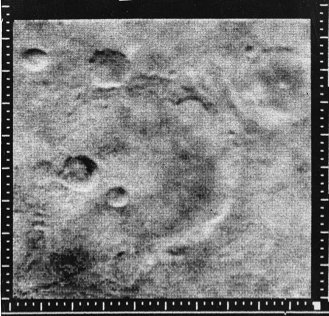
NASA/JPL's flyby image taken by Mariner 4: Mariner cra(July 14, 1965)Ideal air pressure for humans is Earth’s sea-level pressure. At or below the average pressure at or below 150 meters, 450 feet, actually.

And, assuming we’re using something like SCUBA gear, less than 150 feet underwater; give or take a bit.

Our limits involve partial pressure of oxygen, metabolism, individual differences. It’s complicated, which is an understatement.

I live in central Minnesota, 1,250 feet above sea level, but have long since acclimated, so breathing is no problem for me.

At higher altitudes, however, no amount of acclimation will let us get enough oxygen.

Our minimum air pressure, assuming Earth’s nitrogen-oxygen mix, is 35.6 kilopascals. Approximately.

Kilopascal is geek-speak for a thousand Pascals. Earth’s average sea-level pressure is 101,325 pascals, or 101.353 kilopascals. It’s also called one standard atmosphere, and don’t bother trying to memorize all this. There will not be a test.

Even at the top of Mount Everest, humans don’t need pressure suits. We can get by, carrying extra oxygen along for altitudes in the death zone.

But since water’s boiling point drops as air pressure goes down, at some point water will boil at our normal body temperature. At that point, called the Armstrong limit, pressure suits aren’t an option: they’re a requirement.

Although nifty special effects in the film Total Recall (1990) may have been inspired by the Armstrong limit: that’s ‘Hollywood magic,’ not science. And that’s another topic.

Now, because I like lists and tables and stuff like that, here’s average atmospheric pressure at various places on Mars, Earth and Venus. The units are kilopascals:5

  • 0.03 Olympus Mons summit
  • 0.6 Mars average
  • 1.16 Hellas Planitia bottom
  • 6.25 Armstrong limit
  • 33.7 Mount Everest summit
  • 35.6 or less — death zone
  • 101.3 Earth sea level
  • 106.7 Dead Sea level
  • 9,200 Surface of Venus
Orbits and the Van Allen Radiation Belts
NASA's illustration, a cutaway model of Earth's inner and outer Van Allen belts. (February 13, 2013)
Earth’s inner and outer Van Allen radiation belts. (NASA illustration)

Chesley Bonestell's illustration of a rotating space station orbiting 1,000 miles above Earth, for Collier's magazine. (March 22, 1952)Wernher von Braun had good reasons for putting the Collier’s space station in a 1,075-mile-altitude almost-polar orbit.

That way, folks on the station would circle Earth every two hours. The orbit’s plane wouldn’t change, but Earth would keep turning; so after 24 hours folks on the station would have had a view of every spot on Earth.

Just one problem. Orbiting at 1,075 miles altitude, the Collier’s space station would have been at or near the edge of the inner Van Allen radiation belt.

The inner belt’s energetic protons aren’t good for electronics or humans, so most satellites stay below that danger zone.

The International Space Station is in low Earth orbit, about 250 miles up. Partly because that’s below the inner Van Allen radiation belt.

Missions to Earth’s moon went through the belt, but since they spent very little time rubbing elbows with the Van Allen belt charged particles, astronauts weren’t exposed overly much.

Once outside the Van Allen belts, they picked up radiation from Solar particles. But again, not enough to be a health hazard.

Starting around 1895, Norway’s Kristian Birkeland in Norway studied how electron beams and magnets interact. Henri Poincaré of France analyzed his results, Carl Størmer — the point I’m making is that when Explorers 1 and 3 detecting what we call the Van Allen belts, it wasn’t a surprise.

Radiation belts are among of the “physical … rigors” we learned about after Collier’s “Man Will Conquer Space Soon!” series hit America’s newsstands. We’ve also been learning about coronal mass ejections and other space weather.6

Humanity’s Arrival on Mars: Timetables and Technology

NASA's 'Journey to Mars:' Perseverance rover's caching strategy.

The Collier’s 1952-54 “Man Will Conquer Space Soon!” articles were right: we knew the science and had most of the technology, either off the shelf or in development, to reach Earth’s moon within 25 years.

Dr. Wernher von Braun and Cornelius Ryan may be right about our timetable for reaching Mars.

“Can We Get to MARS?”
Dr. Wernher von Braun, Cornelius Ryan, Collier’s (April 30, 1954)
“…Will man ever go to Mars? I am sure he will — but it will be a century or more before he’s ready. In that time scientists and engineers will learn more about the physical and mental rigors of interplanetary flight — and about the unknown dangers of life on another planet. Some of that information may become available within the next 25 years or so, through the erection of a space station above the earth (where telescope viewings will not be blurred by the earth’s atmosphere) and through the subsequent exploration of the moon, as described in previous issues of Collier’s…”

But the last time I checked, outfits like NASA still have the late 2030s penciled in as our target date for landing humans on Mars.

That’s about two decades ahead of the Collier’s best-case estimate. It might seem overly optimistic, considering that we still don’t have Collier’s ‘big wheel’ space station.

Folks have, however, sent orbiters and various landers to Mars; many of which are still in operation or were shut down earlier this year.

  • Orbiters
    • Mars Odyssey (2001) U.S.
    • Mars Express (2004) ESA
    • Mars Reconnaissance Orbiter (2006) U.S.
    • Mars Orbiter Mission (Mangalyaan) (2013) India (mission ended April 2022)
    • MAVEN (2014) U.S.
    • Trace Gas Orbiter (2016) ESA/Roscosmos
    • Hope Mars Mission (Emirates Mars Mission) (2021) United Arab Emirates
    • Tianwen-1 (2021) China
  • Surface explorers
    • Mars Science Laboratory (2012) U.S.
      • Curiosity (rover)
    • InSight stationary lander (2018) U.S.
    • Tianwen-1 (2021) China
      • Zhurong (rover)
    • Mars 2020 (2021) U.S.
      • Perseverance (rover)
      • Ingenuity (helicopter)

'Crossing the Last Frontier,' Dr. Wernher von Braun, Collier's magazine (March 22, 1952) Illustration by Fred Freeman. Caption: 'A self-contained community, this outpost in the sky will provide all of man's needs, from air conditioning to artificial gravity.'I think some the apparent disconnect between Collier’s predictions and what actually happened is illustrated in Fred Freeman’s 1952 cutaway of the Collier’s space station.

Those things that look like large television screens almost certainly are not.

One of the labeled work stations is “photographic screen control,” and another “photographic screen.”

There’s also a darkroom, labeled “developing room,” on the deck below “telescope control.”7

Let’s remember that the Collier’s series was a no-nonsense look at what could be done, using cutting-edge technology of the day.

Technology that existed as practical devices. Not ‘Buck Rogers’ gadgets. Like television.

Scientists, Buck Rogers, “Televista,” “Detecto-Television” and DuMont Laboratories
Philip Francis Nowlan's Buck Rogers being shown a Detecto Television device. Detail from a Buck Rogers comic strip. (ca. 1930s)
Buck Rogers and a Detecto-Television set. (ca. 1930s)

Television technology arguably started with mechanical facsimile machines like Alexander Bain’s in the 1840s and Frederick Bakewell’s in 1851.

By 1914, Archibald Low’s “Televista” impressed retail magnate H. G. Selfridge. He made Low’s Televista part of the Scientific and Electrical Exhibition in his department store.

But these were all laboratory models. They worked, but were too expensive and not nearly high-resolution enough for commercial use.

Then, in 1928, WRGB became the first (experimental) commercial broadcast television station in the world.

Or maybe it was Reichs-Rundfunk-Gesellschaft’s station, during Weimar Germany.

RRG had been broadcasting public radio back in Weimar days. Maybe it ran the first broadcast television station. But, possibly because the National Socialist German Workers’ Party took over RRG, what little I’ve found about its television station is sketchy.

Electronic television’s roots go back to the late 19th century. In 1926, Alan Archibald Campbell-Swinton announced “not very successful” experiments involving a cathode ray tube and what he called “distant electric vision.”

Philo Farnsworth’s 1928 demo model has gotten credit as the first working electronic television system, but it wasn’t commercially viable; since most folks want to watch more than a straight line.

DuMont Laboratories manufactured and sold the first all-electronic television sets for the general public in 1938. American broadcast networks popped up during the 1940s.

Color television goes back to Vladimir K. Zworykin’s 1925 cathode ray device. DuMont Laboratories displayed a demo color-projection model in 1938, but it wasn’t until 1946 that RCA released an all-electronic color television set.8

“I Love Lucy” and Robot Spaceships

Collage: a rotary telephone, ca. 1955; Number One Electronic Switching System, 1976 and after; title card for The Addams Family titles, ca. 1964.; family watching television, 1958; publicity still from Batman, ca. 1967.By 1952, an increasing number of Americans were watching television.

So scientists and technicians working with Fred Freeman would have known that Buck Rogers’ Detecto-Television wasn’t entirely fictional.

But I suspect they also thought that orbital weather observers needed better image quality than viewers of “The Roy Rogers Show” and “I Love Lucy.”9

And they would, I think, have been right.

So how come we still haven’t had meteorologists working full-time in space stations, but have sent robot spaceships to Mars?

The Abacus, the the Analytical Engine and Terrain Relative Navigation
JPL/NASA's Figure 6. Mars 2020 flight system in the Launch / Cruise Configuration. (2014-2017)
NASA/JPL’s illustration: Mars 2020 flight system.

The abacus is still the best data processing tech for some applications.

But during the 19th century, folks like George Boole and Charles Babbage worked out some of the math needed for next-generation abacuses.

Or should that be abaci? Never mind.

Babbage made what’s probably the first non-abacus mechanical computer: his Difference Engine. Then, lifted programming tech from the 18th century Jacquard loom controller, he developed the Analytical Engine.

Skipping lightly over William Eccles’s crystal diode oscillator, Julius Edgar Lilienfeld’s field-effect transistor, Bell Labs’ point-contact transistor and a whole bunch of companies that made the very first transistor radio —

From 1906 to 1954, solid-state electronics went from laboratory curiosity to commercial personal electronics.

Skipping even more lightly over the next several decades, computers and robots scared some folks silly, made life more interesting and productive for others.

And by the time NASA launched the Mars 2020 mission, the lander was piloted by the Terrain Relative Navigation (TRN) system.

Oversimplifying something fierce, photos of the MARS 2020 landing site had been sent back by robot spaceships orbiting Mars. Folks at JPL and NASA gave TRN those photos, told it what they figured a safe landing spot would look like, and let the robot handle final descent.

Considering how long it takes signals to get from Earth to Mars, it’s the only practical way to handle Martian flight.10

We’re not at the point, yet, where mission control tells a rover or flier where to go next: and the robot says (in ‘robotese’) “no, that doesn’t make sense; I’m going over here, and will let you know if I find something interesting.”

But I think we’re going in that direction, and that’s another yet topic.

Collier’s “Man Will Conquer Space Soon!” Series: to be Continued

Rolf Klep's illustration, page 27 of Collier's March 22, 1952 issue: cutaway view of three-stage reusable ground-to-orbit shuttle. (March 22, 1952)I was going to talk about the Collier’s shuttle, and their rather grandiose Mars expedition. But I’ve run out of time this week, so that’ll wait.

Meanwhile, here’s the usual link list. This week’s is mostly what I’ve written about spaceflight and how I see robots:


1 Moon programs, imagined and real:

2 Remembering the Space Race:

3 Science fiction, science fact:

4 Martian air, mostly:

5 Atmospheric aspects:

6 Charting the Solar sea, metaphorifcally:

7 Collier’s space station and recent Mars missions:

8 Television, from laboratory curiosity to mass media:

9 Two shows from the 1950s:

10 computers, history and a robot pilot (sort of):

Posted in Back to the Moon, Onward to Mars, Discursive Detours, Series | Tagged , , , , , , , , | Leave a comment