ChatGPT, Attorney at Law — or — Trust, but Verify

Florence Lo/Reuters' ChatGPT screen in perspective, via engaged.com, used w/o permission.

There are times when I almost regret having successfully avoided a conventionally-successful career.

Last weekend was not one of them.

Partly because I saw what happens when an otherwise-smart person forgets to think.


Big-Time Bungle: Bogus References

BBC News article headline, 'ChatGPT: US lawyer admits using AI for case research'. image credit: Reuters. (May 28, 2023)
BBC News headline: ChatGPT and a law firm’s embarrassment, (May 28, 2023)

ChatGPT: US lawyer admits using AI for case research
Kathryn Armstrong, BBC News (May 28, 2023)

“…A judge said the court was faced with an ‘unprecedented circumstance’ after a filing was found to reference example legal cases that did not exist.

“The lawyer who used the tool told the court he was ‘unaware that its content could be false’.

“ChatGPT creates original text on request, but comes with warnings it can ‘produce inaccurate information’….”

First, a little background. Then I’ll give my opinion about ChatGBT and artificial intelligence in general, and why I don’t think humanity is doomed. Not any more than usual, at any rate.

A law firm was helping someone sue an airline. They sent a brief to the airline’s lawyers.

The law firm’s trouble started when the airline’s lawyers did what the law firm should have done before sending a brief: look up the cases referenced in the brief.

That was an exercise in futility, since the cases weren’t real.

The airline’s lawyers wrote the judge, explaining their problem. The judge asked the law firm to explain their “bogus quotes and bogus internal citations”.

Back to that BBC News piece.

“…‘Six of the submitted cases appear to be bogus judicial decisions with bogus quotes and bogus internal citations,’ Judge Castel wrote in an order demanding the man’s legal team explain itself.

“Over the course of several filings, it emerged that the research had not been prepared by Lawyer P. [redacted], the lawyer for the plaintiff, but by a colleague of his at the same law firm. Lawyer S. [redacted], who has been an attorney for more than 30 years, used ChatGPT to look for similar previous cases.

“In his written statement, Lawyer S. [redacted] clarified that Lawyer P. [redacted] had not been part of the research and had no knowledge of how it had been carried out….”
(Kathryn Armstrong, BBC News (May 28, 2023)) [emphasis mine]

(I’ve put a longer excerpt near the end of this post.1 I redacted the names, just in case folks who achieved international fame get touchy. Besides, there’s no point in trying to make their situation any worse.)

Trust, Assumptions and ChatGPT

Image from TECHAERIS article: 'Samsung employees may have leaked sensitive company data to ChatGP', Alex Hernandez (April 7, 2023).My hat’s off to Lawyer S. [redacted], for his clarification. It’s a fine example of taking responsibility for one’s actions.

His not noticing ChatGPT’s warning that it can “produce inaccurate information” is a fine example, too.

But not the sort that most folks want on their resume.

And the story just keeps getting better. Or worse, depending on one’s viewpoint.

Lawyer S. kept screenshots of what looks like a conversation he had with ChatGPT.

“…’Is v. [redacted] a real case,’ reads one message, referencing V.v.C. [redacted], one of the cases that no other lawyer could find.

“ChatGPT responds that yes, it is — prompting ‘S’ (Lawyer S. [redacted]) to ask: ‘What is your source’.

“After ‘double checking’, ChatGPT responds again that the case is real and can be found on legal reference databases such as LexisNexis and Westlaw.

“It says that the other cases it has provided to Lawyer S. [redacted] are also real….”
(Kathryn Armstrong, BBC News (May 28, 2023))

Double checking references is a good idea. Having ChatGPT do its own double checking, not so much.

Let’s do a thought experiment: assuming that ChatGPT is a person, which I don’t.

ChatGPT was released in November, 2022,2 about six months ago. Let’s say that the law firm, or Lawyer S., began using the chatbot immediately.

That’d make ChatGPT the equivalent of an intern, or maybe a law clerk, fresh out of college with no previous work experience.

I’m no lawyer, but trusting a new-on-the-job clerk to do research is one thing.

Assuming that the same newbie clerk should verify references in its own report — that’s something else.


Two Timelines, a Career and Experience

Dik Browne's 'Hagar the Horrible:' 'It may be the end of civilization as we know it.' (February 25, 1973)I don’t see either ChatGPT, or artificial intelligence in general, as a looming doom.

On the other hand, learning new skills — or at least using common sense — is at least as important now as it was when I was growing up.

Now let’s look at a possible timeline for the 30-years-plus career of Lawyer S.

Let’s make it 31 years, and say that he pursued his career on schedule. That would mean he graduated from law school and started practicing in 1992.

Earning a law degree takes seven years after high school,3 so he graduated from high school in 1985 and was born in 1967.

This is hypothetical, so Lawyer S. might be a bit older than that. But let’s assume he’s in his mid-50s: and look at what’s been happening since his birth.

During his childhood, artificial intelligence was literally science fiction in films like “2001: A Space Odyssey” and “Colossus: The Forbin Project”. Meanwhile, computers were getting smaller, less expensive and a whole lot more capable.

Using 20-20 hindsight, personal computers go back to Edmund Berkeley’s Simon in 1950. But as mass-market consumer electronic devices, personal computers began in 1977 and didn’t take off until the 1980s. I’m oversimplifying, a lot.

Lawyer S. probably heard of personal computers as a high schooler, but my guess is that even then he was focused on less nerdy matters.

Microsoft’s MS-DOS came out around the time Lawyer S. began practicing law,4 assuming that my timeline is accurate: which, remember, is an assumption.

Now, let us turn our attention away from this attorney’s successful career — and look at what I’ve been doing.

A Little of This, a Little of That

Photo: Brian H. Gill, at his desk. (March 2021)By the time Lawyer S. was in college, in the mid-1980s, I’d gotten a B.A. in history.

I’d also flunked out halfway through both a masters in library science and a B.S. in computer science. But I had earned a B.S. in English and done time as a secondary school teacher. I’d had a bunch of other jobs, too, including:

  • Beet chopper
  • Computer operator
  • Employment service interviewer
  • Flower delivery guy
  • Office clerk/customer service
  • Radio disk jockey
  • Sales clerk
  • Staff writer for an historical society

I’d married a woman with a degree in computer science, started a family with her and began working for a small publishing house here in Sauk Centre.

Fast-forward seven years. Lawyer S. has now become a practicing attorney. I’ve been writing advertising copy and doing graphic design for that publisher.

At some point, my employer’s marketing manager noticed my personal website: so I created and launched one for the company.

I became their ‘computer guy’ and list manager. That’s a fancy way of saying that I answered questions and sorted out SNAFUs. When I wasn’t doing that, I was keeping track of their customers and mailing lists.

I’m not sure that any of my job history, aside from that very brief stretch as a teacher and time as a radio DJ, was “professional” work: since I hadn’t been trained or certified for what I did. Apart from some on-the-job training, which was a really good idea.

But, having seen what can happen when folks enjoy more success and less unemployment, I’m grateful for not getting stuck in a rut.

And I’ve been encouraged to think, even on the job.


Using Our Brains: It’s an Option

WiNG's photo of the Beijing Television Cultural Center fire. (February 9, 2009) via Wikimedia Commons, used w/o permission.
Common sense and safety protocols put on hold: Beijing. (2009)

I can’t reasonably argue that artificial intelligence is completely harmless.

No technology, from lightning rods to video games, is utterly idiot-proof.

Even fire, a technology we’ve been using for maybe a million years, is a problem when someone doesn’t use common sense.6 I figure that’ll still be true when the Code of Ur-Nammu, the UN Charter and whatever we try next will seem roughly contemporary.

The problem isn’t technology. It’s us, and I’d better explain that.

We’ve got brains. We’re rational. But we also have free will: so using our brains is an option, not a hardwired response. And our choices have consequences. (Catechism of the Catholic Church, 1701-1709, 1730-1738)

Common Sense and Other Alternatives

From Fritz Lang's 'Metropolis' (1927). the hero is hallucinating: seeing a big machine as Moloch, eating workers.I talked about ChatGPT, fear and getting a grip back in mid-April.

Not much has changed since then, although I’ve been noticing more scary headlines about the existential threat of chatbots, and fewer doomsayers touting economic woes.

I didn’t, and don’t, see chatbots and artificial intelligence as a dire threat.

But folks like that 20-something national guardsman who shared classified military intelligence on social media? And this probably 50-something attorney who put faith (apparently) in the unerring skills of a six-month-old chatbot?5

I don’t think either of them are a threat to humanity. Not as individuals. But if enough folks start putting their minds on hold: we could have problems.

A Skunk, a Wood Pile, Dynamite and the Sixties

RxS' photo: 'Gateway to Lake Wobegon' sign in Holdingford, Minnesota. (2006) via Wikipedia, used w/o permission.Making daft mistakes isn’t new.

My wife tells me of the time when some kids noticed a skunk outside the school.

This was back when the local school had wood-burning heaters, and a wood pile stacked against one wall.

Boys, at least, could and did take rifles to school with them so they could do some hunting on the way home. The point is that social norms were different then.

Anyway, the skunk hid in the wood pile. The kids couldn’t spook it out. So one of them went home; returning with dynamite, a fuse and a blasting cap.

Yes, I know. Today that’d be international news. Back then, it was kids using stump-removal tech without permission.

And remember, these were kids. Smart rural kids, but kids nonetheless.

The one with dynamite used a tad more than was absolutely necessary. When the smoke cleared, the skunk was gone: along with the wood pile and much of the school building’s paint on that side.

Nobody was hurt. Startled by the blast, but not hurt. The kids were tasked with cleaning and repainting that side of the school, and life went on.

That was then, this is now.

I do not, by the way, yearn for ‘the good old days’. I remember them, and they weren’t.

Many reforms of the Sixties were long overdue. Some have worked out fairly well. Some, I think, haven’t. And that’s another topic.

Changing Times, Human Nature

Brian H. Gill's collage: a rotary telephone, ca. 1955; Number One Electronic Switching System, 1976 and after; title card for The Addams Family titles, ca. 1964.; family watching television, 1958; publicity still from Batman, ca. 1967This is not the world I grew up in.

I’m okay with that, and in many ways I think “now” is better than “then”. But in other ways: well, at best it’s no worse.

And that leads me to an online chat I had with my oldest daughter last weekend.

We’d been talking about the debacle involving an attorney and ChatGPT.


Me:
“Yeah. Amazing. I – good grief.
What bothers me, in a way, is that I’m disgusted – but not all that surprised.”

Oldest daughter:
“Well, you’re over 70, lived through the ’60s, and have been paying attention.”

“Disgusted” is a fairly strong word. I don’t use it all that much. When I do, it’s often because someone who should have known better displayed a stellar lack of good sense.

This is where I could launch into a conventional ‘back in my day’ rant about the decline and fall of practically everybody. But I won’t. Again, my memory is too good.

Much as I might enjoy living in a world where folks have always acted rationally, that’s not the world we all live in.

With the passing of decades since my youth, I’ve forgotten names and details: but some high-level national officials became briefly famous after being caught selling state secrets.

At the time, I wasn’t sure what bothered me more: that they were betraying their country’s trust, or that they were selling information at bargain-basement-closeout prices. That may say more about me than the doofuses who got caught, and that’s yet another topic.

The point this time is that human nature hasn’t changed.

We’re still rational, we still have free will, so we can still put our minds on hold.

And that’s still a bad idea.

THE ROBOTS ARE COMING! THE ROBOTS ARE COMING!

Ford Beebe, Saul A. Goodkind, George Plympton and Basil Dickeyvia's malevolent marauding mechanical monster from 'The Phantom Creeps'. (1939) via David S. Zondy's 'Tales of Future Past' http://davidszondy.com/futurepast/ So: what can I, personally, do to save humanity from creeping socialism, acid rain, or the current crisis du jour?

Precious little, actually.

I’m just some guy living in central Minnesota, talking about chatbots and making sense.

I can, however, suggest that using our brains is a good idea.

Even if that means reading past the headlines, and maybe even thinking about the appeals to fear that are in play.

Like this gem:

AI could pose ‘risk of extinction’ akin to nuclear war and pandemics, experts say
Aimee Picchi, MoneyWatch, CBS News (May 30, 2023)

“Artificial intelligence could pose a ‘risk of extinction’ to humanity on the scale of nuclear war or pandemics, and mitigating that risk should be a ‘global priority,’ according to an open letter signed by AI leaders such as Sam Altman of OpenAI as well as Geoffrey Hinton, known as the ‘godfather’ of AI.

“The one-sentence open letter, issued by the nonprofit Center for AI Safety, is both brief and ominous, without extrapolating how the more than 300 signees foresee AI developing into an existential threat to humanity.

“In an email to CBS MoneyWatch, Dan Hendrycks, the director of the Center for AI Safety, wrote that there are ‘numerous pathways to societal-scale risks from AI.’

“‘For example, AIs could be used by malicious actors to design novel bioweapons more lethal than natural pandemics,’ Hendrycks wrote. ‘Alternatively, malicious actors could intentionally release rogue AI that actively attempt to harm humanity. If such an AI was intelligent or capable enough, it may pose significant risk to society as a whole.’…”

Again, no technology is one hundred percent absolutely guaranteed idiot-proof safe.

A breath of good sense in the CBS News piece is “…AIs could be used by malicious actors….” — Hendrycks, at least, apparently realizes that people use technology.

How we use it, and what we use if for, is up to us.

If “malicious actors” use AI, artificial intelligence, with the cunning and wisdom displayed by that attorney: hazmat cleanup might be the biggest problem for the rest of us, after their demise.

Toyota's photo: Kirobo Mini. (2018)Then there was a headline that might have, but didn’t, read “Killer Robot Drone Runs Amok”. The article even, at the very end, included a little background and context.

I put an excerpt in the footnotes.7

One more thing. “Trust, but verify” is a rhyming Russian proverb.8 And that is yet again another topic, which finally brings me to the seemingly-inevitable links:


1 A definition and an excerpt:

  • brief
    Wex, Legal Information Institute, Cornell Law School

A longer, but still redacted, excerpt from that BBC News piece:

ChatGPT: US lawyer admits using AI for case research
Kathryn Armstrong, BBC News (May 28, 2023)

“…A judge said the court was faced with an ‘unprecedented circumstance’ after a filing was found to reference example legal cases that did not exist.

“The lawyer who used the tool told the court he was ‘unaware that its content could be false’.

“ChatGPT creates original text on request, but comes with warnings it can ‘produce inaccurate information’.

“The original case involved a man suing an airline over an alleged personal injury. His legal team submitted a brief that cited several previous court cases in an attempt to prove, using precedent, why the case should move forward.

“But the airline’s lawyers later wrote to the judge to say they could not find several of the cases that were referenced in the brief.

“‘Six of the submitted cases appear to be bogus judicial decisions with bogus quotes and bogus internal citations,’ Judge Castel wrote in an order demanding the man’s legal team explain itself.

“Over the course of several filings, it emerged that the research had not been prepared by Lawyer P. [redacted], the lawyer for the plaintiff, but by a colleague of his at the same law firm. Lawyer S. [redacted], who has been an attorney for more than 30 years, used ChatGPT to look for similar previous cases.

“In his written statement, Lawyer S. [redacted] clarified that Lawyer P. [redacted] had not been part of the research and had no knowledge of how it had been carried out….

“…Screenshots attached to the filing appear to show a conversation between Lawyer S. [redacted]) and ChatGPT.

“‘Is v. [redacted] a real case,’ reads one message, referencing V.v.C. [redacted], one of the cases that no other lawyer could find.

“ChatGPT responds that yes, it is – prompting ‘S’ to ask: ‘What is your source’.

“After ‘double checking’, ChatGPT responds again that the case is real and can be found on legal reference databases such as LexisNexis and Westlaw.

“It says that the other cases it has provided to Lawyer S. [redacted] are also real.

“Both lawyers, who work for the firm L. L. O. [redacted], have been ordered to explain why they should not be disciplined at an 8 June hearing.

“Millions of people have used ChatGPT since it launched in November 2022.

“It can answer questions in natural, human-like language and it can also mimic other writing styles. It uses the internet as it was in 2021 as its database.

“There have been concerns over the potential risks of artificial intelligence (AI), including the potential spread of misinformation and bias….”

2 I talked about this in April: “ChatGPT and the End of Civilization as We Know It” > It’s New, it’s Scary and it’s (Not) the End of Creative Writing (April 15, 2023)

3 What it takes to be a lawyer:

  • Lawyers
    Occupational Outlook Handbook, U.S. Bureau of Labor Statistics

4 A little history:

5 Headlines:

6 “No photos, no video clips, no in-depth reports” — but hard to ignore:

7 “missing ‘important context'”:

US Air Force denies AI drone attacked operator in test
Zoe Kleinman (June 2, 2023)

“…I spent several hours this morning speaking to experts in both defence and AI, all of whom were very sceptical about Col Hamilton’s claims, which were being widely reported.

“One defence expert told me Col Hamilton’s original story seemed to be missing ‘important context’, if nothing else.

“There were also suggestions on social media that had such an experiment taken place, it was more likely to have been a pre-planned scenario rather than the AI-enabled drone being powered by machine learning during the task – which basically means it would not have been choosing its own outcomes as it went along, based on what had happened previously.

“Steve Wright, professor of aerospace engineering at the University of the West of England, and an expert in unmanned aerial vehicles, told me jokingly that he had ‘always been a fan of the Terminator films’ when I asked him for his thoughts about the story.

“‘In aircraft control computers there are two things to worry about: “do the right thing” and “don’t do the wrong thing”, so this is a classic example of the second,” he said.

“‘In reality we address this by always including a second computer that has been programmed using old-style techniques, and this can pull the plug as soon as the first one does something strange.'”

8 A little more history:

Posted in Discursive Detours, Journal | Tagged , , , , , , | 2 Comments

Super-Duper Super Earths and the Search for Life

Ph03nix1986's image: comparing the size of Kepler-442b and Earth. (January 2015) from Wikimedia Commons via Big Think, used w/o permission.
Size comparison: Kepler-422 b and Earth, artwork by Ph03nix1986. (What’s wrong with this picture?)

This week, I’ll talk about Professor Ethan Siegel’s view that “the myth of the super-habitable super-Earth planet” is “a scientific catastrophe”, other non-catastrophes; and a problem with “super-Earths” as a label.

Along the way I’ll look at science, news, headlines and silliness. And finally, skip lightly over a 13th century academic debate that got out of hand.

This post started more than two weeks ago, when a headline caught my eye.

Now, I’m more likely to click on links to articles about exoplanets and stars, than check on who’s dating who in Hollywood, or what a television sports analyst said about fans.

But words like “catastrophe” get my attention, even though I think they’re overused. Particularly when they’re describing something other than news media’s favorite obsessions.

And that is why the following item caught my eye:


“…A Scientific Catastrophe”?

NASA Ames/W. Stenzel's artistic concept', 'Searching for Habitable Worlds': four exoplanets super-earth mini-neptune. (December 2022) used in Big Think article (May 8, 2023)
Artwork: NASA Ames/W. Stenzel’s “Searching for Habitable Worlds” (December 2022)

Why ‘super-Earth’ exoplanets are a scientific catastrophe
Ethan Siegel, Starts With A Bang, via Big Think (May 8, 2023)

“Key Takeaways

  • “Of the more than 5,000 exoplanets known, the most common class of exoplanet is one that has no representation in our own Solar System: the Super-Earth.
  • “Between 2 and 10 Earth masses — larger and more massive than Earth but smaller and less massive than Uranus or Neptune — it was the most common exoplanet class found by Kepler.
  • “Many have speculated that super-Earths may be even more conducive to life, as well as more common, than Earth-like planets. That’s almost certainly untrue; here’s why.

“It’ time to expose a scientific catastrophe: the myth of the super-habitable super-Earth planet….”

I think Dr. Ethan Siegel (theoretical astrophysicist) has a point.

I also recommend his Big Think article. He pulled together a good sampling of what we know about exoplanets in general. With particular focus on those whose heft is between Earth’s and the Solar System’s ice giant worlds.

His text is heavy on facts and nearly devoid of filler or fluff. Just as commendable, he uses many graphics: including E. Pécontal’s animation, illustrating the radial velocity method of spotting exoplanets.

That said, I don’t think speculation about super-Earths is a “scientific catastrophe”.

Granted, I’m thinking of René Heller and John Armstrong’s “Superhabitable Worlds”, Astrobiology (2014).1

Earth ISN’T the Best of All Possible Worlds???

Ph03nix1986's 2015 artist's concept of a superhabitable world, used on 'Superhabitable planet' Wikipedia page.

Superhabitable Worlds
René Heller, John Armstrong; Astrobiology (January 2014) via arXiv

“…4. Conclusions….”

“…Terrestrial planets that are slightly more massive than Earth, that is, up to 2 or 3 M⊕, are preferably superhabitable due to the longer tectonic activity, a carbon-silicate cycle that is active on a longer timescale, enhanced magnetic shielding against cosmic and stellar high-energy radiation….”

“…Eventually, just as the Solar System turned out to be everything but typical for planetary systems, Earth could turn out everything but typical for a habitable or, ultimately, an inhabited world. Our argumentation can be understood as a refutation of the Rare Earth hypothesis.While we agree that the occurrence of another truly Earth-like planet is trivially impossible, we hold that this argument does not constrain the emergence of other inhabited planets. We argue here in the opposite direction and claim that Earth could turn out to be a marginally habitable world. In our view, a variety of processes exists that can make environmental conditions on a planet or moon more benign to life than is the case on Earth….”
[emphasis mine]

If Siegel’s article identified the “many” folks who thought that maybe super-Earths were “more conducive to life” than our world, I missed it.

He did, however, say why many planets that are between two and 10 times as massive as ours are very likely not suitable for life. I’ll get back to that.

Heller and Armstrong — they wrote that “Superhabitable Worlds” paper — may turn out to be wrong about rocky planets that are more massive as Earth. But their 2014 paper gave reasons for their conclusions.

They also acknowledged that a planet just like Earth, orbiting a star just like ours, could be habitable; and that the odds of finding a world just like that were slim to none.

Heller and Armstrong started by discussing a “menagerie” of hypothetical exoplanets about 1.5 times as massive as Earth, with a radius 1.12 that of Earth’s, orbiting a star similar to Gl58: a red dwarf star in the general direction of Beta Librae.

Then they sketched out possible habitable zones for a rocky moon orbiting a Jupiter-size planet. They showed how the moon would be heated by sunlight from the star, sunlight that had reflected off the planet, and by tidal heating.

Tidal heating is the sort of thing that makes Io the most volcanically active body in the Solar System.2 The most active that we know of, at any rate.

Bigger Isn’t (Always) Better: But Neither is Smaller

NASA Ames/JPL-Caltech/T. Pyle's impression of Kepler-186f. (2014) via NASAAfter that, they describe what they think would make a planet superhabitable.

That part of their paper goes on for five pages, so I’ll skip most of what they said.

One point they made was that bigger isn’t always better when it comes to habitability.

That’s because we’ve been learning that plate tectonics recycles chemicals and minerals living critters need. That process works on Earth, but apparently not for smaller worlds.

“…smaller planets have smaller diameters and thus higher surface-to-volume ratios than their larger cousins. Such bodies tend to lose the energy left over from their formation quickly and end up geologically dead, lacking the volcanoes, earthquakes and tectonic activity which supply the surface with life-sustaining material and the atmosphere with temperature moderators like carbon dioxide. Plate tectonics appear particularly crucial, at least on Earth: not only does the process recycle important chemicals and minerals….”
Planetary habitability, Wikipedia [emphasis mine]

A 2011 study presented at a meeting of the EPSC-DPS by L. Noack and D. Breuer (I put a link under footnote 3) said that plate tectonics works on Earth because our planet’s mantle is at the right temperature and pressure.

The good news is that there’s apparently a range of temperature and pressure that work: not some wildly-improbable exact balance.

The intriguing news is that, if Noack and Breuer are right, Earth is about as small as a planet can be and have enough heat and pressure inside to make plate tectonics go. Go and keep going long enough for life to get started and get interesting, at any rate.

But again, bigger isn’t always better. They figured that a rocky planet’s insides would be too hot for worlds more than five times as massive as ours.3


Science News, Silliness, Headlines and “Catastrophe”

'Nouvelles découvertes dans la Lune....' A lithograph from 'Great Astronomical Discoveries', The New York Sun, translated into French. (1835) Artwork probably by Benjamin Day. Part of the 'Great Moon Hoax of 1835'. 'Lunar animals and other objects Discovered by Sir John Herschel in his observatory at the Cape of Good Hope and copied from sketches in the Edinburgh Journal of Science.' Benjamin Henry Day, Library of Congress, via Wikipedia, used w/o permission.
From The New York Sun’s ersatz science series, translated into French. (1835)

Bear in mind that I’m in my 70s. I remember McCarthyism’s dying gasps, Ehrlich’s “The Population Bomb”, and the Cold War.4

My notion of a “catastrophe” may be a tad more catastrophic than Professor Siegel’s.

Proxima Chorizo, the Great Moon Hoax and Headlines

A 'top scientist's' photo: a slice of chorizo, with a black background, which he described as a James Webb Space Telescope image of Proxima Centauri.I was annoyed when a high-profile scientist told his fans that a slice of chorizo was a Webb telescope image of Proxima Centauri.

But when he sobered up, he explained that he had a perfectly good reason for posting a picture of Proxima Chorizo.

So “annoyed” is about as far as I’ll go with that incident.

I see the Great Moon Hoax of 1835 as edging a bit closer to “catastrophe”.

Particularly since The New York Sun wouldn’t publish a retraction. Not even after folks realized that Sir John Herschel hadn’t discovered bat-people on the Moon.

That’s understandable. Their mini-bison and bipedal beavers sold papers. I can’t help wonder, though, how much their make-believe science series encouraged folks to write off science as flim-flam.

Then there are headlines like these:

The Forbes article’s headline is accurate, partly.

And, although the scientists weren’t named in the article, there was a link to their paper. Turns out that there were four of them, and they did say Kepler-422 b had enough sunlight to support Earth-type photosynthesis.

But not that it was the only such planet in the whole galaxy, other than Earth.

Efficiency of the oxygenic photosynthesis on Earth-like planets in the habitable zone
Giovanni Covone, Riccardo M Ienco, Luca Cacciapuoti, Laura Inno; Monthly Notices of the Royal Astronomical Society (August 2021)

“…we also find that Kepler-442b receives a PAR photon flux slightly larger than the one necessary to sustain a large biosphere, similar to the Earth biosphere….”

In fairness, Forbes focuses on finance, industry, investing, and marketing. Not science.

The Wired UK article’s author was less imaginative.

Orphanides explained that a paper published in the Astrophysical Journal outlined a new method for assigning the ‘maybe habitable’ label. And that, by that method’s standard, Kepler-442 b might be just a bit more habitable than Earth.5

But the headline? Well, headlines are there to grab attention. And that one did its job.


Exoplanets: New Categories for Strange New Worlds

NASA/JPL-Caltech's infographic: pie chart showing percentages of known gas giants, Neptune-like exoplanets, super-Earths and terrestrial planets. (2022) via Big Think, used w/o permission.
NASA/JPL-Caltech’s infographic with pie chart: four types of exoplanets.

If planetary scientists put the super-Earth label on every exoplanet with a mass between two and 10 times Earth’s, then that could be a problem. Because many are not Earth-like.

Natalie Batalha's and Wendy Stenzel's chart of exoplanet populations found with Kepler data. (2017) (NASA and Ames Research Center)By 2017, researchers had found many planets that weren’t like anything in the Solar System, and didn’t fit into the old ‘terrestrial, gas giant, ice giant’ categories.

Hot Jupiters, for example, are at least as massive as the Solar System’s gas giants, but whip around their stars in tight orbits.

Ocean worlds are probably covered by profoundly deep oceans and/or have far more ice than Earth. From what I’ve read, the liquid on “ocean worlds” is water. Probably.

That’s assuming that the ‘big ocean’ model is accurate — as it almost certainly is for moons like Enceladus and Europa.

But an ice giant’s ice might be ammonia, methane or water. In this case, “ice” is any volatile chemical with a melting point above around 100 Kelvin. We’ve got two in our Solar System: Uranus and Neptune.

The Solar System’s planets are close enough for astronomical spectroscopy to show us what chemicals are in their atmospheres or on their surfaces. Scientists have used the same techniques for studying a few exoplanets.

But in many cases, the data we have to work with is an exoplanet’s orbital period, mass, and — for transiting planets — diameter.6

That information would tell hypothetical astronomers on a planet circling Tau Ceti that the Solar System’s Venus and Earth are almost certainly rocky planets with about the same mass. And that Venus should be warmer than Earth. But it wouldn’t tell them much else.

Sorting Exoplanets by — Radius?

Open Exoplanet Catalogue's graph: 5000 exoplanets known at the start of 2022, sorted by radius.
The ca. 5,000 known exoplanets, sorted by radius. (early 2022) Open Exoplanet Catalogue via E. Siegel.

Even so, just knowing a planet’s mass and diameter tells us quite a bit: particularly when researchers combine data from all known exoplanets.

That graph, used by Professor Siegel in his “Catastrophe” article, sorts 5,000 known (as of the start 0f 2022) exoplanets by radius.

I’m not sure how or where Open Exoplanet Catalogue got the radius of 5,000 exoplanets. When I checked their website, I didn’t find that graph.

We had catalogued about 5,500 exoplanets by early 2022. But as far as I know, we didn’t know the radius of each one.

Fast-forward to May, 2023. As of this month, scientists know of 5,300 and some odd exoplanets, a bit over 4,000 of which are transiting exoplanets.

Transiting exoplanets are worlds that pass between their star and us once every orbit. Observing and measuring these transits tells scientists how wide the worlds are.

I don’t know how Open Exoplanet Catalogue got radii for non-transiting worlds. Maybe it’s derived from their mass. Then again, maybe not.

Anyway, I gather that if Earth was on that graph, it’d be at -1.0 units. Neptune would be at -0.5 and Jupiter would be at 0.0.

And, again looking at that graph, it looks like the number of exoplanets peaks at a little shy of Neptune’s size, with another peak at Jupiter-size and larger. According to that graph.7

I spent more time than I maybe should have, trying to tack down where Open Exoplanet Catalogue got their “radius” data. Without success.

Maybe the graph’s “radius” label should have been “mass”.

There was, as of March 2022, a clustering of exoplanet masses around one Jupiter-mass and another around about 0.03 Jupiter-mass.7

Mass, Period and Discovery Method of Known Exoplanets (March 2022)

NASA/JPL-Caltech/NASA Exoplanet Archive's scatter plot: known exoplanets' mass, period, and discovery/measurement method. (2022) via Big Think, used w/o permission.
NASA Exoplanet Archive’s scatter plot: mass, period and discovery/measurement method. (2022)

I’d enjoy geeking out over how scientists have been spotting exoplanets, and why they’ve spotted so many big planets with small orbits.

But you’re in luck.

If I’m going to get this thing finished in a reasonable time, my reasonable option is making a list of methods, plus a quick definition.

  • Astrometry
    Precisely measuring the positions and movements of stars
  • Imaging
    Getting a ‘photo’ of a planet, often in infrared
  • Microlensing
    Observing the ‘flash’ when light from a planet gets focused by an intervening star’s gravity field
  • Orbital brightness variations
    Just what it says: observing cyclic changes in a star’s brightness (CHECK THIS)
  • Radial velocity
    Looking for changes in star’s spectrum caused by Doppler shift
  • Transits
    Observing light from a star dimming as a planet moves across its face
  • Timing variations
    Observing and timing transits

Maybe exoplanets really do come in two basic sizes, with two standard orbital periods: either Jupiter-size with a 1,000 day orbit, or between Uranus and Neptune-size with a 10-day orbit.

That’d make the Solar System, with its two gas giants, two ice giants and four terrestrial planets an oddball. And maybe that’s so.

On the other hand, each detection method we’ve got has its own selection bias.

It’s very possible that we’ve found a great many massive planets in either very tight orbits or in fairly big orbit — because that’s what our current methods are good at spotting.8

New Worlds Discovered by Kepler, TESS, and Everything Else

NASA/GSFC/SVS/Katrina Jackson's illustration, showing how transit detection of exoplanets and exomoons works. (ca. 2018)
Illustration: how transit detection of exoplanets and exomoons works. (NASA/GSFC/SVS/Katrina Jackson (ca. 2019))
NASA/JPL-Caltech/NASA Exoplanet Archive's bar chart: Cumulative number of exoplanet detections by year and detection method. (1989-2022) via Big Think, used w/o permission.
Cumulative exoplanet discoveries by year and detection method. (1989-2022) For latest count see exoplanetarchive.ipac.caltech.edu

Until about 2012, scientists were mostly spotting new exoplanets by measuring the radial velocity of stars. Just to make things more complicated, radial velocity detection is often called Doppler spectroscopy, and that’s another topic.

Oddly enough, I’ve yet to see the flood of exoplanets discovered with the Kepler space telescope tied in with the 2012 ‘end of the world’ thing. Possibly because nerds like me focus more on the science side of the Mayan long count calendar, and less on pop prophecies.

The spike in confirmed exoplanets in 2016 probably came from NASA’s data dump in May of that year. Analysis dump, actually. Then, in July of 2018, TESS (Transiting Exoplanet Survey Satellite), started sending back data.

Kepler and TESS aren’t the only transit-detecting space observatories. And there’s the CNES/ESA COROT (Convection, Rotation and planetary Transits), and projects like SuperWASP and HATNet on Earth.9

That’s not a complete list. The point is that a whole lot of scientists have been gathering and analyzing data, using over a half-dozen methods: mostly transit, lately.

So how come, out of the five-thousand-plus new worlds they’ve spotted, they haven’t found ‘Earth 2.0’ — a planet pretty much like Earth, orbiting a star like ours?

Still Seeking the Legendary Earth 2.0

NASA/Ames/Jessie Dotson and Wendy Stenzel; scatter plot, annotated by E. Siegel: confirmed exoplanets by radius and orbital period, with radius/orbital period of Mercury and Earth for comparison. (2022) via Big Think, used w/o permission.
Confirmed exoplanets by radius and orbital period. (2022) NASA/Ames/J. Dotson and W. Stenzel.
Red and green annotations by E. Siegel.

That scatter plot shows exoplanets know as of 2017, sorted by radius (vertical) and orbital period (horizontal).

The red oval is where we’d find a planet more-or-less like Mercury. Earth-size worlds in an orbit somewhat like ours would be in the green oval.

‘Earth 2.0’, a planet like ours orbiting a star like ours, would be right in the center of the green oval. We hadn’t spotted one like that in 2017, and still haven’t.

But we have found a few planets that are roughly Earth’s size: like Kepler-186f and TOI-700 d. They’re both in their star’s habitable zone. The stars are red dwarfs, though: so neither would be sure-fire ‘Earth 2.0’.

A few exoplanets have been called Earth analogs, and a few of those were temporarily dubbed ‘Earth 2.0’.

Some are too hot for life as we know it. Some are big enough to be called super-Earths.10 And that, finally, brings me to what bothers Professor E. Siegel about “super-Earths”.


The Problem with “Super-Earths”

NASA/JPL-Caltech/DSS photo/sky chart. Part of the constellation Cassiopeia, with location of HD_219134 circled. (2015)
Part of the constellation Cassiopeia, with HD_219134 circled. NASA/JPL-Caltech/DSS (2015)

The earliest example I’ve found of the term “Super-Earths” is in a 2006 paper.

“…The first such planets were discovered during the past year, judging by their measured masses of less than 10 Earth-masses (M⊕) or Super-Earths. … Their composition can be either completely terrestrial or harbour an extensive ocean (water and ices) above a rocky core….”
(“Radius and Structure models for the First Super-Earth Planet“; Diana Valencia, Dimitar D. Sasselov, Richard J. O’Connell; The Astrophysical Journal (submitted October 4, 2006))

Having “a mass higher than Earth’s, but substantially below those of the Solar System’s ice giants” is a Wikipedia page’s definition for super-Earth. Apparently the label and mass-only description caught on.

But even in 2006 — or 2007, when the paper was published — it wasn’t the best moniker. Scientists knew that a fair number of “super-Earths” could be quite un-Earthlike.

Unlike Professor E. Siegel, I don’t think that’s a “catastrophe”.

Sloppy labeling, yes; but not a catastrophe.

Not unless scientists start forgetting distinctions and labels like ocean world, mini-Neptune, sub-Neptune, super-puff and Chthonian planet.

I’d be astounded if we’re still using all those labels a hundred years from now. We’ve been learning a lot, fast, about exoplanets.

Natalie Batalha's and Wendy Stenzel's chart of exoplanet populations found with Kepler data. (2017) (NASA and Ames Research Center)A few decades back, we didn’t know that these worlds existed. A few decades from now, with new data and new analysis, many of today’s models for what’s inside exoplanets may turn out to be very wrong.

Diana Valencia et al.’s 2006 paper used GJ876d, Gliese 876 d, the first known “super-Earth”, as its model. I’d use it as an example, too, but not quite two decades later we still don’t know its radius.

And we won’t, until scientists come up with new observation and analysis methods. We do, however, have a pretty good handle on its mass: between six and a half and seven and a quarter times Earth’s.

So I’ll be looking at what we know about HD 219134 b, a super-Earth orbiting HD 219134, a star that’s a tad over 21 light-years out, in the general direction of Beta Cassiopeiae.11

HD 219134 b: Data, Density and Uncertainty

NASA Exoplanet Catalog's visualization of HD219134's inner planets. (2023)
Visualization of HD 219134’s inner planets, from NASA Exoplanet Catalog.

The star HD 219134 is smaller and cooler than our star, with a K3V spectral class.

Its habitable zone, where a planet like Earth could have liquid water on the surface, is smaller than the Solar System’s.

And HD 219134 b is even closer to its star. It’s far too hot for life as we know it.

Astronomers have taken a close look at HD 219134 b: not directly, but by measuring shifts in its star’s radial velocity, and how much starlight it blocks when it transits HD 219134.

That’s given them HD 219134 b’s mass and radius, with a fair degree of accuracy: which in turn gives its density. Whatever its made of, on average the exoplanet is dense.

Density (grams per cubic centimeter) of:

  • HD 219134 b
    6.36 (± 0.72)
  • Earth
    5.5134
  • Mercury
    5.427
  • Neptune
    1.638

If those numbers are right, HD 219134 b is almost certainly not made of stuff similar to Neptune’s interior. And maybe not quite like Earth’s.

Slightly more recent data says that the exoplanet’s radius is smaller: about 1.5 times Earth’s. Which would make it even denser that Earth.

The last I checked, we haven’t detected an atmosphere around HD 219134 b. But scientists have worked out that it might have one: and if so, it probably isn’t mostly hydrogen.

Given how much data’s available, that’s pretty good work. And gives other scientists starting points for planning new observations of HD 219134’s planetary system.12

My guess is that HD 219134 b is a “super-Earth”: both in the sense of having more mass than Earth and less than Uranus or Neptune, and in the sense implied by “super-Earth“, being a planet that’s (probably) rocky.

“Super-Earths”: Not Necessarily Terrestrial

Chaos syndrome's illustration, comparing orbits of 55 Cancri A's planetary sysytem and the Inner Solar System's.Many exoplanets with the super-Earth label are at least as dense as Earth, so they may be made of stuff like our home.

55 Cancri A e, for example is even denser than HD 219134 b: 6.66 grams per centimeter squared (+0.43 or -0.40).

But others, like Kepler-737b, with a density around three and a third grams per centimeter, are much less dense than Earth.

Since they’re also more massive than Earth, the odds are good that they’re not particularly Earth-like.

What is inside exoplanets — is something I’ll leave for another time.

I think having a label for exoplanets with masses between Earth’s and Uranus’ makes sense.

But “super-Earths” isn’t an ideal label. “Earth” can imply Earth-like. Some of them aren’t particularly Earthlike at all. Looking at their density, they’re probably not even terrestrial, like the Solar System’s inner worlds.13


Cosmic Pluralism, Aristotle, God, and Getting a Grip

Detail, Gustave Doré's illustration for 'Inferno', Canto IV - Limbo, Dante is accepted as an equal by the great Greek and Roman poets.' Plate 12 (1857)
Doré’s illustration for “Inferno”, Canto IV: Dante meeting great Greek and Roman poets. (1857)

Aristotle was a very smart man.

Trust me, this relates to super-Earths, exoplanets and the search for extraterrestrial life. Like I said, Aristotle was very smart. But he wasn’t the only smart citizen of an ancient Greek city-state.

Take Anaximander, for example. He lived about two centuries before Aristotle, and said that we lived in a universe with many worlds. But he didn’t have fan base that kept Aristotle’s work front and center while the Roman Empire rose and crumbled.

About a thousand years back now, European scholars picked up where their ancient counterparts left off. They also put Aristotle in an exalted position.

I suspect that it didn’t hurt, either in Aristotle’s day or later, that Aristotle’s cosmology put Earth at the very center of the universe. Or, perhaps more accurately, at the bottom, and that’s yet another topic.

The point is that Earth was important: and the only earthly world. According to Aristotle.

Aristarchus and other ancient philosophers who said maybe we’re not standing on the only world weren’t entirely forgotten.

I figure we’d have realized that Earth wasn’t alone eventually, anyway. Truth has a way asserting itself.

The ‘one world or many’ debate heated up in the late 1200s.

Some European scholars said folks like Aristarchus were on the right track.

Others said there is only one Earth and we’re standing on it. Because Aristotle said so.

I’m oversimplifying developments in Western philosophy over a span of millennia something fearful, by the way.

The ‘because Aristotle said so’ thing got the Bishop of Paris involved. His Condemnation of 1277 said, at least by implication, that God’s God and Aristotle’s not.14

27A. That the first cause cannot make more than one world.
Selections from the Condemnation of 1277“, Gyula Klima, Fordham University (November 23, 2006)

Truth Matters

NASA/JPL-Caltech/R. Hurt's artist's concept: how rocky, potentially habitable planets might appear. (April 13, 2022)
Habitable planets might look like this. Illustration by R. Hurt. (2022)

Recapping, 27A of the Condemnation of 1277 implied that if we’re standing on the only earthly world, it’s because God (or ‘the first cause’ in Medieval academic-speak) wants it that way.

And that if the universe has many worlds like ours, that’s the way it is: whether Aristotle would have approved or not.

I suspect one reason the Condemnation of 1277 is so controversial these days is the ‘God’s God, Aristotle’s not’ thing.

Flat-out saying — even though Aristotelian cosmology fits nicely into the Mesopotamian cosmic poetry reflected in the Bible — that what’s true is true, even if it means we must readjust our assumptions?

That emphatically does not fit the ‘rigid, arbitrary and unthinking’ view of religion in general and Christianity in particular that’s been popular of late. I’ll grant that rabidly-righteous and frighteningly-faith-filled folks don’t help dispel that image.

A few more points, and I’m done.

I don’t “believe in” extraterrestrial life. I figure we’ll either find life that emerged on other worlds: or we won’t. I’m pretty sure we won’t stop looking.

I certainly wouldn’t mind if we learn that we have neighbors in this universe, and I’m drifting off-topic.

Trying to “not believe in” exoplanets would be silly, at best. Scientists have discovered thousands so far, and the odds are good that evidence of many more is in data that hasn’t been crunched yet.

The bottom line is that truth matters. A lot. That’s not just my opinion. Here’s what Saints, popes and a scientist have said about paying attention and accepting truth:

Religion and natural science are fighting a joint battle in an incessant, never relaxing crusade against skepticism and against dogmatism, against disbelief and against superstition, and the rallying cry in this crusade has always been, and always will be: ‘On to God!’
(“Religion and Natural Science”, Translated and published in “Max Planck: Scientific Autobiography and Other Papers” (1968); via Wikiquote [emphasis mine])

“…if methodical investigation within every branch of learning is carried out in a genuinely scientific manner and in accord with moral norms, it never truly conflicts with faith, for earthly matters and the concerns of faith derive from the same God. … we cannot but deplore certain habits of mind, which are sometimes found too among Christians, which do not sufficiently attend to the rightful independence of science and which, from the arguments and controversies they spark, lead many minds to conclude that faith and science are mutually opposed.…”
(“Gaudium et Spes“, Pope St. Paul VI (December 7, 1965) [emphasis mine])

“…God, the Creator and Ruler of all things, is also the Author of the Scriptures — and that therefore nothing can be proved either by physical science or archaeology which can really contradict the Scriptures. … Even if the difficulty is after all not cleared up and the discrepancy seems to remain, the contest must not be abandoned; truth cannot contradict truth….”
(“Providentissimus Deus“, Pope Leo XIII (November 18, 1893) [emphasis mine])

“Question the beauty of the earth, question the beauty of the sea, question the beauty of the air…. They all answer you, ‘Here we are, look; we’re beautiful.’…
“…So in this way they arrived at a knowledge of the god who made things, through the things which he made”.
(Sermon 241, St. Augustine of Hippo (ca. 411))

One more thing. God is large and in charge. And I’m okay with that.

“Our God is in heaven and does whatever he wills.”
(Psalms 115:3)

I was going to talk about our search for extraterrestrial life, hypothetical life chemistry, and why I hope we have neighbors. But this post is running long, so I’ll leave that for later.

Now, finally — really finally, this time — the usual links:


1 Superhabitable, uninhabitable, and an opinion:

2 Strange worlds, hypothetical and otherwise:

3 Habitabable may not mean ‘just like Earth’:

4 Science and history, some of which I lived through:

5 Publications and (pop?) science:

6 Diverse and distant worlds:

7 Lists and statistics:

8 More lists, and how we study exoplanets:

9 Something silly, and a whole bunch of stuff that’s not:

10 Searching for another place like Earth:

  • Wikipedia

11 Stars and planets:

12 Searching for habitable worlds:

13 Super-Earths and/or terrestrial planets:

14 Philosophers and history:

Posted in Exoplanets and Aliens, Series | Tagged , , , , , , , , | Leave a comment

A Prescription, Disorders, Conformity and Culture

Sauk Centre, Minnesota. Wednesday afternoon. (May 17, 2023)
Looking out my front door on a slightly smoky Wednesday afternoon. (May 17, 2023)

First, the good news. I am not experiencing withdrawal (or, more politely, “discontinuation syndrome”). The not-so-good news is that I’m putting off what I was getting ready for today until next week.

This ‘journal’ post is, in part, an explanation:

About smoke in the air, here in central Minnesota: we’re downwind of Canadian wildfires. Sometimes it’s overhead, sometimes it’s at ground level too.

Google air quality map ca 22:30 Central time May 17, 2023; 3:30 UTC May 18, 2023.
Google’s Air quality map Wednesday evening, showing overhead smoke. (May 17, 2023)

Decisions — or — Ducks in a Row and Other Alternatives

Photo: Brian H. Gill, at his desk. (March 2021)This has been another interesting week.

That’s partly because I learned about a newly-confirmed exoplanet, TOI-244 b. What scientists said about this super-Earth ties in with what I’d hoped to have ready this week.

That’s the good news. For me, at any rate.

But it’s also mildly frustrating news. Getting my facts straight, my ducks in a row and ideas organized would take more time than I have.

Since I’ve got free will, I could forego ferreting out facts, let my ducks wander into traffic, and trust my freewheeling mind to churn out something worth reading.

Since I want what I write to make sense, that strikes me as a really bad idea. So instead I’ll spend time on this journal entry, and keep working on that ‘super-Earths and the search for life’ post.


Smoke in the Air, Health Issues and a Needed Prescription

My methylphenidate prescription, with one day left. (June 10, 2021)My wife and I, and the two now-grown kids who live here in Sauk Centre, could feel better: partly due to smoke that’s blowing over from Canada.

Our granddaughter’s surgery went well, and she’s been home for several days. I talked about that last week.

She’s still what my oldest daughter and I call “subdued”: which makes sense.

A broken arm does not feel good. This is the first time she’s experienced that outcome of the interaction between a swing and gravity. I figure she’s on a learning curve, and that’s another topic.

Meanwhile, I spent part of last week and the first few days of this hoping that authorization for a sincerely-needed medication would get processed before I run out.

I put myself on half-doses last week. That would have kept me going through Wednesday of this week. Doing so is not a particularly good idea. But maintaining full daily doses until my supply runs out is a worse one.

I’d better explain that.

Responsibility and Requirements, Reasonable or Otherwise

Rurik's photo: The maze of Longleat House. (Autumn 2005) via Wikipedia, used w/o permission
The Longleat hedge maze in southern England. Labyrinths like this are fun.

① Remembering to request an authorization each month is my responsibility.

② I’ve been told, and believe, that the regional health authority must have five business days to do whatever it is they do after my monthly request for an authorization disappears into their labyrinthine departments.

Whether or not I think this is reasonable is irrelevant. It is the reality I deal with.

I don’t like having to get permission each month to keep using my brain

But again: this is the reality I deal with.

Clarifying something: “using my brain” isn’t quite accurate. Make that “using my brain without metaphorically fighting the machinery”.

Happily, I’ve had decades of practice, staying moderately functional while dividing attention between what’s happening ‘outside’ and maintaining control ‘inside’.

Benefit/Risk and Labels

Vincent van Gogh's Sorrowing Old Man' or 'At Eternity's Gate.' (1890)The prescribed medication that needs authorization every month is methylphenidate. It’s marketed under the brand names Ritalin and Concerta, and is occasionally used as fodder for headlines.

It’s also a Schedule II controlled substance. American citizens have been protected from controlled substances since 1971, so I must ask for a new authorization each month.

Schedule II controlled substances have medical uses “with severe restrictions”, and have “a high potential for abuse.” (21 U.S. Code § 812 – Schedules of controlled substances)

Folks who made the controlled substances list had a point. Like so much else in this world, methylphenidate can be be misused.

For that matter, folks can misuse caffeine; although research that could make it a controlled substance is still controversial. I’m just glad I don’t need authorization each time I buy instant coffee, and that’s yet another topic.

Back to methylphenidate. It’s a central nervous system stimulant. I’m taking the maximum safe daily dose.

I could see what happens when I take more, but I won’t. Results of taking too much can start with agitation — hallucinations and toxic psychosis optional — and end with circulatory collapse.1 Risking that would be a very bad idea.

So I use methylphenidate as-prescribed: when that’s possible. That has made my life better, and significantly improved the lives of my family, too.

Learning Experiences

AP photo via BBC News, used w/o permissionI don’t like the monthly descent into bureaucratic protocol. I certainly haven’t enjoyed times when the authorization SNAFU took weeks to untangle. But again, it’s a reality which I must deal with.

Besides, experiencing withdrawal a few times has given me opportunities for understanding what others have endured, so I’ll see that as an ‘up’ side.

I also learned that what I experienced was “discontinuation syndrome”, not “withdrawal”.

I did a little checking and learned that the symptoms and causes of both were identical. That strongly suggested that I was looking at two labels for one phenomenon.

I verified my conclusion with a doctor: “discontinuation syndrome” is withdrawal from a prescribed medication.2

That’s probably a comfort to folks who’d get upset if their experience shared a label with something junkies sometimes experience.

I think labels, and words in general, matter. I also think reality matters. And prefer using labels which more descriptive than euphemistic.

Oh, wait. I haven’t said why I started taking methylphenidate.

Diagnosis

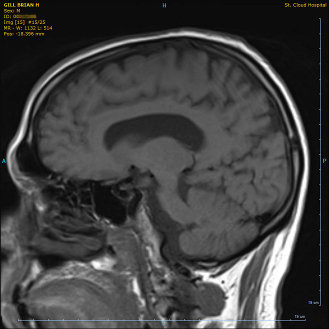
An image from Brian H. Gill's brain scans in 2018.A dozen or so years back, my wife said I should consider seeing a psychiatrist.

I agreed. Partly because I’d long since learned that listening to my wife is a good idea, partly because something was obviously amiss.

Long story short, it didn’t take long to establish that I was experiencing depression, and had been for decades.

Depression, in this context, is a mental disorder with measurable physical effects. Or maybe, some researchers say, a person’s biochemistry causes depression.

Either way, now I had a name for how I’ve felt since I was 12, back in the early 1960s.

Depression wasn’t my only problem. ADHD-PI, also known as ADHD-I or attention deficit hyperactivity disorder predominantly inattentive, is at or near the top. Which sounds odd, since being hyperactive, physically, is profoundly not an issue with me.

Today, folks with ADHD-whatever generally get diagnosed early: as infants or children. Since I was born during the Truman administration, that didn’t happen.

I gather that getting an ADHD diagnosis for kids was fashionable at one point.3 I think that would be not good for the kid, or the parents, and I’m wandering off-topic.

An Informed Decision, Unforeseen Results

National Institutes of Health's illustration: regions of the brain affected by PTSD and stress. (ca. 2018)At any rate, ADHD etc. is one of my disorders that can be treated.

Not cured, I gather: but I’ve got options other than resignation to my fate.

Methylphenidate was not the first drug the psychiatrist and I tried.

When it became an option, I wasn’t overly keen on using it.

I knew that methylphenidate was addictive. Still is, for that matter. If I started taking it, my body would rapidly become dependent on it.4

But at the time I thought the benefit/risk balance was in my favor. I still do, although I hadn’t realized how frustrating the monthly request could be.

Or how often I’d wonder whether this month’s authorization would get lost, and I’d experience withdrawal. Again.

This time around, I had one day’s half-dose supply left when the authorization finally cleared. And, thankfully, the pharmacy had a supply of methylphenidate on hand. And that’s yet again another topic.


“Reefer Madness”, “Frankenfish” and Me

'Reefer Madness' (1936, released 1938-1939) theatrical release poster. (1972)Methylphenidate doesn’t cure what I’ve got, and apparently isn’t even a treatment for some of my disorders.

“What I’ve got”, officially, varies over time. Possibly because definitions in the DSM keep getting revised. Anyway, this is a sampling from my diagnosis sheet:

  • ADHD: Attention deficit hyperactivity disorder, inattentive type
  • ASD: Autism spectrum disorder
  • Cluster A personality disorder
  • GAD: Generalized anxiety disorder
  • PDD: Persistent depressive disorder
  • PTSD: Post traumatic stress disorder

I could let ‘there is no cure’ bother me, but prefer doing what I can — and accept that I cannot do everything.

A distinct ‘up’ side to living in the current era is that methylphenidate and medications like it exist. Taking my meds makes my life much less difficult that it might have been.

A not-so-up-side to living in early 21st century America is that we’re still dealing with responses to an earlier generation’s concerns and paranoia: which gave us the Controlled Substances Act, or CSA. The CSA took effect in May of 1971.

I remember the 1960s. I think pill-popping, prescribed and otherwise, was a problem, and that drug abuse is still is a problem.

But it wasn’t and isn’t the only issue we’ve been dealing with, and I do not think that either “Reefer Madness” or “Frankenfish” represent reasonable responses to real concerns.5


“…Odd or Eccentric”?…. I Can See That

Illustration of 'icepick' lobotomy, from Dr. Walter Freenan II's 'Psychosurgery in the Treatment of Mental Disorders and Intractable Pain.' (1950)I’m not sure what I think of “Cluster A personality disorder”: or the idea of personality disorders in general.

That may be partly due to my memories of the ‘good old days’ when conforming to a particular group’s social norms mattered.

Time passed. The Establishment of my youth ripped whatever remained of their reputation to shreds. Now we’ve got a new Establishment, with new social norms, and that’s still another topic.

The point is that I’m not entirely comfortable with the folks in charge defining some behaviors and ways of thinking as “disorders”. The good news is that lobotomies aren’t nearly as fashionable as they were in my salad days.

And that brings me to Cluster A personality disorder.6 Although bits and pieces of Cluster B’s definitions that sort of fit me, I’ll admit that Cluster A may be a somewhat closer match. Particularly the schizotypal part.

“…Cluster A (odd or eccentric disorders)
Cluster A personality disorders are often associated with schizophrenia: in particular, schizotypal personality disorder shares some of its hallmark symptoms with schizophrenia, e.g., acute discomfort in close relationships, cognitive or perceptual distortions, and eccentricities of behavior. However, people diagnosed with odd-eccentric personality disorders tend to have a greater grasp on reality than those with schizophrenia….”
(Personality disorder, Wikipedia)

Schizotypal Personality Disorder: Two Lists

William Hogarth's 'A Rake's Progress' Plate 8 ' In The Madhouse'. (1735 (original engraving), 1763 (retouched by Hogarth, adding Britannia on wall))Insanity happens. What the word means depends on whether it’s used in an informal, legal or political context. As a medical term, it’s apparently been replaced by mental disorder.

Folks have tried to understand mental disorders for a long time. As a field of study, psychology started a couple dozen centuries or 17 decades back, with Thales or Gustav Fechner.

We’ve been learning a lot lately: redefining categories and making new ones, like schizotypal personality disorder. It showed up in the DSM-III. We’re up to DSM-5-TR now, and that’s — you guessed it — more topics.

Nine years back, fitting five of these nine criteria warranted a ‘schizotypal personality disorder’ diagnosis.7 Bear in mind that this isn’t expert advice.

  1. Ideas of reference
    (the notion that ‘it’s all about me’, that events are aimed at oneself)
  2. Odd beliefs or magical thinking
  3. Unusual perceptual experiences and bodily illusions
  4. Odd thinking and speech
  5. Suspiciousness or paranoid ideation
  6. Inappropriate or constricted affect
  7. Behavior or appearance that is odd, eccentric, or peculiar
  8. Lack of close friends or confidants, other than first-degree relatives
  9. Excessive social anxiety that doesn’t diminish with familiarity, tends to be associated with paranoid fears
    (Source: “Schizotypal Personality Disorder: A Current Review“, Current Psychiatry Reports (CPR) (July 2014))

Mayo Clinic’s list is shorter, or compressed.

  • Peculiar dress, thinking, beliefs, speech or behavior
  • Odd perceptual experiences, such as hearing a voice whisper your name
  • Flat emotions or inappropriate emotional responses
  • Social anxiety and a lack of or discomfort with close relationships
  • Indifferent, inappropriate or suspicious response to others
  • “Magical thinking” — believing you can influence people and events with your thoughts
  • Belief that certain casual incidents or events have hidden messages meant only for you
    (Source: Personality disorders, Diseases & Conditions, Patient Care & Health Information, Mayo Clinic)

Next, I’ll do an informal and very unscientific self-analysis.

Navel-Gazing — or — The Paranoids are After Me! 😉

Fred Barnard's 'Discussing the War in a Paris Cafe,' Illustrated London News. (September 17, 1870) via Wikipedia, used w/o permission.Going through the CPR list in reverse order, starting with numbers nine and eight: excessive social anxiety with a dash of paranoia, and no close friends other than first-degree relatives.

“First-degree relatives” doesn’t include spouses,8 and I enjoy interacting socially, so I don’t quite qualify.

On the other hand, I’m not someone who must get together with a few hundred close personal friends several times each week.

Maybe I do qualify, after all.

Odd, eccentric or peculiar appearance or behavior? Inappropriate affect? Yes, on both counts: since “affect” in this context probably means facial expressions and body language.

I’ve got a beard and long hair, which isn’t customary in these parts. My “affect” could be a great deal less on the 50th percentile than it is, but it’s something I’ve learned to monitor.

Suspiciousness or paranoid ideation? I don’t think so. I’ve learned to avoid being gullible, but that’s probably not “paranoid ideation”. I hope not, at any rate.

Odd thinking and speech? I talk like a professor. I subscribe to Sky and Telescope, and occasionally read papers on PubMed Central. None of that’s normal, so yes: I exhibit odd thinking and speech.

Unusual perceptual experiences and bodily illusions? I don’t think so. Hallucinations aren’t part of my daily life. Except a stress-related auditory hallucination, decades back, and that’s long since gone.

Magical thinking? No: like everyone else, my thoughts don’t affect others unless I turn them into words or actions.

“Odd beliefs”: I’m an American who grew up in a Protestant family and became a Catholic. That is odd.

Finally, “ideas of reference”? Definitely not. I realize that the universe isn’t all about me.

My score is maybe three or four out of nine. I almost qualify; and might, from another person’s viewpoint.


Disorders, Cultural Expectations and Making Sense

Joseph Keppler's 'The Bosses of the Senate' cartoon, first published in Puck Magazine. (January 13, 1889) This version by the by the J. Ottmann Lithographing Company, via Wikimedia Commons, used w/o permission.
Joseph Keppler’s “The Bosses of the Senate”. (1889)

As I said earlier, I’m not entirely comfortable when the folks in charge define some behaviors and ways of thinking as “disorders”.

That’s partly, I suspect, because I wasn’t The Establishment’s page my youth. And, although The Establishment’s got new preferences and slogans, I’m still not dancing to their tune. Mixed metaphors there, but never mind.

I think personality disorders, as defined by the American Psychiatric Association, are real.

“…To be classified as a personality disorder, one’s way of thinking, feeling and behaving deviates from the expectations of the culture, causes distress or problems functioning, and lasts over time…..”
(What are Personality Disorders?, Personality Disorders, Patients and Families, American Psychiatric Association)

But with my background, “…deviates from the expectations of the culture…” encourages a degree of caution.

I’d better explain that.

Living Up, or Down, to Expectations

Screenshot from a 20th Century Fox trailer for 'Gentlemen_Prefer_Blondes.' Marilyn Monroe and men in formal suits and vests. (1953) via Wikipedia, used w/o permission.In my ‘good old days’, “she’s smart as a man” was supposed to be a compliment.

Men would avoid being seen in public, holding their baby. Some women would cross the street, rather than pass by a pregnant woman.

I do not miss those ‘good old days’.

Back then, seeing most women as bubble-headed, while grudgingly admitting that the rare boring bookworm might achieve male intelligence, was the culture’s expectation. I’m oversimplifying, but not by much.

Living up, or down, to cultural expectations wasn’t much better for boys. My opinion. Although reading was taught to both boys and girls, being bookish outside the classroom wasn’t encouraged. Certainly not for my half of humanity.

Granted, my lack of obsession with sports may connect with being born a cripple. If I do something, I want to be at least adequate in my performance.

Back to cultural expectations of my salad days.

Some girls defied convention by admitting competence in academic skills. I was in my early teens before I realized that boys could, on average, be as smart as girls.

Treating personality disorders was different in those days. I don’t know how many boys were encouraged to ‘man up’ and stop exhibiting reading skills and creativity.

That changed, as did overt efforts to force girls into the household-appliance role. Disconnects between claims that women are people and commercial/media objectification remained and remains an issue. Again, my opinion.

Being Out of Step

Eugenics law historical marker, Indiana.That last bit about cultural expectations reminded me of another point.

On the rare occasions when someone identifies me in political terms, I’m generally ‘some conservative guy’. I figure that’s because I’m not on the same page as today’s Establishment.

Compared to the red-white-and-blue-blooded stalwart American patriots of my youth, I’d probably look liberal. And comparatively sane, but this isn’t the time for me to go off on that tangent.

Since I don’t fit The Establishment’s approved model for beliefs and behavior, I could seek treatment for my personality disorder. Which I have, actually, with mixed results, but never mind.

Happily, I haven’t been and may not be forced into a re-education program. Even under McCarthyism and more recent enthusiasms, that hasn’t become a national policy.9

A Few Good Ideas

Postcard: Willowbrook State School. Staten Island post cards collection, Scanned by New York Public Library, via Wikipedia, used w/o permission.I’d be a great deal more upset about my country’s current situation, if I didn’t realize that it’s temporary.

It also helps that I see many periods, from the Gilded Age and Progressive Era, on up to the present, as a mix of horrific policies and a few good ideas.10

The trick, as I see it, is to help preserve what’s right, fix what’s not, and keep seeing other people as people.

It’s not easy, and at the nuts and bolts level it’s not always simple.

But I think it’s a good idea. I’ve talked about this sort of thing before:


1 Controlled substances, mostly:

2 Terms and conditions:

3 Disorders:

4 A controlled substance:

5 Background:

6 Why I’m not missing the ‘good old days’:

7 Terminology:

8 Another term:

9 Culture, control and conformity:

10 Miscellanea, mostly United states 1870s-2010s:

Posted in Discursive Detours, Journal | Tagged , , , , , | 2 Comments

May 13, 2023: It’s Been an Interesting Week

Photo: Brian H. Gill, at his desk. (March 2021)I’d been planning on having something else ready for posting.

By Friday afternoon, that obviously wasn’t going to happen. So I’ll talk about what has been happening.

I should have my ducks in a row by the end of next week.

This week’s highlight was an unexpected visit from number-two daughter, son-in-law and granddaughter.

They’d been vacationing in Kentucky, and had planned on driving straight through to their home in North Dakota.

Then our granddaughter had a learning experience involving a swing and gravity. She’ll be okay, but right now she’s dealing with a broken arm. And that’s why they stopped off in Sauk Centre.

Turns out that our granddaughter emphatically wanted to see Grandma and Grandpa Gill, her aunt and uncle.

Her parents aren’t overly-indulgent; but under the circumstances, they figured that taking time for a stopover was a good idea. Our young granddaughter is doing a fine job, by the way, dealing with her broken arm.

But she was also, while she was here, somewhat subdued. Understandably. She broke all three bones in her arm, which is why she had surgery Friday.

The last I heard, it’s “had” surgery: past tense. She’s had the operation and is recovering, last I heard. Taking the ‘no news is good news’ attitude, I’ll see that as good news.

I can’t, reasonably, be happy that my granddaughter broke her arm. But I was glad of the opportunity for a little ‘granddaughter time’.

Meanwhile, my wife and the two now-grown kids here in Sauk Centre could be feeling better: although so far I’ve been less obviously under the weather.

All of the above may explain why I’ve been feeling distracted this week.

It also reminds me that it’s been some time since I’ve talked about life, health and all that.

Life Happens, and That’s Okay

Sb2s3's photo of a foggy road near near Baden, Austria. (2015) via Wikimedia Commons, used w/o permission.I was mentioning our granddaughter in my daily prayers before this week’s visit.

That’s something I’ll keep doing.

Talking about what prayer is, why it’s a good idea, and why it’s part of my daily routine is more than I’ve got time for today.

So is a detailed discussion of why I don’t think the Almighty smote my granddaughter because I watched Star Trek, back in the 1960s.

Now that I think of it, it’s been a few years since that sort of Bible-thumping craziness squelched across my path. I don’t miss the experience, and that’s another topic.

Let’s see, where was I? Family, a broken arm, a pleasant if low-key visit, prayer. Right.

I see being alive as preferable to the alternative, all else being equal. It’s a personal opinion, but it’s also part of my faith: something I’m obliged to believe.

Human life is precious. All human life is precious. It’s sacred: a gift from God. So is physical health. Taking care of both, within reason, is a good idea. (Catechism of the Catholic Church, 2288)

That doesn’t mean that good people are guaranteed good health, and that you can tell who the bad guys are by seeing who’s sick. Flipping that attitude over, the good guys aren’t always sick and smiling bravely. Reality doesn’t work that way.

Being healthy is okay. Being sick is okay. They’re both part of being alive. Getting well, and helping others get well, is a good idea. The same goes for scientific research: about which ethics apply, same as anything else we do. (Catechism, 1410, 1500-1510, 2292-2296)

But staying or getting healthy shouldn’t be my top priority. Putting anything or anyone where God belongs would be idolatry. And a bad idea. (Catechism, 2112-2113)

If all this this sounds familiar, I’m not surprised.

I’ve talked about it before:

Posted in Journal | Tagged , , , | Leave a comment

International Space Station: Seven More Years

NASA's photo: 'Expedition 68 crew members participate in an evening conference with International Space Station mission controllers on the ground. From front to back, NASA astronaut Josh Cassada; JAXA astronaut Koichi Wakata; ESA astronaut Samantha Cristoforetti; and NASA astronauts Frank Rubio, Nicole Mann, and Bob Hines.' (October 2022)
ISS Expedition 68 conference with mission controllers. (October 2022)

Nations and organizations running the International Space Station agreed to keep supporting it until 2030.

That’s what I’ll be talking about this week. Along with why the ISS won’t last forever, plans for either ditching it in the South Pacific or starting an orbiting salvage yard, commercial space stations and something my oldest daughter and I thought of.


The (Comparatively) International Space Station

NASA's emblem of the ISS (International Space Station). (2008) via Wikipedia, used w/o permission.
Emblem of the International Space Station. (2008)

The International Space Station, ISS, isn’t the only one in Earth orbit.

Tiangong is China’s first long-term space station. They launched its first module in 2021. The third module was in place by the end of 2022. The last I heard, China’s station was a potentially international effort, with an all-China crew of three.

Meanwhile, the ISS has been in operation since November of 2001. Crew size started with three, and has been as low as two. At the moment, seven folks are living and working on the ISS. They’re from only three of the world’s 200-odd countries:

  • Sergey Prokopyev (Russia) (ISS Commander)
  • Andrey Fedyaev (Russia)
  • Dmitriy Petelin (Russia)
  • Francisco Rubio (United States)
  • Stephen Bowen (United States)
  • Sultan Al Neyadi (United Arab Emirates)
  • Warren Hoburg (United States)

Even so, that’s not doing too bad. The ISS really is international, run by five space agencies: CSA, ESA, JAXA, NASA and Roscosmos.

The agencies are from four nations — Canada, Japan, Russia and the United States — and one international organization: ESA, the European Space Agency. Which is not EUSPA, the European Union Agency for the Space Programme.

Putting it mildly, the situation’s complicated.

Cooperation, Complications, and Doing Science Anyway

NASA's photo: ESA astronaut Hans Schlegel, in the ISS Columbus module. (February 15, 2008) via Wikipedia, used w/o permission.
Hans Schlegel, ESA, in the ISS Columbus module. (February 2008)

In a way, ISS-style cooperation began back in 1972, with the USA/USSR Apollo-Soyuz Test Project. But the ISS itself didn’t get started until 1988.

That’s when Japan, Russia and the United States of America, along with eleven member states of the European Space Agency signed off of the SSIGA (Space Station Intergovernmental Agreement).

There’s another layer of agreements between NASA and ESA, CSA, RKA and JAXA; and yet more beyond that. You get the idea. ISS cooperation has been anything but simple from the get-go.

Then Russia invaded Ukrain, Roscosmos Director General Dmitry Rogozin hinted that the ISS would fall out of orbit without his help, and — like I said, complicated.

The good news is that the ISS is still in pretty good working order.

And that’s let scientists do research in fields like astrobiology, materials science and space weather that’s not possible on the ground. They’ve also been studying how life in microgravity has been affecting them.1

ISS Support Promised Through 2030

NASA photo: 'Tom Marshburn and Christopher Cassidy (left), both STS-127 Mission Specialists (MS) as they work to remove and replace (R and R) VCC and Integrated Equipment Assembly (IEA) batteries on the P6 Truss during STS-127 Extravehicular Activity 4 (EVA-4)'. (July 24, 2009)
Replacing batteries on the ISS P6 Truss. (July 2009)

Again, the ISS is in pretty good shape. For something that’s been orbiting for 24 years. And, like any other long-term installation, it needs routine maintenance.

But it wasn’t designed to last forever, and is starting to show its age. That’s why folks at NASA and elsewhere have been working out procedures for shutting down the ISS.

Having definite plans for making sure the ISS doesn’t crash onto someone’s roof is more than just being a good neighbor. It’s looking ahead and prudently deciding that getting sued — or worse — might be unpleasant.

The Outer Space Treaty (1967) says the United States and Russia are legally responsible for all modules they’ve launched. I have no idea how that will play out in real life.

At any rate, there have been plans in the works for how and when to bring the ISS down at least as early as 1999.

Back in 2012, for example, NASA proposed deorbiting the station in 2020. So I figure that having it still up and running in 2023 is good news.

And this is even better news:

Partners Extend International Space Station for Benefit of Humanity
Mark Garcia, NASA Space Station (April 27, 2023)

“The International Space Station partners have committed to extending the operations of this unique platform in low Earth orbit where, for more than 22 years, humans have lived and worked for the benefit of humanity, conducting cutting-edge science and research in microgravity. The United States, Japan, Canada, and the participating countries of ESA (European Space Agency) have confirmed they will support continued space station operations through 2030 and Russia has confirmed it will support continued station operations through 2028. NASA will continue to work with its partner agencies to ensure an uninterrupted presence in low Earth orbit, as well as a safe and orderly transition from the space station to commercial platforms in the future….”
[emphasis mine]

Getting that extension wasn’t easy.

The Space Frontier Act of 2018 was supposed to give the okay for a 2030 extension, but didn’t make it through the U.S. House of Representatives. But something called Leading Human Spaceflight did get approved. So did the CHIPS and Science Act, in 2022.2

There’s a joke about “do you want fish with your CHIPS” lurking in there, but never mind.

I’m also aware that politicos of assorted affiliations were involved, don’t see a point in deifying or demonizing them, am not looking forward to the looming election — and that’s another topic.


Best Structural Engineering of the 20th century

NASA's updated blowout diagram of the International Space Station. (January 3, 2023)
Blowout diagram of the ISS. (January 2023)

So, how come we aren’t keeping the ISS in orbit permanently?

Maybe it’s partly because of politics.

But I figure the main reasons are technology and cost.

Why can’t the ISS operate forever?
Max King, The Planetary Society (June 14, 2022)

“…Long-term installations like the ISS require regular maintenance. But just like the maintenance for a car or an old house, that maintenance continually grows more expensive.

“The systems the ISS needs to use for power, communication with Earth, and life support for the crew are all designed to be repairable in orbit by astronauts or robotic operations. While maintenance and upgrades to these systems happen all the time, the degradation of the station’s structure will limit its time in orbit.

“The structure of any spacecraft is exposed directly to the harsh environment of outer space can cause damage, but additionally — in the case of the ISS — stressful docking and undocking maneuvers from other spacecraft lead to wear….”

Orbiting Earth every 90 minutes, our planet’s magnetic field shields the ISS from some, but not all, radiation that fills the inner Solar System.

I figure a good reason for keeping the ISS up as long as we have is getting data on how the comparatively mild ‘climate’ of low Earth orbit affects materials.

Besides radiation, there’s heat and cold. During each 90 minute orbit, outside surfaces of the ISS go from -120 degrees Celsius (-184 degrees Fahrenheit) to 120 degrees Celsius (248 degrees Fahrenheit) and back again.

Here in central Minnesota, we don’t have it that bad. But our annual freeze-bake cycle does make us a land of four seasons: Autumn, Winter, Spring and Road Repair.

Part of our problem with potholes is water thawing and refreezing.

But materials exposed to hot-cold cycles get stressed when they expand and contract whether water seeps in or not. That’s why bridges and roads have expansion joints, and I’m drifting off-topic.

Folks designing the ISS knew about radiation and temperature extremes, but there’s only so much durability they could design into the system.

They planned for temperature fluctuations, designing with materials and coatings that’d reduce the stress. But two dozen years of UV radiation and atomic oxygen that’s around the ISS haven’t been kind to materials.3

Slow and Careful Docking at the ISS

SpaceX Demo-2 supply run to the ISS. (2020) via NASA TV and YouTube, used w/o permission.
SpaceX Crew Dragon docking at ISS. (2020)
SpaceX Demo-2 supply run to the ISS: inside the Dragon spacecraft. (2020) via NASA TV and YouTube, used w/o permission.
Inside the Crew Dragon. (2020)

Then there’s docking and undocking spacecraft at the ISS.

Pilots, including the AI that fly spacecraft like the SpaceX Dragon, are very gentle. Relative speed between the ISS and docking spacecraft are around a tenth of a foot per second, or 0.07 miles an hour.

That’s very slow. But a Dragon weighs several tons, so there’s a lot of energy involved.

Supply runs to the ISS come about every three months, so there will be something like 120 docking events and 120 undocking events between 2000 and 2030. Each one puts a little more strain on the ISS structures.

Engineers designed the ISS with adequate safety factors.

But they couldn’t design the docking systems and other structures to be as rugged as, say, the jet bridges folks walk through when boarding airliners.

Everything in orbit must be lifted off Earth’s surface and brought to orbital speed.

Since we’re only just now developing reusable launch vehicles, that’s expensive.4 So the ISS is built with equipment and structural components that are as lightweight as possible.

And that means they’re not as rugged as they could be.


Looking Ahead: Commercial Space Stations

NASA astronaut Robert Curbeam Jr. (U.S.A.), left; European Space Agency astronaut Christer Fuglesang (Sweden), right: helping assemble ISS parts like the truss segment. (December 12, 2006)
Attaching a new truss segment to the ISS. (December 12, 2006)

Bigelow Aerospace detail of image from a video, showing the Genesis 2 space station exterior. (image retrieved May 5, 2023)The International Space Station was designed and built with some of the best materials science and structural engineering know-how of the 20th century.

That knowledge was based on experience we’ve been accumulating since long before Imhotep got credit for designing Djoser’s step pyramid.

Central Minnesota’s environment isn’t like Egypt’s, and I’m drifting off-topic again.

The point is that we’ve been adapting existing design principles to new environments for a very long time. And now we’ve started learning how to build practical and durable structures on low Earth orbit and beyond.

Studies like the Materials International Space Station Experiment have been showing scientists what happens when assorted gadgets and materials get left outside. In orbit.

The idea’s basically simple. Researchers put samples into Passive Experiment Containers (PECs) — they look like high-tech briefcases — which folks on the ISS leave outside, photograph at intervals, and eventually take back in for more study.

The folks at Bigelow Aerospace had the same idea when they launched their Genesis II space station prototype. The last I heard, it’s still in orbit.

They’re not the only ones with commercial space stations in the works. Some, like Blue Origin/Sierra Space, have cool names like “Orbital Reef”. Others, like Northrup Grumman’s “Commercial Space Station”, not so much.

Whether the first ‘open for business’ space station is a (snug/cramped) luxury resort, a no-nonsense research lab or a specialty workshop: I’m quite sure there will be more.

Which apparently is another reason support for the ISS was extended to 2030. By then, transitioning to commercial space stations should be an option.5

And that brings me to an issue the ISS folks have been looking at: what does one do with an obsolete space station?


Point Nemo, the Spaceship Cemetery and “The Call of Cthulhu”

Gaianauta's map, showing great-circle distances from coastlines. Thin isolines at 250 kilometer intervals, thick isolines at 1,000 kilometer intervals. Mollweide projection. (2008) via Wikipedia, used w/o permission.
Distances from coastlines, including islands. Thin lines=250 kilometers, thick lines=1,000 kilometers.

Earth has quite a few poles of inaccessibility, places that are the most distant from some border, often a coastline.

“Inaccessibility” may be in the eye of the beholder, though. My home, for example, is about an eight-hour drive east and north of the North American Pole of Inaccessibility. That’s a fair distance, here in the Upper Midwest, but it’s not all that far.

Wrenching myself back on-topic, the easiest disposal method for a defunct spacecraft is to just let it coast. We’ve been doing that a lot, which is why space junk, mainly in low Earth and geosynchronous Earth orbit, is a growing problem.

Given time, stuff in low Earth orbit will fall back down.

The air’s thin up there, a vacuum by many standards, but it’s there.

So everything, from loose nuts and bolts to the ISS, will eventually get slowed down enough to drop into layers of the atmosphere that aren’t near-vacuum. That’s generally defined as the Kármán line, 100 kilometers up.

Diving into the thermosphere’s lower reaches at hypersonic speed, debris heats up. A lot. Small stuff may vaporize before reaching the surface.

The ISS would break apart into a smaller chunks. Many of those would be massive enough to hit the ground. Or water.

And that could be a big problem: for anyone who happened to be under the debris, and indirectly for whoever got blamed. And/or was responsible. And that’s yet another topic.

International law hasn’t quite caught up with falling spacecraft.

But countries, including the United States and Russia, have developed the habit of deliberately crashing their used spacecraft near “Point Nemo”, the spot in the South Pacific that’s farthest from any land. It’s centered on 48°52.6’S 123°23.6’W, more or less.6

Concerns, Reasonable and Otherwise

Tentotwo's Location map of Pacific Ocean, Lambert azimuthal equal-area projection. Spacecraft Cemetery in Pacific Ocean (47°24'42''S by 177°22′45''E) marked by a red circle. Via Wikipedia, used w/o permission.The formal name for that spacecraft cemetery is “South Pacific Ocean(ic) Uninhabited Area.”

It’s uninhabited by humans and, thanks to being in the Southern Pacific Gyre, about as devoid of life as part of an ocean can be on this planet.

Even so, some folks have said that dropping space junk into that part of the ocean is bad for the environment.

Folks with environmental concerns are probably right, at least in the long run, but for now I think dropping used spacecraft into a spacecraft cemetery makes more sense than letting their orbits decay: and hoping for the best.

Other folks see a decommissioned ISS as an opportunity. More specifically, as material for a salvage yard —

“…The ISS not only contains a lot of valuable equipment but also useful resources, such as the metal in its truss and its solar panels, that has been taken to space at great expense. ‘It’s a sunk cost,’ says John Klein, a space policy expert at George Washington University in the US. ‘Let’s reuse what we can.’

“In late 2022, a group of companies including CisLunar Industries and Astroscale in the US presented an idea to the White House to do just that. That could include melting some of the metal in the truss of the station to be re-used to build new structures or vehicles in space, or even detaching entire modules and repurposing them for other space stations’ We definitely think there’s an opportunity here,’ says Gary Calnan, CisLunar’s chief executive. ‘We want to build a salvage yard in space.’…”
(“A fiery end? How the ISS will end its life in orbit“, Jonathan O’Callaghan, BBC Future (May 2, 2023))

I think outfits like CisLunar Industries and Astroscale have the right idea. I also think they’ll probably call their operations “recycling”, for marketing purposes.

Whether they’ll work out technical issues, and unsnarl the legal and bureaucratic tangle of extraterrestrial salvage rights? That’s another question.

BenduKiwi's visual representation of the elder god Cthulu (2006) via Wikipedia, used w/o permission.My oldest daughter and I were discussing the spacecraft cemetery and works of H. P. Lovecraft the other day. Partly because Cthulhu’s home town is where we’re dumping used spacecraft.

She pointed out that dropping spaceships on Cthulhu’s roof might put the eldritch abomination in a bad mood.

That’s be a concern, if either of us saw “The Call of Cthulhu” as anything but fiction.

As it is, at this time of day there’s zero chance of folks traveling through the spacecraft cemetery seeing —

“…a great stone pillar sticking out of the sea, and in S. Latitude 47° 9′, W. Longitude 126° 43′ [and coming] upon a coast-line of mingled mud, ooze, and weedy Cyclopean masonry which can be nothing less than the tangible substance of earth’s supreme terror—the nightmare corpse-city of R’lyeh, that was built in measureless aeons behind history by the vast, loathsome shapes that seeped down from the dark stars….”
(“The Call of Cthulhu“, H. P. Lovecraft (1926))

— but it might make a good tale of cosmic horror.7 And that’s another topic.

More, mostly about space exploration:


1 Spaceflight international:

2 Agreements, legislation and a space station:

3 An allotrope and applied science:

4 Rocket science and new(ish) technologies:

5 The ISS: looking back and ahead:

6 Dealing with defunct spacecraft:

7 Wrapping it up for this week:

Posted in Discursive Detours, Science News | Tagged , , , , , , | Leave a comment