(From Birczanin, via Wikimedia Commons, used w/o permission.)
If no news is good news, then there’s good news from Manyava, Ukraine. Or maybe it’s Maniava. I’ve seen both transliterations of Манява. In Polish, I gather that it’s Maniawa.
I haven’t run across an “official” version of the name in my language’s alphabet. Since the “Maniava” and “Manyava Skete” Wikipedia pages aren’t consistent, I won’t fret over which is the right one. But I’ll try to stick with “Manyava,” except when I’m quoting a source.
Anyway, around 3,500 folks call Manyava home.
One Wikipedia page says Manyava is a village. Another calls Sauk Centre, Minnesota, where I live, a city. I call Sauk Centre a town, partly because I figure that 4,300-odd folks aren’t enough make Sauk Centre a city.
But here in Minnesota, it’s “City of Sauk Centre,” and I’m drifting off-topic.
Manyava’s no-news is that the Russian military apparently haven’t gotten around to “liberating” it yet. Possibly because it’s in Western Ukraine. And not a big enough target.
Liviv, on the other hand, about a hundred miles north of Manyava, was home to maybe 717,000 folks when Putin’s generals started their Ukrainian neo-Nazi hunt.
I gather that most of Liviv is still intact, apart from some missile strikes — a remarkably high fraction of which hit military targets.
At any rate, Manyava is famous for the Manyava Skete. A skete is a particular sort of Eastern Orthodox monastery. The Manyava Skete is at the edge of Manyava.1
The Manyava Skete is famous for the iconostasis in its church, the Exaltation of the Holy Cross. Which isn’t there any more. The iconostasis, I mean.
There’s a bit of a story behind that.
A Village, a Monastery and a Kingdom

(From Mykola Swarnyk, via Smithsonian Magazine, used w/o permission.)
(The Bohorodchany Iconostasis, as displayed in the National Museum, Lviv. (2022))
Where was I?
Manyava and Liviv, Ukraine.
Russia’s Ukrainian neo-Nazi hunt, invasion, whatever.
Manyava’s claim to fame: the Manyava Skete.
Right.
Other monikers for the Manyava Skete are the Ukrainian Athos and Great Hermitage Monastery in Manyava.
The Great Hermitage Monastery was the only Orthodox monastery in Galicia in 1781.
This Galicia was the Kingdom of Galicia and Lodomeria. It was part of the Hapsburg Monarchy at the time. Then, in 1804, it became part of the Austrian Empire. Which was also run by the Hapsburgs.
The Kingdom of Galicia and Lodomeria isn’t, by the way, the Kingdom of Galicia.
That kingdom used to be on the Iberian Peninsula’s northwest corner. It was run by Hapsburgs, too. Then Charles II of Spain finally died.2
A Hapsburg Interlude
 The Hapsburgs were remarkably successful European rulers from around 1273 to 1780.
Or 1806, or 1918: I could pick several plausible ‘last of the Hapsburgs’ dates.
The northeastern Hapsburgs didn’t inbreed themselves into oblivion. Many folks say they’re Habsburgs, not Hapsburgs.
Either way, we’ve still got fairly high-profile Hapsburgs. Like Gabriela von Habsburg, artist and ambassador; Georg von Habsburg, diplomat; and Walburga Habsburg Douglas, lawyer and politician.3 And that’s another topic. Topics.
Back to Manyava. Or Maniava.
Origins of the Bohorodchany Iconostasis
 I’ve read that Job of Manyava, Ivan Vyshensky, Zakhariya Kopystensky and/or Yov Kondzelevych founded the Manyava Skete in 1601. Or 1606. Or maybe 1611.
And that the Internet Encyclopedia of Ukraine’s name for the Manyava Skete is the Maniava Hermitage.
On the other hand, I found general agreement that Yov Kondzelevych was a talented artist. And that he helped make the Bohorodchany Iconostasis. Along with many other folks.
They were working on the Bohorodchany Iconostasis at least from 1698 to 1705. We’re pretty sure about this, because inscriptions on the “Christ the Teacher” and “Ascension of Christ” icons include those dates.
When they were finished, the iconostasis was installed in the Manyava Skete’s Church of the Exaltation of the Holy Cross.4
So, if the Bohorodchany Iconostasis was made for the Manyava Skete’s church, then how come it’s not called the Maniava Hermitage iconostasis? Or some name like that, at any rate.
I’m guessing that it’s partly because a Hapsburg emperor wanted his subjects to be happy and enlightened: by his standards.
The Age of Enlightenment in Retrospect

(From the Internet Encyclopedia of Ukraine (IEU), used w/o permission.)
(The Maniava Hermitage iconostasis, including upper tiers.)
The Age of Enlightenment had been in progress since 1637, 1650, or 1687. Or maybe it started in 1701. Or 1715.
Europe’s self-described enlightened aristocrats strove to support knowledge, reason, and religious tolerance. That’s what they said, at any rate.
I figure it seemed like a good idea at the time. Particularly as an alternative to disasters like the Thirty Years’ War.
I still think Enlightenment ideals like pursuing knowledge and happiness, freedom and tolerance, make sense.
 And I certainly think encouraging people to think is better than inspiring berserk rage through religion-themed propaganda and weaponized pietism.
I also think sapere aude, “the battle cry of the Enlightenment,” makes sense.
Although I also think “dare to be wise” is a better translation. And that Horace said it, more than a millennium before the days of Descartes, Newton and Kant.5
“Dimidium facti qui coepit habet; sapere aude; incipe!”
“He who has begun has half done. Dare to be wise; begin!”
(“Epistles,” Book I, epistle ii, lines 40-41; Horace (ca. 20 B.C. – 14 B.C.)
How the Enlightenment’s enlightened rulers implemented their noble-sounding ideals is another matter.
Holy Roman Emperor Joseph II, “Enlightened Ruler”
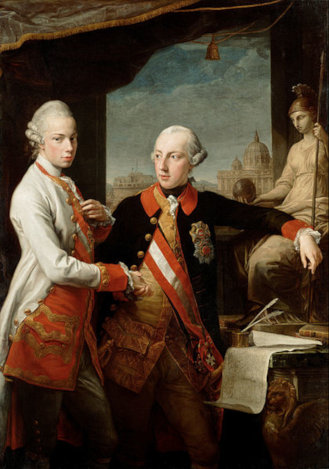 Take Josef Benedikt Anton Michael Adame, for example.
In my language, the name’s Joseph Benedict Anthony Michael Adam. But I’ll call him Joseph II, Holy Roman Emperor. Or just plain Joseph.
Joseph is the chap with the dark coat in that painting. It’s Pompeo Batoni’s 1769 portrait of Joseph and his brother, Peter, Grand Duke Leopold of Tuscany.
Grand Duke Leopold became the next Holy Roman emperor, and made a decent job of it. But I gather that Joseph is an Enlightenment superstar.
He arguably earned that reputation.
Joseph promoted education, confiscated monasteries and other church property, and made religious freedom a legal right. As long as folks didn’t get together for worship in groups of more than a hundred, and met in someone’s house.
Or, if they insisted on having more than a hundred present, their church didn’t look like a church and didn’t have a door opening onto a street.
Can’t have religious tolerance if folks go around worshiping any way they want, you know.
Anyway, some historians dubbed Joseph’s domestic policies Josephinism: hailing him as an “Enlightened ruler.”
I’ll give Joseph credit for sincerity, and for having the good sense to commission a Mozart opera and a Beethoven funeral cantata. Easing up on press and theater censorship strikes me as a good idea, too.
And maybe he really believed that monasteries were “sources of superstition.”
Anyway, Joseph’s officials took over the Manyava Skete on July 1, 1785. The monastery stayed closed until the 1990s, when the Soviet Union collapsed. Or was rebranded as the Russian Federation.6 And that’s yet another topic.
A Confiscation, a Purchase and an Abrupt Move

(From Google Maps, used w/o permission.)
(Bohorodchany, Ukraine, before the Russian invasion. (May 2015))
Three years after the Manyava Skete became government property, folks in Bohorodchany, some 16 miles north of Manyava, bought the monastery’s iconostasis.
They paid the equivalent of about $12 USD in today’s market.
Fast-forward more than a century. The iconostasis was still in Bohorodchany’s Church of the Holy Trinity. A Swiss-German journalist, Victor Tissot, wrote about the “precious monument” in the late 19th century.
Bohorodchany was near the front lines in August of 1914, during a Russian invasion.
A great many folks were getting out as fast as they could, when Austro-Hungarian troops rode into Bohorodchany.
The soldiers weren’t there to “liberate” the town. They and some of the locals dismantled and packed the town’s iconostasis into trucks. Then the soldiers took the pieces to a museum in Vienna.
Bohorodchany, by the way, isn’t a town. It’s an urban-type settlement, the same way Sauk Centre is a city.
Next stop for the Bohorodchany Iconostasis was the Royal Castle in Warsaw, Poland: a country that existed again, officially, after World War I.
If you think that all sounds complicated, then you’re right. If you want simple, read an airport novel7 or listen to political speeches; and that’s yet again another topic.
Events, 1924-2022

(From Kasia Strek and Smithsonian Magazine, used w/o permission.)
(Covering sculptures that can’t be moved in the Peter and Paul Garrison Church, Lviv.)
Fast-forward again, this time to 1924.
Paul Whiteman and his band played Gershwin’s “Rhapsody in Blue” in New York City’s Aeolian Hall, New York City.
The Ottoman Caliphate collapsed.
And Andrey Sheptytsky, the Ukrainian Greek Catholic Church’s Metropolitan Archbishop, bought the Bohorodchany Iconostasis.
Archbishop Sheptytsky had parts of the Bohorodchany Iconostasis displayed in the Lviv Ecclesiastical Museum.
 The Russian and Austro-Hungarian Empires had been fighting over who owned what parts of eastern Europe until World War I ended both Austria-Hungary and the old Russian Empire.
Parts of Ukraine became an anarchist state, followed by a succession of people’s republics, and were part of the Soviet Union when Hitler’s Germany and Stalin’s Russia invaded Poland in 1939.
After that, Hitler’s Germany invaded Ukraine.
Some Ukrainians saw the Wehrmacht as an improvement on Soviet rule. Understandably, I think, considering what Stalin’s Holodomor had done to them. And the churches which had been shut down by Stalin’s commissars.
That lot had the Bohorodchany Iconostasis dismantled, but not destroyed. I don’t know why, since they’d been eager enough where it came to destroying icons.
The commissars hung one of the massive work’s panels in a folklore museum and warehoused the rest in Lviv’s shuttered. Cathedral
Anyway, the 1939 Soviet-Nazi non-aggression pact lasted until 1941. After World War II ended, Ukraine’s Soviet rulers went back to protecting Ukrainians from poets, historians and other folks who use their brains. Then the Soviet Union dissolved.8
And now Putin’s military is back, killing Ukrainians.
War, Human Life, Art and Making Sense

(From Kasia Strek and Smithsonian Magazine, used w/o permission.)
(Bohorodchany Iconostasis panels, before they were packed and moved to safety. (2022))
 Oddly enough, Putin doesn’t seem to have thought of ‘de-Nazifying’ Russia.
That would make at least as much sense as his Ukrainian neo-Nazi hunt, since Russia’s leaders made a deal with Nazi Germany.
Maybe some notions are simply too daft for anyone to consider as an excuse for mass murder and/or genocide. And that’s still another topic, one that I’ve talked about fairly recently.
This week, I’ve been focusing on a particular item in Ukraine’s cultural heritage: the Bohorodchany Iconostasis.
Since I’ve been skipping lightly over dead Ukrainians littering the country’s streets, I’d better clarify a thing or two.
I don’t like war. It kills people and breaks things.
But sometimes it’s less bad than the alternative. So I won’t criticize Ukrainians who are trying to keep Russian troops from killing their neighbors. I’ve said this before.
If I had a choice between either saving a human life or preserving a work of art, I’d pick saving a human life.
But if I could do both, then that’d be my choice. So I think folks in Lviv who are taking portable artwork to relatively secure spots, and putting hopefully-protective covers over sculptures that can’t be moved, are doing a good thing.
There’s more to say, about iconostases — or would that be iconostasi? never mind — rood screens, religious art, and art in general. Lots more.
But I’m running out of time this week, so I’ll be brief. For me.
Creating art is part of being human. As such, it’s a good idea. Within reason. Creating religious art and using it to get closer to God is a good idea. Again, within reason. (Catechism of the Catholic Church, 2501-2503)
Finally, a reminder: comments and ‘likes’ should be possible again, now that I’ve made my Brendan’s Island website and this blog more secure.
So please, click the ‘like’ button. And if you’ve got something to say about this week’s topic(s) and what I’ve written, leave a comment.
Now, the usual links to more-or-less-related stuff:
- “Ukraine, Russia, Annexation; and Learning from History”
(April 30, 2022)
- “Ukraine: Invasion, Annexation, Labels, and a Good Idea”
(March 19, 2022)
- “Faustus: Good Angel, Bad Angel, Parma and Politics”
(January 29, 2022)
- “Notre-Dame, Paris: History, Two Cults and a Fire”
(September 9, 2021)
- “Christopher Marlowe and His World”
(March 6, 2021)
1 Manyava, mostly:
2 Kingdoms, kings and emperors:
- Wikipedia
- Internet Encyclopedia of Ukraine, Canadian Institute of Ukrainian Studies, University of Alberta/University of Toronto
- “The Race to Save Ukraine’s Sacred Art”
Joshua Hammer, Smithsonian Magazine (May 5, 2022)
- Iconostasis
Catholic Encyclopedia
3 House of Hapsburg:
4 Origins of an iconostasis:
- Wikipedia
- Internet Encyclopedia of Ukraine, Canadian Institute of Ukrainian Studies, University of Alberta/University of Toronto)
5 Bright ideals:
- Wikipedia
- My take
- “Sapere Aude!,” Immanuel Kant
Anja Steinbauer, Philosophy Now (2005)
6 ‘Isms,’ artists and history:
7 More history:
8 Still more history:
Like this:
Like Loading...