
Taking People, Pride and Dignity Seriously: June 2022

Luisa Madrid's photo of Queens Pride Parade in Queens, New York City. (June 3, 2018) via the La Guardia and Wagner Archives.
Queens Pride Parade; Queens, New York City (2018)

My news feed tells me it’s Pride Month. Or LGBTQ+ Pride Month. Wikipedia’s page implies that the correct term is LGBT pride.

Decades of experience, spanning McCarthyism’s dying gasps and the efflorescence of political correctness, suggest that I’ll offend someone: no matter what I say or how I say it.

So I’ll start by saying why I don’t think my native language, English, is perfect.

If it was, “pride” would arguably have single, specific meaning.

On the other hand, I could argue that English is wonderfully flexible; affording its users an abundance of nuanced denotations and connotations. And a metaphorical mine field of muddled meanings.

Take “pride,” for example.

  • Pride (Merriam-Webster)
    • inordinate self-esteem
    • a reasonable or justifiable self-respect
    • delight or elation arising from some act, possession, or relationship
    • proud or disdainful behavior or treatment
    • a company of lions

And that’s just a selection from one dictionary.

Since I’m a Catholic, I think pride is a bad idea. And, since “pride” has a whole mess of meanings, I’d better explain what I mean.


Dignity, Good Intentions and Bad Ideas

Rocky Kolberg's view of the Mount St. Helens mushroom cloud, taken 35 miles from the eruption. (May 18, 1980)
Putting “little less than a god” in perspective. Mount St. Helens eruption. (May 18, 1980)

For starters, self-respect can be reasonable.

The Catechism of the Catholic Church calls that sort of self-respect “dignity.” (Catechism, 357, 1700, 1701-1709, 2261, 2331-2336)

I can think about “pride” in the Catholic sense of “dignity” without pretending that humans and humanity are garbage.

“Then God said: Let us make human beings in our image, after our likeness….”
(Genesis 1:26)

“What is man that you are mindful of him, and a son of man that you care for him?
“Yet you have made him little less than a god, crowned him with glory and honor.
“You have given him rule over the works of your hands, put all things at his feet….”
(Psalms 8:57)

As I’ve said before, we’re pretty hot stuff. We really are “little less than a god:” with all the power, authority and responsibility that goes along with our nature.

But “little less than a god” isn’t God. Not even close. And that gets me back to pride.

Pride as a Capital Sin: Dignity on Steroids

Studio Foglio's Mr. Squibbs, used w/o permission.Pride tops the list of seven capital sins: pride, avarice, envy, wrath, lust, gluttony, and sloth or acedia.

They’re “capital” because they generally lead to more bad attitudes and behavior. (Catechism of the Catholic Church, 1866)

“Lust,” by the way, in this context, isn’t the same as experiencing human sexuality. (Catechism, 2331-2379)

It’s a “…disordered desire for or inordinate enjoyment of sexual pleasure….” (Catechism, 2351)

And “pride,” again in this context, is a disordered attitude:

PRIDE: One of the seven capital sins. Pride is undue self-esteem or self-love, which seeks attention and honor and sets oneself in competition with God. (1866)
(Catechism, Glossary)

This sort of pride is hubris: dignity on steroids, self-confidence above and beyond the call of reason. I’ve talked about that, mad scientists, and using our brains, before. Often.

A key word here, I think, is “disordered.”

Love, Respect and Making Sense

Detail of photo, St. Peter's Square, Vatican City. (2015) via Pontifical Council for the Promotion of New Evangelization, Vatican State, used w/o permission.
St. Peter’s Square, Vatican City. (2015)

Wanting respect is reasonable. I think folks who support Gay/LGBT Pride Month for that reason have a point.

I don’t agree with much of what’s said on the gay/LGBT pride issue.

But I won’t rant and rave, partly because I think that’d make no sense. And partly because of something I’ll get back to.

Basically, I should love God, love my neighbor, and see everybody as my neighbor. (Matthew 5:4344, 22:3640; Mark 12:2831; Luke 6:31, 10:2537; Catechism, 1789)

That’s everybody. No exceptions.

Loving and hating my neighbor isn’t possible. Not at the same time.

If I was a perfect person, living in a perfect world, loving each of my neighbors would be easy. I’m not, and this isn’t, so it’s not. Easy, that is.

But I have to try, anyway.

Like I said, love matters. That includes caring about other folks.

For much of my life, happily, I’ve known folks who care about my health and well-being.

Sometimes their love meant telling me that something I do is a bad idea. I didn’t enjoy the experience. Not at the time.

Good Intentions

An anonymous artist's rendering of the Book of Sirach, first chapter, German translation. (1654) via Wikimedia Commons, used w/o permission.Loving someone by ‘being nice’ won’t turn a bad idea into a good idea. A few things are bad ideas, no matter what.

Murder, killing an innocent person, is one of them. It’s a bad idea and I shouldn’t do it. (Genesis 4:10; Catechism, 2268-2279)

My gluttony, a disordered interest in food, doesn’t define my personal identity. But it’s an issue I deal with. It’s also a bad idea.

My wife knows that I like food ‘way too much. She’s told me that it’s a bad idea. A doctor said pretty much the same thing.

I didn’t like hearing that, but I agree.

My wife is a wise woman, so she has been working with me to change my eating and exercise habits. I haven’t consistently cooperated, but I’m learning.

But let’s say that she didn’t want to make me feel bad, and kept quiet. Or, worse yet, encouraged me to keep eating. That might have felt good, for a while.

I’d still have the weight and health issues that my behavior caused. Lying to me would have been a bad idea.

So, I think, would labeling me a wretched glutton, and saying that God hates me.

I don’t think that’d a reasonable response to anyone’s undesirable behavior. Besides, I’d be concerned about anyone who’d enjoy that sort of treatment.1

Bottom line? Although I’m responsible for what happens after I act, or don’t act; that responsibility may be reduced or nullified, due to “…ignorance, inadvertence, duress, fear, habit, inordinate attachments, and other psychological or social factors….” (Catechism, 1731-1735, 1789)

On the other hand, ‘I meant well’ won’t turn a bad idea into a good idea. (Catechism, 1789)

Gluttony and Social Stigma

Human Genome wall for SC99's photo: A fat mouse and a normal mouse.I talked about respect and dignity earlier. Basically, I’m obliged to show respect for the dignity of each person.

That seems reasonable.

Gluttony isn’t generally considered a good idea in today’s America, but my appearance doesn’t make me a pariah.

That’s a bit odd, or maybe not so much.

My weight isn’t what’s odd. It’s simple cause-and-effect. I’ve eaten too much, and not exercised enough. My obesity probably isn’t just caused by gluttony, by the way. It’s complicated, and that’s another topic.

What’s odd is not being shunned, or worse, because of my weight. I’m pretty sure that fitness fiends wouldn’t use me as a role model, not a positive one. But they’re easy to avoid or ignore.

The point is that I haven’t spent a lifetime dealing with folks who seemed determined to fill me with guilt and shame. I’ll grant that some health fanatics can be a tad overbearing.

That’s what’s odd, since obesity hasn’t been a status symbol since the Renaissance. Current American culture views gluttony, an obvious cause of obesity, as a bad idea. The attitude isn’t entirely wrong.

But I don’t remember running into anyone who attacked fat folks for ‘religious’ reasons. Not with the hatred I’ve seen expressed against folks with unusual sexual desires. Why that is, I don’t know.

Seven Sins

Stradanus' illustration for Dante's Inferno, Canto 6: gluttony. (1587)Gluttony is one of the seven capital sins. I mentioned them before. So is “sloth,” which isn’t laziness.

Not in this context, at any rate.

The ‘seven capital sins’ sloth is acedia, a lack of spiritual effort, refusing to ‘work out my salvation.’2 (Philippians 2:12, 3:20; Catechism, 1949, 2094, 2733)

“Pride” again, is self-esteem above and beyond the call of reason.

Humility, acknowledging reality, is pride’s antidote.3

One reality I must acknowledge is that letting my desires and impulses control what I eat is a bad idea.4 No amount of positive self-talk will change that.

Neither would throwing myself into the fat acceptance movement’s silly side. I’ll admit that I might enjoy organizing a ‘fat pride day’ protest. For the wrong reasons. There’s a sardonic streak in me that’s not good. And that’s yet another topic.

Acting Like Love Matters: A Good Idea

Etching by B. Picart, after C. Le Brun: 'A frontal outline and a profile of faces expressing anger. (1713)Condemning someone whose impulses aren’t like mine seems silly.

Self-righteous indignation at the actions of other sinners seems imprudent, at best. My own track record is far from spotless.

I think homosexual acts are bad idea.5 I emphatically also must think that everyone deserves respect and reasoned compassion; not unjust discrimination. (Catechism, 2357-2359)

Imprudent over-corrections of past injustices are, I think, understandable. But as I’ve said, good intentions won’t turn bad ideas into good ones.

Nothing I say or do can solve every problem we face. I am equally powerless to undo injustices like murders at the Pulse nightclub in 2016.6

But I can suggest that love is a good idea. So is acting like love matters.


Nostalgia, Tradition and Traditions

Unknown artist's illustration of Chickenman, Dick Orkin's fictional not-so-superhero; who opposed 'crime and/or evil' on radio in the 1960s.Even if I could, I wouldn’t take America back to the ‘good old days’ before 1965, 1954, 1933, 1848,7 or some other imagined ‘Golden Age.’

Today’s America is far from perfect, too.

That leaves one direction: forward.

Not yearning for a bygone era may seem odd, coming from a Catholic.

I’ve been asked why I think my beliefs matter in today’s world.

The question makes sense, given all-too-common attitudes.

Some Christians act as if nostalgia and faith were synonyms.

Sometimes I run into a Catholic who says Vatican II ruined everything. Some of these folks formed their very own little churches, convinced that they’re the only Catholics left.

I wasn’t a Catholic before Vatican II, so my childhood memories include pleasant experiences in a Protestant church.

Even if I was a ‘cradle Catholic,’ I hope I’d have the good sense to see a difference between Tradition and tradition.

Tradition with a capital “T” is the living message of the Gospel, maintained and passed along through the millennia. It doesn’t change. (Catechism, 75-83)

Some of our traditions, lower-case-“t,” are important, too. But they’re not set in stone. Sometimes they stop being useful. Then it’s time to change or drop them. This is okay. (Catechism, 83)

Moving Forward

Screenshot from a 20th Century Fox trailer for 'Gentlemen_Prefer_Blondes.' Marilyn Monroe and men in formal suits and vests. (1953) via Wikipedia, used w/o permission.America in the 1950s was a ‘Golden Age’ for some folks.

I remember the trailing edge of their ‘good old days,’ and my memory’s pretty good.

I remember when someone had to look more-or-less like me to get a decent job, and when “she’s smart as a man” was supposed to be a compliment.

The ‘good old days’ — weren’t. And I thank God they aren’t coming back.

Many long-overdue reforms which began in my youth haven’t turned out as I had hoped. But on the whole, I like living in today’s America. It’s not perfect. But that’s true of every society, today or in the past.

I must do what I can to help make tomorrow’s America, and world, better. (Catechism, 1913-1916, 2239)

There isn’t much I can do to change my nation, much less the world. But I can do something about myself.

Not Easy, But a Good Idea

NASA's image of Earth, from the Rosetta spacecraft's narrow-angle camera from a distance of 633 000 kilometers (393,300 miles). (November 12, 2009)Changing the world starts inside me, with an ongoing “inner conversion.” (Catechism, 1886-1889)

Unless I act as if I think people matter, I can hardly expect folks to take me seriously.

Not when I talk about love, justice, charity, and respect for “the transcendent dignity of man.” (Catechism, 1928-1942, 2419-2442)

And I certainly shouldn’t imagine that I’m one of the “righteous” few. Life isn’t that simple. Neither are issues we’re dealing with.

“…Here I think of the political history of the United States, where democracy is deeply rooted in the mind of the American people. All political activity must serve and promote the good of the human person and be based on respect for his or her dignity….

“…A delicate balance is required to combat violence perpetrated in the name of a religion, an ideology or an economic system, while also safeguarding religious freedom, intellectual freedom and individual freedoms. But there is another temptation which we must especially guard against: the simplistic reductionism which sees only good or evil; or, if you will, the righteous and sinners….”
(“Visit to the Joint Session of the United States Congress,” Pope Francis8 (September24, 2015))


I’m Not Normal

Brian H. Gill. (March 17, 2021)Earlier, under the Love, Respect and Making Sense heading, I said that “I won’t rant and rave” about gay/LGBT pride issues “partly because of something I’ll get back to.”

Here’s where I get back to that.

As I said a couple months back, I don’t do “conventional.” Small wonder, considering what’s shown up in my medical records:

  • ADHD: Attention deficit hyperactivity disorder, inattentive type
  • ASD: Autism spectrum disorder
  • Cluster A personality disorder
  • GAD: Generalized anxiety disorder
  • PDD: Persistent depressive disorder
  • PTSD: Post traumatic stress disorder

I’m not even conventionally unconventional. Take Cluster A personality disorder and me, for example.

Almost Fitting Into a Cluster, But Not Quite
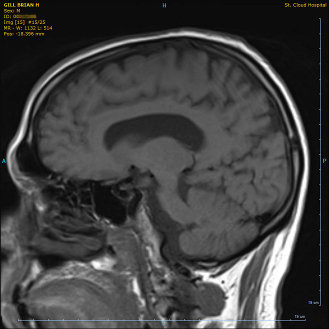
An image from Brian H. Gill's brain scans in 2018.Mayo Clinic says Cluster A personality disorder comes in three flavors:9

  • Paranoid personality disorder
  • Schizoid personality disorder
  • Schizotypal personality disorder

I come under the schizotypal type, characterized by:

  • Peculiar dress, thinking, beliefs, speech or behavior
  • Odd perceptual experiences, such as hearing a voice whisper your name
  • Flat emotions or inappropriate emotional responses
  • Social anxiety and a lack of or discomfort with close relationships
  • Indifferent, inappropriate or suspicious response to others
  • “Magical thinking” — believing you can influence people and events with your thoughts
  • Belief that certain casual incidents or events have hidden messages meant only for you

I can see it.

“Peculiar dress,” not so much. Unless you count my beard and hair.

Beliefs? I’m an American who was raised as a Protestant and became a Catholic: so, yeah. That’s a bit peculiar. Plus, I talk like a college professor. Sometimes like a ’60s or ’70s stereotype interior decorator.

“Odd perceptual experiences?” Not the hallucinatory sort. Except back when I was recovering from losing one of our kids. I kept hearing my computer’s hard drive rattling, when it wasn’t; and that’s yet again another topic.

“Flat emotions?” Oh, boy, no: anything but. Inappropriate, maybe.

Social anxiety and all that? My life might have been less interesting if I had been plagued by social anxiety. More topics.

The rest: indifferent or otherwise odd responses to others?

Maybe I’ve exhibited an indifferent response, somewhere in the last seven decades. But not, I think, often. My emotional responses tend to be on a scale from ‘intense’ to ‘extreme.’

Odd, maybe. I have had to learn, for example, that many folks take politics and politicians very seriously — even when I see a darkly humorous side.

“Magical thinking” and imagining that I’m getting secret messages? No. Not happening.

Fitting a Profile

Illustration of 'icepick' lobotomy, from Dr. Walter Freenan II's 'Psychosurgery in the Treatment of Mental Disorders and Intractable Pain.' (1950)We’ve learned a great deal about psychiatric and personality disorders since my childhood and youth.

Folks with issues like mine often get spotted early and treated these days.

Sometimes successfully.

I wasn’t. Not until I was into middle age.

Which may be just as well, since lobotomies were still somewhat fashionable in my ‘good old days,’10 which is another reason I don’t miss them, and that’s still another topic.

Then there’s what a career counselor asked me, back in the ’70s.

I’d been having my usual frustrating experience, being one of the 99-plus out of a hundred or so job applicants who didn’t get hired. I’ve since learned that my affect or affect display isn’t squarely on the 50th percentile, which didn’t help.

“Affect display” is psychobabble for verbal and non-verbal displays of emotion.11 I’m a very emotional man, and — well, apparently I don’t consistently act normal.

Anyway, back to frustrations, me, and a career counselor. We’d been discussing incentives I might offer a potential employer, including government funding.

He asked me if I was homosexual. Turns out, the question made sense: during the ’70s in the Upper Midwest, at any rate. For one thing, bias against homosexuals made — I think it was still called affirmative action — an option.

For another, I fit the profile.

I’m creative, articulate and not obsessed with sports. I can’t swear, some four decades later, to “articulate” being in the mix. But I’m pretty sure that talking like I was at least a little smart was part of the reason I fit the homosexual profile.

But, despite fitting the profile, I’m not homosexual. Which is no great virtue. I’ve got issues, lots of issues: but not that particular one.

Learning that nice, normal folks might perceive me as homosexual, however, explained a few otherwise puzzling interactions I’d had.

Odd Urges and Malignant Virtue

'I'd force peace right down their bloodthirsty throats.' Deacon Mushrat in Walk Kelly's Pogo. (1952)And it’s helped me both appreciate the experiences of folks who do deal with odd urges, and sympathize with those who’ve tangled with the malignant virtue of self-appointed guardians of society.

“Malignant virtue” is a phrase I first ran across in a Lord Peter Wimsey novel, although it’s been around at least since the 1860s.

“There are times, Charles, when even the unimaginative decency of my brother and the malignant virtue of his wife appear to me admirable.”
(Lord Peter Wimsey, in “Murder Must Advertise,” Dorothy L. Sayers (1933))

“…counting every thing which the most malignant virtue could shrink from, I have culled eighty lines. Eighty lines out of nine thousand!…”
(“The Good Gray Poet. A Vindication,” William Douglas O’Connor (1866))

And that’s — you guessed it — even more topics.

Maybe most Americans, by now, realize that a man can be smart, creative, not experience withdrawal if deprived of daily sports news highlights — and have heterosexual orientation despite all that.

Then again, maybe not. I’ve gotten the impression that sincerely-held beliefs don’t fade easily, no matter how wacky they are.

So I won’t hope to change anyone’s mind about good guys and bad guys, neo-Nazis and pinko scum, or whatever.

“Respect, Compassion, and Sensitivity” — Makes Sense to Me

New York World-Telegram and the Sun staff photographer C. M. Stieglitz's photo:Robert Thompson and Benjamin J. Davis: accused of improper political views. (1949)But I will suggest that maybe, just maybe, folks who deal with disorders are still folks: real people, not monsters or cardboard-cutout bogeymen.

Even if my background and personality didn’t make the idea seem reasonable, accepting folks who aren’t perfect comes with being a Catholic.

“The number of men and women who have deep-seated homosexual tendencies is not negligible. This inclination, which is objectively disordered, constitutes for most of them a trial. They must be accepted with respect, compassion, and sensitivity. Every sign of unjust discrimination in their regard should be avoided. These persons are called to fulfill God’s will in their lives and, if they are Christians, to unite to the sacrifice of the Lord’s Cross the difficulties they may encounter from their condition.”
(Catechism, 2358)

I’m about as sure as I can be about anything, that relabeling a disorder as ‘normal’ won’t make everything better.

Then there’s the matter of conflating ‘normal,’ ‘good,’ and ‘acceptable.’ And that’s a can of worms I’ll leave for another time. Can of worms? Make it a barrel.

I’ve talked about this sort of thing before, and probably will again:

1 Disorders my culture recognizes:

2 Acedia and other issues:

3 Humility, in the Catholic sense, is acknowledging reality and giving God due credit; I’ve talked about that before:

4 Experiencing desires and emotions is part of being human; so is thinking, or should be:

5 Insights from:

6 As song said, “nobody’s right if everybody’s wrong:”

7 Assorted recent milestones — or — the end of civilization as they knew it:

8 About freedom:

9 Clusters A through C, mostly B:

10 It slices! It dices! It wins a Nobel Prize!

11 Acting weird:

Posted in Being Catholic, Discursive Detours | Tagged , , , , , , | Leave a comment

Learning Something New: WordPress Blocks

I’ve known for some time that WordPress, the content management software this blog uses, has been encouraging folks like me to stop using its “classic” user interface and start using blocks.

Blocks, it seems, are the best thing since sliced bread. They’re the bee’s knees and the snail’s eyebrows.

Blocks make creating rich content easy as falling off a log. They’ll inspire me to create new pages in a flash.

Although apparently I don’t need Adobe Flash to make blocks work.

Which is just as well, since I wasn’t planning on using Flash media.

At any rate, I kept putting off using WordPress blocks. Previous experiences suggested that anything that wonderful and stupendous, that easy-to-use and likely to make my life so much easier — would be far more trouble than it was worth.

So I kept putting off what I suspected would be a steep, as in near-vertical, learning curve.


Then I realized that WordPress had been warning folks like me that their classic user interface would be supported until 2022. And that it was high time for me to start climbing that curve.

So far, I’ve been pleasantly surprised. And have found a pretty good how-2 tutorial page.

I’ve also learned that the Block Editor, the way I’m using it at any rate, won’t show rich content that I’ve created: if the rich content isn’t quite what the Block Editor expected.

There are less anthropomorphic ways of saying that, but I figure you know what I mean.

For me, so far, this week has been good news. And will almost certainly give me more opportunities for practicing patience.

Looking back, I’ve been paying more attention to the technical side of blogging this year. And that’s another topic.

Posted in Journal | Tagged , , | Leave a comment

Curiosity and Science, Intent and Wisdom 11:22

Louis William Wain's (1860-1939) 'A curious cat.' Originally a gift from the artist to Ernest Ralph, Wain's barber in Napsbury. (ca. 1930)
(From Bonhams auction house, used w/o permission.)
(Louis William Wain’s “A curious cat.” (ca. 1930))

As a behavior, curiosity is part of being a rat, a cat, or a human.

In humans, at least, it’s also an emotion.

Whether the decline in curiosity exhibited by many of us as we mature is a natural process, or is the result of education1 — that’s a can of worms I’ll ignore today.

Cultural values very likely also encourage, or discourage, curiosity. Happily, there’s more to my native culture than this proverb:

“Curiosity killed the cat,” meaning:

  • Curiosity can get you in trouble sometimes
    (Common Proverbs, LSI Education, London)
  • Stop asking questions
    (English idioms, Resources for learning English, EF/Education First)

Mad Scientists and Being Human

Studio Foglio's Mr. Squibbs, used w/o permission.Again, there’s more to my culture’s attitude toward curiosity than “stop asking questions.”

Although you’d never know it from our tales of mad scientists, rife with warnings against the folly of “tampering with things man was not supposed to know.”

Dr. James Xavier: “I’m blind to all but a tenth of the universe.”
Dr. Sam Brant: “My dear friend, only the gods see everything.”
Dr. James Xavier: “My dear doctor, I’m closing in on the gods.”
(“X: The Man with the X-Ray Eyes” (1963), via IMDB.com)

In contrast, we’ve got folks like Chesterton and Samuel Johnson.

“There is no such thing on earth as an uninteresting subject; the only thing that can exist is an uninterested person.”
(“Heretics,” Chapter III: “On Mr. Rudyard Kipling and Making the World Small”, G. K. Chesterton (1905) via Wikiquote)

“Curiosity is one of the permanent and certain characteristics of a vigorous intellect.”
(“The Rambler,” Samuel Johnson (1750-1752) via Wikiquote)

My view is close to Chesterton’s, that there’s no such thing as an uninteresting subject. But that’s my preference, or opinion. It matters to me, but isn’t therefore a universal truth.

So, is curiosity a good idea or a bad one?

St. Augustine, Ignorance, Foolishness and Metaphorical Cloaks

A frontispiece for 'Historia Mundi Naturalis,' by Pliny the Elder, published Sigmund Feyerabend, Frankfurt am Main. (1582)As usual, it’s not that simple.

Neither is what St. Augustine of Hippo had to say about curiosity in his “Confessions.”

“Notwithstanding, in how many most petty and contemptible things is our curiosity daily tempted, and how often we give way, who can recount?”
(“Confessions,” Book X, St. Augustine of Hippo (ca. 400 A.D.) Trans. Edward Bouverie Pusey, via Gutenberg.org)

Curiosity makes semblance of a desire of knowledge; whereas Thou supremely knowest all. Yea, ignorance and foolishness itself is cloaked under the name of simplicity and uninjuriousness;
(“Confessions,” Book II, St. Augustine of Hippo (ca. 400 A.D.) Trans. Edward Bouverie Pusey, via Gutenberg.org)

Making sense of curiosity, and avoiding foolishness, wasn’t any easier 14 and a half centuries after St. Augustine of Hippo wrote his “Confessions.” And wasn’t any less controversial, I strongly suspect.

Science, Social Justice and Getting a Grip

Wiley Miller's Non Sequitur: The Church of Danae vs. logic and the laws of physics. (August 24, 2016) used w/o permission.Not quite a millennium and a half after St. Augustine of Hippo’s day, Vincenzo Gioacchino Raffaele Luigi Pecci became Pope Leo XIII.

The late 19th century was not good times for folks who like the status quo.

New ideas and festering old attitudes were getting along about as well as fire and oil, cobra and mongoose.

From 1878 to 1903, Pope Leo XIII insisted that both socialism and laissez-faire capitalism were bad ideas, and that workers deserved decent wages and safe working conditions.

I figure he upset a great many folks, and I think that he was right.

Oversimplifying Pope Leo XIII’s position on social justice, science, and theology, something fearful: he reminded us that both God and truth matter. And that neither is going to get in the way of our faith.

Seems obvious, putting it that way. To me, at any rate. But I wasn’t brought up believing that faith meant putting my mind on “hold.”

Meanwhile, Darwin’s “Origin of Species” mixed with the efforts of liberal Anglicans to pry England’s schools loose from Henry VIII’s state church.

With results similar to what you’d get from a blender set to “puree,” with the lid off.

Meanwhile, archaeology was becoming less of an amateur treasure-hunting sport and more of a legitimate scholarly pursuit. And, perhaps inevitably, we got both ‘Biblical archaeology’ and ‘Bible science,’ AKA ‘creation science.’

Happily, somewhere in the early to mid 20th century, ‘Biblical’ archaeologists started focusing more on unraveling part of humanity’s long story, and less on confirming their assumptions. Stalwart anti-evolutionists, on the other hand, carried on.2

I’ll give ardent champions of both ‘Biblical’ studies credit for enthusiasm and imagination.

Making Sense and Other Alternatives

ArchonMagnus' diagram of scientific method.But deciding what’s real first, and then selecting facts that fit the preferred conclusion?

I can’t see that as a good idea.

Starting with a conclusion, making up questions that’ll prove it, and then picking facts that give the ‘right’ answers is pretty much the opposite of scientific method.3

That sort of alleged “science,” used as arguments for believing what folks like Ussher said the Bible says? It’s not just bad science. It’s “faith” based on fictions. Or, at best, based on codified folklore.

I’ll grant that ‘creation science’ media has been a tried and true staple for some — not all — Christian retailers.

But I also think that real-world analogs to Non Sequitur’s “Church of Danae” encourage the notion that religion in general and Christianity in particular don’t make sense.

Lovecraft’s “Placid Island of Ignorance”

Nottsuo's 'Shoggoth.' (2016)Then there’s H. P. Lovecraft and his “placid island of ignorance” attitude.

Lovecraft apparently started out as a conventional American Protestant.

Then, in 1902, he started learning about space, got interested in astronomy, and realized that this universe is really, really big.

That, World War I, plus Lovecraft’s interest in Nietzsche and Mencken, gave us his cosmicism philosophy and the Cthulhu mythos.4

I like reading tales like “The Call of Cthulhu,” but don’t share his attitude toward the “terrifying vistas of reality, and our frightful position therein….”

Possibly because my faith didn’t require that I see Earth as the center of everything before I became a Catholic, and still doesn’t.

“…The most merciful thing in the world, I think, is the inability of the human mind to correlate all its contents. … The sciences, each straining in its own direction, have hitherto harmed us little; but some day the piecing together of dissociated knowledge will open up such terrifying vistas of reality, and of our frightful position therein, that we shall either go mad from the revelation or flee from the light into the peace and safety of a new dark age….”
(“The Call of Cthulhu,” H. P. Lovecraft (1929); via WikiQuote)


A Pope, a Saint, the Bible, and “Terrifying Vistas”

Detail, Hubble Space Telescope's ACS' view of NGC 602 and N90. (July 14/18, 2004) from NASA/Hubble, used w/o permission. (NGC 602 is an open cluster of stars in the Small Magellanic Cloud.)Before looking — make that glancing — at what St. Thomas Aquinas said about curiosity, here’s how Pope Leo XIII, St. Augustine of Hippo and the Bible say about those “terrifying vistas.”

“…God, the Creator and Ruler of all things, is also the Author of the Scriptures — and that therefore nothing can be proved either by physical science or archaeology which can really contradict the Scriptures. … Even if the difficulty is after all not cleared up and the discrepancy seems to remain, the contest must not be abandoned; truth cannot contradict truth….”
(“Providentissimus Deus,” Pope Leo XIII (November 18, 1893) [emphasis mine])

Question the beauty of the earth, question the beauty of the sea, question the beauty of the air…. They all answer you, ‘Here we are, look; we’re beautiful.’…
“…So in this way they arrived at a knowledge of the god who made things, through the things which he made.”
(Sermon 241, St. Augustine of Hippo (ca. 411) [emphasis mine])

“Indeed, before you the whole universe is like a grain from a balance,
or a drop of morning dew come down upon the earth.
“But you have mercy on all, because you can do all things;
and you overlook sins for the sake of repentance.”
(Wisdom 11:2223 [emphasis mine])

God looked at everything he had made, and found it very good. Evening came, and morning followed—the sixth day.”
(Genesis 1:31 [emphasis mine])

Lovecraft Lives??

E. J. Pace's 'The Descent of the Modernists,' from 'Christian Cartoons.' (1922)(From E. J. Pace, via Wikimedia Commons, used w/o permission.)
(A scary picture from “Christian Cartoons,” E. J. Price. (1922))

Another quote/excerpt, partly because I like the title’s take on “curiosity killed the cat,” and partly because “being lost in a mysterious universe without having any purpose” sounds downright Lovecraftian.

Curiosity killed the cat, but it may help you get the Nobel prize
BioFrontiers Institute, University of Colorado (March 17, 2017)

“I don’t feel frightened by not knowing things, by being lost in a mysterious universe without having any purpose — which is the way it really is so far as I can tell — it does not frighten me.”
(Richard Feynman, The Pleasure of Finding Things Out)

I don’t see a point in being frightened by what humanity hasn’t learned yet, or by what we have been learning.

As for being lost in this universe, that’s really not an issue; since I’ll be spending my life here on Earth. Only a few folks have left humanity’s home, and then only for a few days. So far. And that’s another topic.

Living in a Vast and Ancient Universe
Collage of Andrew Z. Colvin's 'Earth's Location in the Universe' diagrams, via Wikimedia Commons.

In any case, I’m a Catholic.

My faith doesn’t depend on opinions held by Ussher or any other European scholar, a few centuries back: before we began learning how vast and ancient this universe is.

Detail, 'The Carina Nebula: Star Birth in the Extreme,' The Hubble Heritage Project. Space Telescope Science Institute. (April 24, 2007) Via Wikimedia Commons.And it’s sure not threatened by knowledge of this wonder-packed universe. Or, for that matter, by what we don’t know.

“No matter where and how far we look, nowhere do we find a contradiction between religion and natural science. On the contrary, we find a complete concordance in the very points of decisive importance. Religion and natural science do not exclude each other, as many contemporaries of ours would believe or fear. They mutually supplement and condition each other. …”
“…Religion and natural science are fighting a joint battle in an incessant, never relaxing crusade against scepticism and against dogmatism, against disbelief and against superstition, and the rallying cry in this crusade has always been, and always will be: ‘On to God!’
(“Religion and Natural Science,” Lecture about the relationship between religion and science. Originally entitled Religion und Naturwissenschaft. (1937) Complete translation into English: “Max Planck: Scientific Autobiography and Other Papers” (1968); via Wikiquote [emphasis mine])

“The heavens declare the glory of God;
the firmament proclaims the works of his hands.”
(Psalms 19:2)


“The Vice of Curiosity?”

Detail, Gentile da Fabriano's 'Coronation of the Virgin,' gable painting, right inner panel, showing St. Thomas Aquinas.' (ca. 1400)Now, finally, a (very) little of what St. Thomas Aquinas said about “the vice of curiosity” in “Summa Theologica.”

“…As stated above (II-II:166:2 ad 2) studiousness is directly, not about knowledge itself, but about the desire and study in the pursuit of knowledge. Now we must judge differently of the knowledge itself of truth, and of the desire and study in the pursuit of the knowledge of truth. For the knowledge of truth, strictly speaking, is good, but it may be evil accidentally, by reason of some result, either because one takes pride in knowing the truth, according to 1 Corinthians 8:1, ‘Knowledge puffeth up,’ or because one uses the knowledge of truth in order to sin….”
(“Summa Theologica,” Second Part of the Second Part, Question 167; St. Thomas Aquinas (13th century) Trans. Fathers of the English Dominican Province (1920) via NewAdvent [emphasis mine])

First off, the “accidentally” St. Thomas Aquinas talks about here isn’t the “I ran off the road accidentally” sense of the word.

An “accident” can be an unplanned event, a fallacy, an abrupt geological discontinuity, or a philosophical idea. Then there’s Accident, Maryland, and that’s yet another topic.5

In context, I’m pretty sure that this “accidentally” is the philosophical variety: a property something has which is not part of its essential nature, and which can change.

A brick, for example, could be painted brown, blue or green. But it would still be a brick. The brick’s colors are there “accidentally,” while the brick remains essentially a brick.

So, if knowledge of truth truth is basically good, how could it possibly be bad?

Pretty easily, actually, since we have free will and have been dealing with consequences of a really daft decision. (Genesis 1:31; 3:1-19; Catechism of the Catholic Church, 385-412, 1730-1742)

Quarks, Truth and Intent

The 'Flammarion Woodcut, from his 'L'Atmosphère: Météorologie Populaire.' (1888)Next, “Summa” shows us how someone can use studiousness for a wrong reason.

I gather that it’s a matter of intent. (Catechism, 1750-1756, 1789)

“…for instance those who study to know the truth that they may take pride in their knowledge. Hence Augustine says (De Morib. Eccl. 21): ‘Some there are who forsaking virtue, and ignorant of what God is, and of the majesty of that nature which ever remains the same, imagine they are doing something great, if with surpassing curiosity and keenness they explore the whole mass of this body which we call the world. So great a pride is thus begotten, that one would think they dwelt in the very heavens about which they argue.’…”
(“Summa Theologica,” Second Part of the Second Part, Question 167; St. Thomas Aquinas (13th century) Trans. Fathers of the English Dominican Province (1920) via NewAdvent [emphasis mine])

I don’t run into scientific triumphalism nearly as much now as I did in my youth. Although now and again I read someone’s rehash of ‘now that we understand the laws of nature.’

Cush's diagram of Standard Model of elementary particles, plus hypothetical gravitons. (2017)And I suspect that scientists are becoming less the old-school aristocratic scholars, and more a bunch of giddy nerds.

I mean to say, giving newly-discovered elementary particles monikers like “quark” and “gluon” — which come in red, green, blue and five other color singlet states?6

I strongly suspect they’re having fun, as well as trying to unscrew the inscrutable. And that’s yet again another topic.

Or maybe not so much. I like the informal turn science seems to have been taking, but don’t and won’t claim that ‘through nerdishness shalt thou be savethed.’

I’m pretty sure that a nerd could get as self-absorbed as the stuffiest stuffed-shirt man of science.

To Be Continued
Hubble Space Telescope's ACS image: NGC 602 and N90 in the Small Magellanic Cloud. With Wisdom 11:22 text.

The trick, for me at least, is remembering that God’s God, I’m not — for which we should all be thankful. And that’s still more topics.

I had more to say about Question 167, Second Part of the Second Part, in “Summa Theologica:” including why I started reading it. But I’ve run out of time this week, so that must wait.

Thanks for reading this — and please click the “Like this” button, below.

That’s all I’ve got this week, except for the usual links:


1 Being interested

2 A Saint, a pope, an activist, history and weirdness:

3 Dealing with truth, one way or another:

4 On the edge of “terrifying vistas:”

5 Philosophy and a town in Maryland:

6 It’s elementary:

Posted in Discursive Detours | Tagged , , , | Leave a comment

A Roman Founding Myth and Aeneas, Action Hero

Agostino Carracci's 'Aeneas and his family fleeing Troy.' (1595)
(From Agostino Carracci, via The Metropolitan Museum of Art, Wikimedia Commons; used w/o permission.)

I figure folks have been hankering for the ‘good old days’ since long before we started keeping written records. And occasionally preserving them.

The records, I mean. Not the ‘good old days.’

Change happens, which is anything but a new idea.

“πάντα χωρεῖ καὶ οὐδὲν μένει”
“Everything changes and nothing stands still.”
(Heraclitus; (ca. 500 B.C.) via Plato’s “Cratylus,” Diogenes Laërtius in “Lives of the Philosophers” Book IX, section 8; one of many translations/Wikiquote)

Since I’m a Catholic, I think this universe is in a “state of journeying,” “in statu viae.” It’s moving toward an ultimate perfection, but isn’t there yet. Everything and everyone in this world helps move it along. (Catechism of the Catholic Church, 302, 306-308)

Or gets in the way.

We’ve got free will. Folks sometimes behave badly. But, happily, God is large and in charge. We do have reason to keep hoping. And working to make this a better world. (Catechism, 268-274, 309-314, 1730-1742, 1817-1821, 1928-1942, 2415-2449)


Large and In Charge? God, Human Nature, and Consequences

Location of Robb Elementary School in Uvalde, Texas. Wikipedia Maps.The mass murder in an Uvalde, Texas, elementary school has been headline news this week, so I’d better clarify “God is large and in charge;” and why my faith isn’t shaken when someone decides to hurt others.

God makes everything. Including us. God said that everything and everyone is “very good.” Then the first of us decided that their ‘I want’ outranked their relationship with God. We’ve been making daft decisions ever since. (Genesis 1:31; 3:1-19; Catechism, 385-412)

As I see it, humanity and human nature was and is basically good. But we’re wounded, dealing with consequences of a very bad decision.

I suppose God could have overridden our free will, making us into nice and orderly little robots. Can’t say that I see that as an appealing idea.

Instead, we’re still human: with all the authority, power and responsibility that goes along with our nature. I’ve talked about that before.1


This Week: Golden Ages, Troy and a Founding Myth

Screenshot from a 20th Century Fox trailer for 'Gentlemen_Prefer_Blondes.' Marilyn Monroe and men in formal attire. (1953) via Wikipedia, used w/o permission.Although I’ll occasionally get nostalgic, I’m convinced that trying to drag society back to some imagined golden age is impossible.

Which is a good thing, since the ‘good old days’ I remember — weren’t.

And I’m as sure as I can be, that we’ve never had Hesiod’s Golden Age.

Although some ‘good old days’ were objectively better than an unpleasant present.

This week I’ll be talking about Hesiod’s and other golden ages, Troy and the Late Bronze Age collapse, and one of Rome’s founding myths.


Once and Future Golden Ages

Scott Adams' 'Dilbert.' Dogbert's Good News Show. (April 30, 1993
(From Scott Adams, used w/o permission.)

Calling the ‘good old days’ a Golden Age arguably started with Hesiod’s “Works and Days,” composed around 700 B.C. — assuming that Hesiod was Hesiod and that’s another topic.

At any rate, Hesiod described five ages: Golden, Silver, Bronze, Heroic and Iron.

Everybody got along during Hesiod’s Golden Age, nobody got old and everyone had enough to eat. Then pretty much everything and everyone went downhill.

Hesiod said that his ‘now’ — when the population of places like Athens and Knossos had grown to maybe 5,000 — was the Iron Age. And that life in the Iron Age is all toil and hardship, with nothing but the decline of all moral and religious standards ahead.

Sounds a lot like the doomsayers of my youth, actually.

And today’s headlines: not the same bogeymen, but the same ‘we’ll all die’ attitude.

Hesiod-style Golden Ages and their lower-case ‘good old days’ metaphoric analogs have been endemic in Western civilization ever since. Alternating with the equally-sensible apocalyptic visions of scaremongers.

Seeing ‘today’ as less than ideal isn’t uniquely Greek, or Western.

Yongxinge's photo: detail of a painting in the Long Corridor, Summer Palace, Beijing. (2006) Folks in south Asia have the Satya Yuga, AKA Krita Yuga, segment of the Yuga Cycle.

Folks in one of my ancestral homelands looked forward, if you can call it that, to Ragnarök: which would be anything but a golden age.

On the other hand, Völuspá says that survivors will get together on Iðavöllr and build the city of Gimlé. All of which is debatable and debated,2 although I see it as an example of a ‘good old days’ or golden age that hasn’t happened yet.

Fear, Phaedrus and Social Media

Hedwig Storch's photo of Thutmosis III cartouches in the temple at Deir el-Bahari. Photo taken May 14, 2011I see many ‘good old days’ and ‘golden ages’ as at least partly subjective.

Take Plato’s somewhat crotchety Socrates, in “Phaedrus,” for example.

“…this discovery of yours will create forgetfulness in the learners’ souls, because they will not use their memories; they will trust to the external written characters and not remember of themselves. … you give your disciples not truth, but only the semblance of truth … they will appear to be omniscient and will generally know nothing; they will be tiresome company, having the show of wisdom without the reality…”
Phaedrus,” Plato, (ca. 370 B.C.) Benjamin Jowett, trans; via Project Gutenberg)

“External written characters” weren’t exactly new in Socrates’ day. Folks in Greece had been adapting Phoenician script to their language for at least three and a half centuries.3

But judging from Plato’s version of Socrates’ viewpoint, writing was still a newfangled and potentially disruptive force. In the eyes of folks who put high value on rote memorization, at any rate.

Ironically, we know about Socrates mainly because Plato and others wrote down his ideas. And that’s yet another topic.

Or maybe not so much.

Plato’s Socrates saw writing as something that would keep folks from really thinking about ideas. Sort of like today’s fears that social media makes folks into shallow nitwits.

More than 23 centuries later, I think Plato’s Socrates was right. Sort of.

I learned to read as a child, and have read a great deal. But I can’t recite even a short poem like Tennyson’s “Ulysses” from memory. Not without re-reading and rehearsing it.

My rote memory skills aren’t what they would have been in an unlettered society.

On the other hand, because I can read — I have access to Plato’s dialogues, translated into my native language. And a great deal more.

Forgetting, and Rediscovering, Troy

The Troy Excavation Archive, Canakkale's photo: bronze seal with Luwian hieroglyphs. Found in Troy VI. (1995)
(From The Troy Excavation Archive, Canakkale; via Smithsonian Magazine; used w/o permission.)
(A bronze seal with Luwian writing, found in the ruins of Troy.)

Other ‘good old days’ were objectively better than the then-current here and now.

Take folks who had been living in Troy, for example. Those who got out in time.

Seven centuries before Socrates was born, four or five centuries before Homer’s day, Troy was a great city of the northeastern Aegean.

It’s not there any more, and hasn’t been for millennia.

In 1995, an archaeologist found a Luwian hieroglyphic inscription on a bronze seal in the ruins of Troy. Some scholars think Trojans spoke Luwian back then, but we’re not sure.

Meanwhile, folks over in what would be Greece were flourishing, introducing new technology and innovative architecture. They were literate folks, using a written language we call Linear B.

Then, somewhere between 1200 and 1150 B.C., something went horribly wrong.4

The End of Civilization as They Knew It: Death, Destruction and Then the Greek Dark Ages

Finn Bjørklid's (?) map showing the Bronze Age collapse.Cities burned. Bodies in Karaoğlan were left unburied — that’s the site’s Turkish name, we don’t know what its people called their city — and survivors for the most part forgot how to write.

I don’t blame them. For some time, just staying alive would very likely have been a full-time job.

Survivors in Mycenaean Greece stopped using Linear B. It took them centuries to start redeveloping an alphabet based on Phoenician script.

Homer’s “Iliad” is the only account of the Trojan War I’ve heard of. Assuming that Homer actually composed the epic poem, roughly four centuries after the disaster.

And that the legendary author was really real.

I’ve read that since Homer didn’t really exist, he couldn’t have written the “Iliad,” and anyway he couldn’t write.

Can’t argue with logic like that. And that’s yet again another topic.

Somewhere between the time Odoacer deposed Augustulus and London’s Fleet Prison finally closed, Western scholars decided that Troy hadn’t ever existed. Then Schliemann found Trojan ruins.

Troy and the Trojan War was still a debatable, or debated at any rate, topic when I earned my history degree.

Then we learned that the Trojan War was just part of an apocalypse we now call the Late Bronze Age collapse.5


Roman Origins and Aeneas

Ron Beck/USGS Eros Data Center Satellite Systems Branch image of Rome, Italy, from Landsat 7 data. (August 3, 2001)
(from Ron Beck, USGS Eros Data Center Satellite Systems Branch, via NASA’s earthobservatory, used w/o permission.)
(Rome, Italy: an image from the Landsat 7 satellite. (August 3, 2001))

Folks have been living where Rome is today for at least 14,000 years. We’re pretty sure that what became the city of Rome got started around 770 B.C. — give or take a half-century.

Various Roman historians came up with their own ‘year one’ for Rome, using one or another of the Olympiads as reference points. Or, in Cato the Elder’s case, the Trojan War.

Putting Rome’s founding 432 years after the Trojan War meshes well with the “Aeneid:” Virgil’s tale of Roman origins.

The “Aeneid” could be based on actual events, since Trojan refugees would have been well-advised to head west, away from what we call the Late Bronze Age collapse.

But whether Virgil’s Aeneas is based on a real Trojan survivor, or is a sort of Roman Molly Pitcher, depends on who’s talking.

And small wonder. The Trojan hero was mentioned by Homer: who didn’t exist, according to an occasionally-fashionable academic view.

The earliest stories about Aeneas left a paper trail that starts around 750 B.C., give or take. That’s about four centuries after the Trojan War.

Since then, his story has been re-imagined and re-told by Virgil, Gaius Julius Hyginus, Livy, Ovid, Snorri Sturlason — his Aeneas was named Mennon — Guido delle Colonne and others. So I’d be surprised if what we know about Aeneas wasn’t a trifle muddled.6

Getting back to Virgil’s Aeneas, he’s a larger-than-life hero who leads Trojan survivors through assorted adventures, finally settling on hills by the Tiber river.

Aeneas: Action Hero

Pieter Schoubroeck's 'Aeneas trägt seinen Vater Anchises aus dem brennendem Troja.' (1606))
(from Pieter Schoubroeck; via Kunsthistorisches Museum, Wikipedia; used w/o permission.)

Virgil’s “Aeneid” wasn’t so much a biography of Aeneas as it was Rome’s national epic or founding myth: an origin story for Virgil’s Rome and Romans.

Cornè's 'Landing of the Pilgrims.' (ca. 1803-1807)Sort of like the Great American Novel, as imagined by some.

Or, I’d say, more like the mythologized Pilgrim Fathers; as described in holiday specials during my youth.

Instead of trying to summarize Virgil’s 9,896 lines of dactylic hexameter, I’ll skip over the judgement of Paris, Trojan horse, Dido and a whole mess of Roman gods: re-telling what’s left as an action-adventure story.

Barely escaping Troy’s destruction, Aeneas leads a small band of refugees away from the flaming ruins of their city and their world.

After encountering monsters, heroes, a queen and other refugees who are trying to build a new Troy, Aeneas descends through the underworld and learns that he’s destined to found a great city. Which he does, at Pallanteum, which became part of Rome.

Virgil’s “Aeneid” casts the Roman goddess Venus as the mother of Aeneas, with other Roman gods and goddesses replacing the Greek originals.

His epic was arguably every bit as mythic as Homer’s.

So was his Aeneas: who lived a life of Roman virtues, with a selfless sense of duty toward his familial, religious, and societal obligations.7 Although from my 21st century perspective, the Dido incident didn’t fit that pattern.


History, Myth and the Apotheosis of Washington

Detail of 'The Apotheosis of Washington,' United States Capitol rotunda; Constantino Brumidi. (1865)
(From Constantino Brumidi, via Wikimedia Commons, used w/o permission.)
(Detail of the U.S. Capital rotunda’s “The Apotheosis of Washington” fresco. (1865))

I’m forgetting something. Let’s see.

Heraclitus. Uvalde, Texas. Hesiod’s Golden Age and Linear B. An ancient apocalypse. Right.

Virgil’s “Aeneid” is a founding myth, or — from some academic viewpoints — either a warning against or praise of Augustus Caesar’s rule. And that’s still another topic.

But I’ve been talking about the “Aeneid” because I suspect that Virgil saw Troy and Trojans as the setting and citizens of a long-lost golden age. And that one of his goals was to show Rome as the rightful heir of his era’s metaphorical Camelot.

I think founding myths are important parts of a culture’s folklore.

So are tales of golden ages.

If nothing else, our Camelots and Pax Romanas let us imagine a better world: and would ideally inspire us to correct what’s wrong with our era, and preserve what’s right.

I also think remembering that myths aren’t history is vital. A myth can ‘truthfully’ teach attitudes and values without being objectively true.

But mythologizing a culture’s heroes, no matter how well-intentioned, can lead to — ah — remarkable images like “The Apotheosis of Washington” on the ceiling of my nation’s capitol rotunda.8 And that’s — you guessed it — another topic. Topics.

I’ve got more to say about golden ages; Rome’s good times, bad times and Tarquin the Proud; and, probably, the Oath of the Horatii. But that must wait for another day.

Meanwhile, here’s the usual list of related stuff:


1 Human nature and the existence of evil:

2 Ages, golden and otherwise:

3 A poet, philosophers and writing:

4 ‘It was the best of times,’ for a while:

5 Skipping lightly over the most recent three millennia:

6 Heroes and heroines, myths and legends:

7 Virgil’s Aeneas — Trojan prince, refugee and founder of a great city:

8 Old, and new, stories:

Posted in Golden Ages, Series | Tagged , , | Leave a comment

TAE and ITER: A Few Steps Closer to Fusion Power

JET/UKAEA's photo: inside their JET reactor.One way or another, energy is in the headlines nearly every day.

But I won’t be talking about the latest energy crisis, shortage or agreement.

Instead, I’ll be looking at developments in fusion power from a few months — and a few days — ago.


Getting Started: Fusion Basics

Converting Matter Into Energy: It’s Happening Every Second

NASA Goddard Space Flight Center/Solar Dynamics Observatory's photo: a coronal mass ejection. (August 31, 2012)
(From NASA Goddard Space Flight Center, via Wikimedia Commons, used w/o permission.)

We’ve been using fusion power since day one. In a sense.

Every second, our sun fuses around 600,000,000 tons of hydrogen, making about 596,000,000 tons of helium.

The missing four million tons of matter are converted into energy. A tiny fraction of it eventually reaches Earth, powering plants and giving us the occasional sunburn.

Hydrogen fusion happens in our sun’s core because stuff there is very dense and very hot.

Had I but world enough and time, this is where I’d start talking about plasma, nuclear binding energy, Arthur Eddington and Ivy Mike.1

But I don’t so I won’t. Not this week, at any rate.

Instead, I’ll take a quick — for me — look at progress made by scientists, technicians and AI on both sides of the Atlantic.

I’d intended to talk about this back in February. Then I got sick, and that’s another topic.


One Goal: Fusion Power — Two Approaches

ITER’s Tokamak: a Euro-British International Doughnut

JET/UKAEA's photo: inside their JET reactor; left, during a five-second pulse; right, with normal lighting.
(From TAE Technologies, via BBC News, used w/o permission.)
(“The walls of the JET reactor were changed to a material made from beryllium and tungsten”
(BBC News))

Major breakthrough on nuclear fusion energy
Jonathan Amos, BBC News (February 9, 2022)

“European scientists say they have made a major breakthrough in their quest to develop practical nuclear fusion – the energy process that powers the stars.

“The UK-based JET laboratory has smashed its own world record for the amount of energy it can extract by squeezing together two forms of hydrogen.

“If nuclear fusion can be successfully recreated on Earth it holds out the potential of virtually unlimited supplies of low-carbon, low-radiation energy….”

The JET fusion reactor produced 50 megajoules of energy. Any word with “mega” in it sounds like a lot, but in this case it’s enough to boil the water in about 60 kettles.

Even so, it’s a big deal. The experiments show that JET’s design actually works. And that’s good news, since another reactor, being built in France, uses the same basic design.

JET has been developed, built and tested at the Culham Centre for Fusion Energy, as part of the ITER program.2

International Thermonuclear Experimental Reactor Origins: Very Briefly

BBC News' illustration of a nuclear fusion process.
(From BBC News, used w/o permission.)
(“Ultimately, the process would be used to drive steam turbines to generate electricity”
(BBC News))

“…The ITER facility in southern France is supported by a consortium of world governments, including from EU member states, the US, China and Russia. It is expected to be the last step in proving nuclear fusion can become a reliable energy provider in the second half of this century.

“Operating the power plants of the future based on fusion would produce no greenhouse gases and only very small amounts of short-lived radioactive waste….”
(Jonathan Amos, BBC News (February 9, 2022))

ITER stands or stood for International Thermonuclear Experimental Reactor. It’s also “the way” or “the path” in Latin.

ITER’s roots go back to 1978, when the Soviet Union, European Atomic Energy Community, United States, and Japan started working together. The idea was to turn fusion power plants from a hypothetical pipe dream into a practical reality.

Their cooperation stayed hypothetical until Mikhail Gorbachev became the Soviet Union’s Communist Party general secretary. Today’s ITER started on October 24, 2007.

I have no idea whether this example of international cooperation will survive Putin’s efforts to disgrace Russia.3 And that’s yet another topic.

Meanwhile, in America

TAE Technologies' photo: one end of their C2W device, 'Norman'.
(From TAE Technologies, via BBC News, used w/o permission.)
(Meet TAE Technologies’ C2W, “Norman.”)

Fusion race kicked into high gear by smart tech
Paul Rincon, BBC News (February 10, 2022)

“A US company is speeding up the path to practical fusion energy by using Google’s vast computing power.

“By applying software that can improve on its own, TAE Technologies has cut down tasks that once took two months to just a few hours.

“Google has lent the firm its expertise in ‘machine learning’ in order to help accelerate the timeline for fusion.

“Nuclear fusion promises a plentiful supply of low-carbon energy, using the same process that powers the Sun….”

I’ll admit to a bias. I like what I’ve read about TAE.

First, but not most important, it’s an American company.

I like seeing folks anywhere using their God-given brains to solve problems and help others. But I also like seeing Americans doing the same thing.

Anyway, TAE is — from one viewpoint — doing everything wrong.

Instead of setting up their own department of paperwork, liasoning with a Federal Bureau of Blotting Paper and Inertia, and employing thousands of clerks whose sole purpose is filling out forms in quadruplicate — they’re actually doing research.

Don’t get me wrong. I think there’s a time and place for record-keeping and coordination.

And I strongly suspect that doing almost nothing but coordinating and record-keeping is what put Japan in the IIMD’s digital competitiveness ranking’s 27th place.

IIMD? There’s a whole mess of IIMDs out there. This one is the International Institute for Management Development. And seems that it calls itself IMD.

It’s a business education school in Lausanne, Switzerland and Singapore. I hadn’t heard about it until this week.

Anyway, TAE’s practical approach reminds me of Lockheed’s Skunk Works,4 and that’s yet again another topic.

TAE’s “Norman:” a Different Approach

TAE Technologies' illustration: an artist's rendering of C2W, 'Norman.'
(From TAE Technologies, via BBC News, used w/o permission.)
(“Norman,” an artist’s conception.)

“…The company’s 30m (100ft) -long fusion cylinder — called C2W ‘Norman’ after TAE’s founder, physicist Norman Rostoker, who died in 2014 — represents a different approach to the doughnut-shaped ‘tokamak’ to be used for the world’s biggest fusion experiment, the multi-billion-euro ITER project….

“…[TAE CEO Dr Michl Binderbauer] says the results of the partnership with Google could shave a year from the company’s longer-term schedule, which envisages a commercial fusion test device by 2030….”
(Paul Rincon, BBC News (February 10, 2022))

I’d like to talk about TAE’s approach to practical fusion power: but got ‘page not found’ results when trying to access their research library.

So I figure they’ve changed their site architecture since the citations were made.

Or I could assume that it’s part of a vast conspiracy. Masterminded by Big Oil, the Pixie-Illuminati Cabal, or my favorite: shape-shifting space-alien lizard-men. Maybe I shouldn’t make jokes like that. Some folks take such nonsense seriously.5

Anyway, TAE’s “Norman” isn’t just like ITER’s tokamak design.

Since I won’t have time this week to find TAE’s published research and study it, I’ll skip lightly over what I have found.

Particle Accelerators and Coilguns, Pumpkins and Doughnuts

Frame from Steve Gribben's animation of a coil gun. Source: 'CRICKET — Closeout' (CRICKET: Cryogenic Reservoir Inventory by Cost-Effective Kinetically Enhanced Technology) Larry J. Paxton, Johns Hopkins University, Applied Physics Laboratory, Geospace and Earth Sciences. (2019)For starters, TAE’s “Norman” isn’t shaped like ITER’s tokamak reactors.

A tokamak looks sort of like a pumpkin: one that was assembled by a cubist sculptor, with parts from a building supply store’s remainder sale. A pumpkin with a doughnut-shaped hole in the middle.

The C2W “Norman” device — my oldest daughter came up with a shorter description than I would have.

Daughter:
“Kinda reminds me of a Gauss rifle.
“I’d like to thank video games for my knowledge of this monstrosity’s existence.”

Me:
“See, they’re educational!!”

Daughter:
“Granted, the one in Doom looks more like a fun-sized railgun, but, hey, it’s still cool….”
(From a chat between me and my oldest daughter (May 15, 2022))

Hardware in the Doom video games isn’t real. But much of it is based on stuff that is. Like Gauss rifles, which is another name for coilguns.

A coilgun is a mass driver with one or more coils which act as electromagnets. It’s like a railgun, sort of, except that a railgun has rails and a coilgun doesn’t.

A Norwegian scientist patented the first coilgun in 1904, although development probably started decades earlier.

Maybe words like coilgun, mass driver and railgun sound futuristic, but they’re all linear motors: tech that’s based on 19th century research.

Despite being called — occasionally — Gauss rifles, a coilgun’s barrel isn’t rifled. “Gauss” harks back to Carl Friedrich Gauss. He’s the German mathematician who applied his talents to, among many other things, the study of magnetism.

I could call a coilgun a particle accelerator, since its projectile is a ‘small localized object.’

But I won’t, since a particle accelerator’s particles are very small: on an atomic or subatomic scale.6

“Doing Something Quite Different….”

TAE Technologies' photo: control room.
(From TAE Technologies, via BBC News, used w/o permission.)
(Fusion experiments at TAE Technologies: automated and supported by machine learning technology.)

Starting a fusion reaction by firing high-energy particle beams into each other isn’t a new idea.

Scientists at the University of Illinois, Urbana-Champaign, did it in the early 1970s. They got good data out of their experiments, but I gather that most researchers decided fusion reactors using linear particle accelerators weren’t practical.

They didn’t produce enough energy, compared to the energy they consumed.

That was in the 1970s and 80s. And that’s why pretty much everyone except TAE Technologies is working with doughnut-shaped or spherical fusion reactors.

Using machine learning, where software learns from experience, isn’t unique to TAE. Artificial intelligence helps run and study the JET reactor, for example.

I’m guessing that folks at TAE think they can develop a practical fusion power plant by 2030 because their AI is unusually smart. And because they’re looking at the task from a different angle. Several different angles, probably.

For example:

“…According to Prof Jeremy Chittenden, of Imperial College London, TAE is ‘doing something quite different to what everyone else is doing’. Rather than relying on the heat of the plasma to generate fast-moving particles for fusion, the device uses external particle beams which are fired into the hot gas, similar to what happens in a particle accelerator. ‘That’s your fusion source,’ he explains….”
(Paul Rincon, BBC News (February 10, 2022))

One more thing.

The TAE reactor, if they’re successful, will run on deuterium and protium. That sounds exotic, but protium is fancy name for the most common form of hydrogen. Earth’s rivers, lakes and oceans are full of the stuff.7


Fusion Power: Panacea, No; Possible and Practical, Yes

Benefits, Risks and a Grain of Salt

National Ignition Facility's photo: high-energy laser beams converging. (2021)
(From NIH, via Lawrence Livermore National Laboratory, used w/o permission.)

So, once we have fusion power plants, our environmental worries are over and we’ll all live in green-energy paradise?

Eh, yes and no.

Reactors using deuterium-tritium fusion won’t give us fits nearly as much as old-school coal-fired and nuclear power plants.

Tritium? That’s another hydrogen isotope: rare, radioactive and not particularly healthy to be around.

And, although hypothetically a deuterium-tritium reactor would turn all the hydrogen into helium, tritium included: the reality is that some tritium won’t be fused and will get into the atmosphere.

But not much, not if the stuff is handled properly. That’s good news.

Tritium combines with oxygen, forming water. Radioactive water.

The not-so-good news is that some of that water could get into our bodies, staying there for a week or so before getting cycled out.

Then there’s the tech that starts and maintains the fusion reaction: high-energy lasers or particle accelerators, powerful magnets.

All of which control and direct a whole lot of energy. If everything works as it should, it’s not a problem; but if something goes wrong, all that energy is going to go somewhere. And that could be a problem. A big one.

Basically, I see fusion power plants as a good idea; and certainly a better tradeoff between benefit and risk than those using coal or fission reactions.

But I grew up in the Sixties, and remember when folks who should have known better finally realized that asbestos wasn’t a miracle mineral after all.8 So I take glowing claims that fusion power plants are nothing but good news — with a grain of salt.

Boris Badenov’s Insight and the Greenwald Limit

I’ve said it before. There’s no such thing as completely safe technology. Even something we’ve used for ages, like fire, can hurt us if we’re not careful.

It’s like Boris Badenov said, in the original Bullwinkle Show:

Natasha Fatale
“Boris, dahlink, I thought this hiding place was foolproof.”

Boris Badenov
“Foolproof, yes. Idiot proof, no.”
(Down to Earth or the Bullwinkle Bounce/Fall Story or Adrift in the Lift,” The Bullwinkle Show (1960) via IMDB.com

Finally, I don’t know whether TAE will have their commercial fusion power test model ready by 2030.

But I am sure we’re getting close to building practical fusion power plants. Much closer.

Partly because of technology being developed, and partly because we’re learning more about how fusion works.

Recently, for example, researchers developed a mathematical model that helps explain why the Greenwald limit exists. It’s — complicated.

But it looks like tokamak reactors could handle almost almost double the plasma density that’s currently possible. That would mean nearly twice as much energy produced.9 And that’s still another a topic, for another time.

More, and less, related stuff:


1 Nuclear fusion, a sketchy background:

2 A place and a device:

3 Highlights, and otherwise, from the last few decades:

4 Good news, not-so-good news:

5 Silliness and a technology company:

6 Science in the 19th century, technology in the 20th and 21st:

7 Atoms and AI:

8 Learning, sometimes slowly:

9 A new and hopeful development:

Posted in Science News | Tagged , , , | Leave a comment