St. Jude, Judas Thaddaeus: Patron Saint of Desperate Cases

Farragutful's photo: St. Jude the Apostle Cathedral in St. Petersburg, Florida. (July 26, 2017)
(Interior of St. Jude the Apostle Cathedral, St. Petersburg, Florida.)

One thing’s certain. Well, actually, quite a few things are certain.

Something that’s certain about Saint Jude the Apostle is that he’s not Judas Iscariot.

Which may take some explaining. Then again, maybe not. In any case, “Jude” and “Judas” look like two different names in English translations of the Bible.

But they’re two ways of transliterating the same name, יְהוּדָה, Y’hudah, into my language’s version of the Latin alphabet.

Seems that Y’hudah was a fairly common name when our Lord was living in Roman Judea and Galilee. Sorting out which Y’hudah is which isn’t always easy.

As an illustration, let’s take a hypothetical case involving 41st century scholars. If you’ve been reading my stuff, you’ve learned that I like hypothetical cases.

Anyway, some academic debates over ‘who’s this Jude and/or Judas’ started me thinking about a hypothetical 41st century scholarly squabble.

The imaginary task at hand was determining whether Jim, James, Jim Johnson, James Johnson and J. Johnson — all living in northern Minnesota around the year 2000 A.D. — were one person or several different individuals.

Adding to the fun — we’re back to the non-hypothetical world now — folks in the Judea-Galilee area two millennia back started using Greek names after Alexander the Great conquered the region.

By the first century, Judea was a Roman province: so having a Latin name, or at least a Latin nickname, helped make life easier.

I gather that transliterating יְהוּדָה as “Judas” in one case and “Jude” in another is generally done in English and French New Testament translations, but not in other languages.1

In any case, I’ll be talking mostly about St. Jude the Apostle. And the Letter of Jude, plus whatever else comes to mind.


A Digression: Elizabethan Playwrights and Chorizo

An unknown artist's portrait which may be of Christopher Marlowe. (1585), left; John Taylor's (?) Shakespeare (1610), right.

But first, a disclaimer of sorts. I’m neither a professor of Bible studies nor a PhD in pedagogic obfuscation.

So I haven’t claimed that Bacon wrote Shakespeare; or that Homer wasn’t really Homer, or that ancient Greek poets invented Homer.

On the other hand, I have said that Christopher Marlowe and William Shakespeare might be the same person: and that they were both really Queen Elizabeth. Who let off steam by writing plays and dressing up like a man. Two men, actually.

But the Marlow-Shakespeare-Elizabeth secret identity was a joke. As I explained back in January of 2021. Just the same, I’ll repeat what I said then:

“…No, I really do not believe that.

“But after reading enough learned ‘what really happened and who was really what’ papers, I feel like letting off steam. Or, in this case, sharing wildly-improbable nonsense….”
(“Rereading Christopher Marlowe’s ‘Doctor Faustus’ ” , Marlowe Didn’t Write Shakespeare — Marlowe IS Shakespeare!!! (January 6, 2021)

Happily, academic fashions seem to have changed since my youth.

There’s a consensus of sorts, at any rate, that Judas Iscariot is a real person. Although I gather that we’re still getting imaginative speculations as to what “Iscariot” really means, and why it’s Christianity’s fault.2

I’ll count that as a partial ‘win,’ and move on.

‘Proxima Chorizo:’ It Seemed Like a Good Idea at the Time?

A 'top scientist's' photo: a slice of chorizo, with a black background, which he described as a James Webb Space Telescope image of Proxima Centauri. (July 31, 2022)Academic speculation and/or goofiness isn’t limited to claims that Bacon, Marlowe, Derby or someone else wrote Shakespeare.

Take, for example, what I called the ‘Proxima Chorizo’ hoax. A “top scientist” posted a photo of a chorizo slice — claiming that it was a James Webb Space Telescope image of Proxima Centauri.

Then his fans found out, and he apologized: explaining that his motives were pure, and anyway he did it during cocktail hour.

As I see it, ‘Proxima Chorizo’ doesn’t prove that science is a hoax — not any more scholarly insistence that almost any Elizabethan playwright other than Shakespeare wrote Shakespeare besmirches either history or English literature as valid academic disciplines. And I forgot where I was going with this.

Let me think. Jude, Judas, transliteration and names. Bacon, Marlow, Shakespeare and ‘Proxima Chorizo.’ Valid academic disciplines and the occasional screwball notions. Right.

I enjoy alternate histories. When they’re presented as speculative fiction. I enjoy gag photos, some of them at any rate, when they play with our perceptions. And I like Magritte’s “The Treachery of Images.”

But I’m none too pleased when academics and fanboys start acting like conspiracy theory buffs: and are apparently taken seriously.3

Now, finally, an Apostle and The Letter of Jude.


Jude and Judas, Sons and Brothers

Anthony van Dyck's 'The Apostle Judas Thaddeus/Apostel Judas Thaddäus.' (ca. 1620)Backing up a bit, the Apostle I call Jude is “Judas, son of James:” and definitely not Judas Iscariot. (Luke 6:16; John 14:22; Acts 1:13)

That particular James is James, a brother of Jesus the Nazarene, son of Mary; along with Joseph, Simon, and Judas; or maybe it’s Joses and Judas and Simon. (Matthew 13, 55; Mark 6:3)

Then again, maybe not. The Mark 6:3 list of “brothers” may be the “Jude” who wrote The Letter of Jude. I’ll get back to that.

About Jesus having “brothers”, that doesn’t bother me nearly as much as it might.

Partly because I’m an only child and I have “brothers”: men who are also in the Knights of Columbus. And, getting further out in metaphorical waters, “brothers in Christ”: or should that be farther out? Never mind.

Besides, the Apostles aren’t Americans. They’re not even post-Renaissance Europeans. I think a great deal of sound and fury could be avoided if folks would remember this.

The “brothers” of Jesus could have been step-brothers, cousins, or more distant kinfolk.4 Assuming that they were blood relatives, not the metaphorical “brethren” even my poetically-challenged culture occasionally recognizes.

Simon and Jude: Saints

Ricardo André Frantz's photo of Bernini's baldacchino, inside Saint Peter's Basilica, Vatican City. (2005)Jude the Apostle was with Simon the Zealot when authorities in Roman Syria ordered their execution.

Simon the Zealot, by the way, isn’t the Apostle we call Simon Peter or St. Peter.

All three are Saints, and were executed for insisting that Jesus didn’t stay dead.

Simon the Zealot and Jude’s execution happened in 65 A.D. or thereabouts. They were probably an evangelizing team, working from Egypt to Armenia. Our day for remembering them is October 28.

Another version of St. Simon the Zealot’s life has him dying peacefully in Edessa.

St. Jude’s and St. Simon the Zealot’s bodies were eventually interred in St. Peter’s, in Rome. Or somewhere else. Fact is, we don’t know much about either.5


A Letter From “Jude, … Brother of James”

Anonymous photographer's image: Papyrus 78, a fragment containing the verses 4, 5, 7 and 8 of the Epistle of Jude; currently at Sackler Library, in Oxford. (ca. 3rd or 4th century)
(A fragment from a copy of The Letter of Jude. (ca. 3rd or 4th century))

The Letter of Jude starts conventionally enough, identifying the writer:

“Jude, a slave of Jesus Christ and brother of James, to those who are called, beloved in God the Father and kept safe for Jesus Christ:”
(Jude 1:1)

But, as I said before, “Jude” is what Y’hudah — a common name back in the day — looks like when it’s transliterated into my language. Except when it’s rendered as Judas.

This particular Jude may be Jude, brother (cousin or some other relative) of Jesus. And that Jude probably isn’t Jude the Apostle, who’s “Judas the son of James” in The Gospel According to Luke.

“Is he not the carpenter’s son? Is not his mother named Mary and his brothers James, Joseph, Simon, and Judas?”
(Matthew 13:55)

“When day came, he called his disciples to himself, and from them he chose Twelve, whom he also named apostles:
“Simon, whom he named Peter, and his brother Andrew, James, John, Philip, Bartholomew,
“Matthew, Thomas, James the son of Alphaeus, Simon who was called a Zealot,
and Judas the son of James, and Judas Iscariot, who became a traitor.”
(Luke 6:1316) [emphasis mine]

On the other hand, maybe Jude the Apostle had good reason to remind the letter’s recipients that he was “…and brother of James”, rather than flashing his Apostle credentials.

Small wonder we’ve got ongoing discussions over who wrote The Letter of Jude.

I could let that — and the very minimal information we have about St. Jude the Apostle, St. Peter the Zealot, along with exactly when The Letter of Jude was written — bother me.

But I won’t.

I’ll grant that it’d be interesting, maybe useful, to know whether St. Jude the Apostle wrote The Letter of Jude, or whether the Jude who wrote the letter was so obscure that he identified himself by reference to his more famous relative.

It’d also be interesting, maybe useful, to know exactly when The Letter of Jude was written.

I gather that many academics say it must have been written later than either Jude/Judas the Apostle or Jude the brother of James. Mainly, I gather, because the letter refers to stuff that was happening during and after the late 1st century.

Specifically, problems with what St. Irenaeus called “he legomene gnostike haeresis:” “the heresy called Learned (Gnostic)”, or “the sect called Learned”, or something like that.6

Beliefs, Assumptions and Jude’s Letter

Eric Gaba's photo: Imperial Roman bust of Aristotle (ca. 1st or 2nd century A.D.); copied from a lost bronze sculpture made by Lysippos.Maybe so, but The Letter of Jude doesn’t mention Gnosticism specifically. If it did, that’d be evidence that it had been written during or after the 17th century.

That’s when Henry More, a Cambridge Platonist, took an ancient Greek word and plopped it into English.

I’ve seen Gnosticism labeled as a Christian and Jewish idea and/or heresy.

There’s something to that, since self-identified Christians have acted as if they thought God made a horrible mistake by creating a physical reality as well as the ‘nice’ spiritual stuff.

I don’t see it that way; but then, I haven’t seen a reason for arguing with God:

“God looked at everything he had made, and found it very good. Evening came, and morning followed—the sixth day.”
(Genesis 1:31))

Gnosticism is a catch-all category for the idea that folks with spiritual knowledge are special and the material world is icky. Or unimportant, at any rate. It got traction in the late first century and took off in the second.

If that sort of religious fastidiousness and/or license popped up out of nowhere, The Letter of Jude must have been written after the late first century.

But I suspect that current flavors of Gnosticism are rebrandings of Platonism, with roots going back to at least the Axial Age. And that’s another topic.7

In any case, the letter is none too clear about exactly what the folks who “revile what they do not understand” called themselves. (Jude 1:10)


Saints, Emperors, and Our Heritage of Faith

Hubert Rober's 'The Fire of Rome/Incendie à Rome.' (1785)
(“The Fire of Rome”, July 64 A.D., by Hubert Rober. (1785))

So, how come we know so little about St. Jude the Apostle, AKA Jude Thaddeus? And why isn’t the authorship and provenance of The Letter of Jude well-documented?

My guess is that if Judas, son of James, and all the rest had known how important those details would be to English-speaking scholars of the 20th and 21st centuries, then they might have kept scrupulous records. And their successors would have preserved those records.

Or maybe they wouldn’t have. The point is, they didn’t.

But the Apostles and their successors have been passing along what is important.

“In the beginning was the Word,
and the Word was with God,
and the Word was God.
“He was in the beginning with God.
“All things came to be through him,
“and without him nothing came to be.
What came to be
“through him was life,
and this life was the light of the human race;
“the light shines in the darkness,
and the darkness has not overcome it.”
(John 1:15)

Passing Along What We Received

 Gian Lorenzo Bernini's 'Dove of the Holy Spirit,' stained glass over the Throne of St. Peter, St. Peter's Basilica, Vatican. (ca. 1660)What’s important — is Jesus.

The Bible, the Magisterium and Tradition? Those matter, too. That’s Tradition, with a capital “T”, which isn’t trying to live as if it’s 1947, 1066 or whatever.

Our capital “T” tradition is the Apostolic Tradition. It’s a “living transmission, accomplished in the Holy Spirit”, passed along from the Apostles. (Catechism of the Catholic Church, 75-79)

Our heritage of faith also includes the Bible and the Magisterium. All of which interact. (Catechism, 74-95)

The Magisterium is the Church’s teaching authority, which came from Jesus; and is maintained through the Holy Spirit. (Catechism, 85-87)

Reading, studying and understanding the Bible is literally Catholicism 101. (Catechism, 101-133)

But it’s not just ‘the Bible and me’ — and I’ve talked about that before.8

Roman Law, Dead Emperors and Beliefs

Godot13's photo of Masada, in the Judaean Desert, with the Dead Sea in the distance. (March 28, 2013)Again, the Apostles could have kept detailed accounts of who did what and where.

They could have saved those records, too. If they’d been living in an ideal world. But they didn’t and they weren’t.

Their homeland was occupied territory, held by the Roman Empire.

That wasn’t, as I see it, entirely bad news.

Like the Republic before it, the Roman Empire was run by very religious and very tolerant folks. By standards of the day.

Roman emperors had no problem with imperial subjects worshiping however and whatever they liked.

As long as they obeyed Roman law, paid their taxes and followed whatever beliefs their ancestors had.

Roman emperors did, however, have a problem with Christians. And Jews.

Pretty much everyone else was willing, sometimes grudgingly, to add dead emperors to their roster of deities.

The Roman imperial cult wasn’t exactly like its analogs in, say, Egypt. But a blending of religious and secular authority was a familiar part of the ancient political landscape.

Jews and Christians were — unaccountably, from a Roman viewpoint — unwilling to acknowledge the deity of deceased emperors.

What impresses me isn’t that eradicating Christians happened sporadically, until Constantine decriminalized our faith.

It’s that Roman officials weren’t consistently trying to stamp out what must have seemed like a subversive anti-Roman movement.

Speaking of Constantine and Christianity, I think his decision made sense; and that Emperor Theodosius I did us no favors by making Christianity a state religion.

I see how it looked like a good idea at the time. But legitimate ideas about authority and law morphed into notions like the divine right of kings.

That, decisions by folks like England’s Henry VIII and Louis XIV of France, plus centuries of religion-themed propaganda, made a mess we’ll be cleaning up for centuries. And that’s yet another topic.9

“A Class Hated for Their Abominations”

Henryk Siemiradzki's 'Nero's Torches.' (1876)
(“Nero’s Torches”, by Henryk Siemiradzki. (1876))

The year before Saints Jude Thaddeus and Simon the Zealot were executed, fire broke out in a retail district near Rome’s Circus Maximus.

Some Romans evacuated the area. Others tried putting the quickly-spreading blaze out, while still others looted abandoned structures and occasionally lit new fires.

Six days later, the fire was out. Temporarily. Then, three days after the fire’s second burn started, Romans began clearing rubble, rebuilding, and finding someone to blame.

Roman politics was more volatile than contemporary America’s. We have learned a bit over the last couple millennia, and I’ve said that before. Often.

According to records we have of the fire and its aftermath, opinion was divided.

Some folks said Nero hired arsonists, then sang while playing a lyre as he watched the fire from his Palatine Hill palace. Or from the Tower of Maecenas on the Esquiline Hill, or that he was singing on a private stage somewhere.

That’s a nifty story, but others acknowledged that Nero was out of town, in Antium, when the fire started. And that the fire was an accident.

But blaming Nero was popular, at least in some circles. Which may be why Nero said Christians started the blaze, since ‘everybody knows’ what they’re like.

“…ergo abolendo rumori Nero subdidit reos et quaesitissimis poenis adfecit, quos per flagitia invisos vulgus Chrestianos appellabat. … igitur primum correpti qui fatebantur, deinde indicio eorum multitudo ingens haud proinde in crimine incendii quam odio humani generis convicti sunt.”

“…Consequently, to get rid of the report, Nero fastened the guilt and inflicted the most exquisite tortures on a class hated for their abominations, called Christians by the populace. … Accordingly, an arrest was first made of all who pleaded guilty; then, upon their information, an immense multitude was convicted, not so much of the crime of firing the city, as of hatred against mankind.”
(“Annals”, 15.44, Tacitus (14-68 A.D.) translation by A. J. Church and W. J. Brodribb (1876) via Wikipedia)

I get the idea that Tacitus wasn’t a fan of either Nero or those Christians. I also think that post-Enlightenment academic efforts to sort out what actually happened — have been influenced by fallout from events like the Thirty Year’s War and Beeldenstorm.10

Patron Saints

Saint Edmund Arrowsmith; from The Arrowsmith House, via Wikimedia Commons, used w/o permission. (1628)Thanks in part to the policies of folks like Nero, we’ve got Christians who became Saints because they wouldn’t play ball with some secular leader.

But a messy death isn’t what makes them Saints, it’s that they showed “heroic virtue”, and “lived in fidelity to God’s grace….” (Catechism, 828)

Some Saints, like St. Francis of Assisi, are so high-profile that many non-Catholics know about them. Some, like St. Edmund Arrowsmith, aren’t.

St. Jude, AKA St. Jude Thaddeus, the Saint I had in mind when I started writing this, is arguably toward the high-profile end of the ‘awareness’ spectrum.

I’ll admit to a bias. I know about St. Jude in part because he’s the patron Saint of, among other things including Armenia and St. Petersburg, Florida — I’ll start that again.

St. Jude is the patron Saint of desperate situations. And hospitals.

A patron Saint is someone who has shown heroic virtue by living as if Jesus matters, and who has died. That, and canonization, makes the person a recognized Saint.

The “patron” part of the “patron Saint” designation is that they’ve got a reputation for being an advocate for some place or occupation.

I started a “novena to St. Jude” earlier this month, praying on behalf of someone else.

And that brings me to one of the few things I don’t like about my native language.

Prayer

Sauk Centre Adoration chapel: 'Quiet please, prayer in progress.'I’ve been “praying to” St. Jude.

That most emphatically does not mean that I’ve been treating the Apostle as if he’s God.

In my dialect of English, at any rate, “praying to” a Saint means that I’m asking the Saint to pray for me, on my behalf: just as I’ve been praying for someone else.

Asking Saints to pray for us is a good idea. “…We can and should ask them to intercede for us and for the whole world.” (Catechism, 2683)

And my getting around to mentioning St. Jude the Apostle is long overdue. I asked him to put in a word for me and my family, decades back, when we were in — maybe not a desperate situation, but one in which I felt very close to being “helpless and alone.”

We got out of that situation, moved here to Sauk Centre, Minnesota; and I’m finally getting around to “gratefully encouraging devotion” to St. Jude.11

Procrastination can be a very real problem and that’s — yep, that’s yet again another topic.

In case you haven’t had enough of what I write, here’s more:


1 Names and a little history:

2 More names, questions and a definition:

3 Art and a slice of sausage:

4 Names and terms in context:

5 Saints, readings and a place:

6 A durable idea and a Saint:

7 History with a philosophical slant:

8 Background:

9 Apostles, kings and religion:

10 Remembering Rome flambe:

11 More Saints:

Posted in Being Catholic, Discursive Detours | Tagged , , , , | 2 Comments

James Webb Space Telescope Early Results

NASA, ESA, CSA, STScI and Webb ERO Production Team's image from the James Webb Space Telescope. The Cartwheel galaxy group: Cartwheel Galaxy (ESO 350-40 / PGC 2248 / 2MASX J00374110-3342587 / ...) and smaller associated galaxies. Data from Near-Infrared Camera (NIRCam) and Mid-Infrared Instrument (MIRI) (released August 2, 2022 by NASA)
(From NASA, ESA, CSA, STScI; used w/o permission.)
(The Cartwheel galaxy group, 500,000 light-years out, in the constellation Scorpius.
(James Webb Space Telescope image released by NASA (August 2, 2022))

I’ll be looking at some of the first pictures sent back from the James Webb Space Telescope, starting with the Cartwheel Galaxy.


Update: August 7, 2022

A 'top scientist's' photo: a slice of chorizo, with a black background, which he described as a James Webb Space Telescope image of Proxima Centauri.I became aware, after finishing “James Webb Space Telescope Early Results,” that a “top scientist” had told his social media followers that a slice of choizo was a JWST image of Proxima Centauri. (July 31, 2022) Etienne KLEIN — @EtienneKlein — Photo de Proxima du Centaure….)

Top scientist admits ‘space telescope image’ was actually a slice of chorizo
Toyin Owoseje, CNN (Updated 5:46 PM ET, Fri August 5, 2022)

“A French scientist has apologized after tweeting a photo of a slice of chorizo, claiming it was an image of a distant star taken by the James Webb Space Telescope.

“Étienne Klein, a celebrated physicist and director at France’s Alternative Energies and Atomic Energy Commission, shared the image of the spicy Spanish sausage on Twitter last week, praising the ‘level of detail’ it provided….

“…Klein admitted later in a series of follow-up tweets that the image was, in fact, a close-up of a slice of chorizo taken against a black background….”

The CNN article explains that the “celebrated physicist” had a good reason for the hoax. A reason that seemed good during “cocktail hour,” at any rate.

The ‘Proxima Chorizo’ image has been getting considerable attention in news media.

That, and perhaps an over-abundance of caution, has inspired the following statement.

I am reasonably sure that NASA, the European Space Agency and the James Webb Space Telescope Team are not trying to pass off photographs of a pizza as JWST images of the Cartwheel Galaxy.

Now, back to this week’s post.


Astronomers have known about the Cartwheel Galaxy at least since 1941, when Fritz Zwicky photographed the “cartwheel” ring. He’d been using the 18-inch Schmidt telescope on Mount Palomar.

I gather that the 1941 image showed the galaxy’s outer ring, a bright patch at the center, and not much else.

Rings, Spokes and Explanations

J. Higdon (NRAO), C. Struck, P. Appleton (ISU), K. Borne (Hughes STX), R. Lucas (STScI), NASA's composite showing a visual image of the Cartwheel galaxy (at left) and smaller galaxies of the Cartwheel group, superposed with high resolution radio observations of neutral hydrogen (green contours); and Cartwheel Galaxy Hubble WFPC2 image, 120 to 1000 nanometers. (1996))
(From STX, STScI, NASA; used w/o permission.)
(The Cartwheel galaxy group (left), Cartwheel Galaxy in infrared light. (1996))

Since then, astronomers learned that the Cartwheel Galaxy is about 500,000 light-years away, 144,300 light-years across, and the largest of a group of four galaxies.

Besides the outer and inner rings, the Cartwheel Galaxy has at least two sets of ‘spokes.’

We’re pretty sure that the Cartwheel Galaxy’s rings formed when one of the smaller galaxies in the group fell through the Cartwheel. Which was a normal spiral galaxy before the collision.

On the other hand, maybe a Jeans instability led to the Cartwheel’s current look.

Jeans instability has nothing to do with denim slacks. It’s a relationship between sound waves, gravity and density described by Sir James Hopwood Jeans in 1902.

I gather that it’s also controversial, or was. Maybe that’s why more scientists figure the collision explanation is correct. Or part of the reason, at any rate.1

Consequences of the Jeans Instability
“Let’s evaluate the Jeans length and mass, Equations (23) and (24), for parameters of astrophysical interest. Plugging in numbers typical of dense molecular cores (with particle mass m = 3.3 × 10⁻²⁴ g), we obtain [about three square inches of equations omitted] where cs = 260 m/s for T = 10 K and γ = 5/3, although given the effectiveness of cooling in maintaining constant temperature, a better approximation might be the isothermal γ = 1, as assumed in S&G, in which case cs ≈ 200 m/s….”
(“Jeans Instability and Gravitational Collapse,” Physics 431, Drexel University College of Arts and Sciences)

One reason I had for quoting that bit from “Jeans Instability and Gravitational Collapse” was showing how many factors go into figuring out what goes on when galaxies collide.

Another was getting some use out of the time I spent finding what I could about Jeans instability. Now let’s take a closer look at the Cartwheel Galaxy.

A Galaxy of a Different Color

NASA, ESA, CSA, STScI and Webb ERO Production Team's image from the James Webb Space Telescope. Detail of  the Cartwheel galaxy (ESO 350-40 / PGC 2248 / 2MASX J00374110-3342587 / ...) group image, showing 'spokes' connecting inner and outer rings. Data from Near-Infrared Camera (NIRCam) and Mid-Infrared Instrument (MIRI) (released August 2, 2022 by NASA)
(From NASA, ESA, CSA, STScI; used w/o permission.)
(The Cartwheel Galaxy, detail showing ‘spokes.’
(James Webb Space Telescope image released by NASA (August 2, 2022))

That’s a detail from the first image.

These ‘spokes’ connecting the inner and outer rings of the Cartwheel Galaxy are the ones detected by the Webb telescope’s Near-Infrared Camera (NIRCam) and Mid-Infrared Instrument (MIRI).

Other spokes show up in visible light, and still others in radio wavelengths. And they’re not the same spokes. They don’t overlap. Whatever’s going on in that galaxy, it’s complicated.

Black body radiation curve, Astronomy Education at the University of Nebraska-Lincoln.Speaking of complicated, I talked about thermal radiation back in June. Basically, anything warmer than absolute zero glows.

The warmer something is, the more it glows. We call that glow thermal radiation. It’s one sort of electromagnetic radiation.

As something gets hotter, its thermal radiation wavelengths get shorter. Well, the peak wavelengths do, at any rate.

When stuff is warmer than 977 °F, 525 °C, we can see the glow, because that’s when the glow is in wavelengths short enough for our eyes can detect.

The part of the electromagnetic spectrum — I’m going to call it “light” from here in, regardless of wavelength — we can see has wavelengths between 420 and 680 nanometers. Or between 310 and 1,050 nanometers. That’s under ideal conditions and for children and young adults.

Our name for light between about 700 nanometers and one millimeter is infrared light.

Longer than that, it’s microwaves (from extremely to ultra high frequency), and radio waves (from very high to extremely low frequency).

But those are just convenient labels we use. It’s all light. So are ultraviolet rays, X-rays and gamma rays: all of which have wavelengths shorter than visible light.2

Mid-Infrared: Cool

NASA, ESA, CSA, STScI and Webb ERO Production Team's Mid-Infrared Instrument (MIRI) image from the James Webb Space Telescope. The Cartwheel galaxy group: Cartwheel Galaxy (ESO 350-40 / PGC 2248 / 2MASX J00374110-3342587 / ...) and smaller associated galaxies. (released August 2, 2022 by NASA)
(From NASA, ESA, CSA, STScI; used w/o permission.)
(The Cartwheel galaxy group, Image from Webb’s Mid-Infrared Instrument (MIRI).
(James Webb Space Telescope image released by NASA (August 2, 2022))

NASA, ESA, CSA, STScI and Webb ERO Production Team's image from the James Webb Space Telescope: The Cartwheel galaxy group. (released August 2, 2022 by NASA)That Webb image of the Cartwheel galaxy group, the one at the start of this post, isn’t what the galaxies look like.

Or would look like, if we were close enough and if our eyes collected enough light to register such definite colors.

That’s because this post’s first image combines what the Webb’s Near-Infrared Camera (NIRCam) and Mid-Infrared Instrument (MIRI) saw.

NIRCam sees in the near infrared: wavelengths between 600 and 5,000 nanometers.

NIRCam has to be cold to see those wavelengths — I’m going to call them “colors,” since that’s our name for different wavelengths of visible light. It’s designed to operate at 37 Kelvin, about minus 400 degrees Fahrenheit.

MIRI is a camera and a spectrograph that sees light with wavelengths of 4,900 to 28,600 nanometers, so it needs to be colder. Much colder: around 7 Kelvin.3

So neither the NIRCam and MIRI combined image nor the only-MIRI image show what the Cartwheel Galaxy really looks like.

Or maybe what it literally looks like would be a better way of putting the idea.

Astrophotos: More Than Pretty Pictures

NASA, ESA, CSA, STScI's image of NGC 3324.(released July 12, 2022)
(From NASA, ESA, CSA, STScI; used w/o permission.)
(NGC 3324 in Carina Nebula, Image from Webb’s NIRCam.)
(James Webb Space Telescope image released by NASA (July 12, 2022))

Now, there are folks who apparently feel that color images of astronomical subjects aren’t serious science.

I suspect that the ‘color images aren’t serious science’ demographic overlaps folks who think serious anything isn’t ‘real’ science, poetry or whatever unless discussions of it are as dull as dishwater.

I’ll grant that the James Webb Space Telescope team probably picked non-ugly colors as stand-ins for their infrared analogs.

Partly, I suspect, because attractive images help non-scientists get interested in what the scientists are doing.

Partly because they’ll be looking at the ‘pretty pictures’ more than most folks.

And partly because it’s a whole lot easier to see how stuff that’s glowing in a particular way is distributed in a galaxy, a nebula or whatever if it’s a particular color.4

The way I see it, any subject — science, history, sports, whatever — can be presented as reams of statistics without obvious context, or as easily-seen patterns of data. And if the data’s attractively presented, then that’s a bonus.

The Cartwheel Galaxy Group as We Might See It

NASA, ESA, and K. Borne (STScI)/Hubble Space Telescope's image of the Cartwheel galaxy group. (released May 15, 2007)
(From NASA, ESA, K. Borne (STScI); used w/o permission.)
(The Cartwheel galaxy group, colors as we would see them, from Hubble space telescope. (released May 15, 2007)

Even that ‘true color’ astrophoto, made using images from the Hubble Space Telescope, isn’t a color photo like the ones my camera takes.

Scientists combined an I-band (814 namometer) and a B-band (450 nanometer) image, then balanced the red and blue composite to approximate what our eyes would see.

What our eyes would see, that is, if they were huge, collecting enough light for the cone cells in our eye’s retina. One of these days, I may talk about astrophotography, human vision, surface brightness and all that.5

But not today.

A Famous Quartet-Plus-One

NASA, ESA, CSA, STScI's image of Stephan's Quintet. (released July 12, 2022)
(From NASA, ESA, CSA, and STScI; used w/o permission.)
(Stephan’s Quintet.)
(James Webb Space Telescope image released by NASA (July 12, 2022))

Édouard Stephan spotted Stephan’s Quintet in 1877. It’s in the constellation Pegasus and is the first compact galaxy group discovered.

It’s also not really a quintet. Four of the five galaxies are part of a group, and are merging with each other. The fifth member, NGC 7320, is much closer to us: very roughly 39,000,000 light-years, or maybe 40,000,000 light-years. Give or take.

The four associated galaxies are between 210,000,000 and 340,000,000 light-years out.

Like the Cartwheel image, this picture combines images from the Webb telescope’s NIRCam and MIRI.

Another fun fact: Stephan’s Quintet, which is really a quartet-plus-one, is also called the Hickson Compact Group 92 or HCG 92.6

Fun? Details like that are fun for me, at any rate.

There’s a mess more to say about those galaxies, but that’s a set of facts and analysis I’ll leave for another time. Except for the Stephen’s Quintet and a 1947 film.

Featured in “It’s a Wonderful Life”

Tony Rice, Alfred Charles, WRAL's image comparison: 'It's a Wonderful Life' and Hubble/Chandra image of Stephan's Quintet. (December 22, 2019, updated December 18, 2021)
(From Liberty Films, Hubble and Chandra Space Telescopes, Alfred Charles, Tony Rice, WRAL/Capitol Broadcasting Company; used w/o permission.)
(Stephan’s Quintet, “It’s a Wonderful Life” and the Hubble & Chandra Space Telescopes)

Stephan’s Quintet, three fifths of it at any rate, may be the most-televised galaxy group.

A made-for-the-movies version of the galaxy group appeared in “It’s a Wonderful Life.”

The RKO/Liberty Films feature bothered critics, cost the studio something like a half-million dollars — that’s 1947 dollars, mind — and was flagged as a possible communist plot by the FBI.

I am not making that last bit up. Seems that some zealous official wrote a memo:

“With regard to the picture ‘It’s a Wonderful Life’, [redacted] stated in substance that the film represented rather obvious attempts to discredit bankers by casting Lionel Barrymore as a ‘scrooge-type’ so that he would be the most hated man in the picture. This, according to these sources, is a common trick used by Communists. [In] addition, [redacted] stated that, in his opinion, this picture deliberately maligned the upper class, attempting to show the people who had money were mean and despicable characters.”
(FBI memo (May 26, 1947) quoted by Will Chen, Johnny Goodtimes, Kat Eschner; via Wikipedia)

As I’ve said before, and probably will again, I do not miss ‘the good old days.’ I mentioned communist plots and climate change last week, and that’s another topic.

Anyway, “It’s a Wonderful Life” collected dust until the 1976 Christmas season. It’s been a holiday staple ever since.7

And that’s all I have for this week.

Apart, that is, from notes and resources that didn’t make it into this post. Which I’ve saved for future use. Assuming I remember where I put them, and assuming that scientists analyze data from the James Webb Space Telescope and publish what they’ve learned.

The latter is, I think, a safe assumption.

Now, links to posts that are about astronomy and galaxies; and one that’s not:


1 Introducing the Cartwheel galaxy group:

2 Wavelengths, temperatures and detecting glowing stuff:

3 More about astronomy and detecting glowing stuff:

4 More than you may need or want to know about:

5 Color and perception:

6 A four-piece quintet:

7 Galaxies, a movie and a little history:

Posted in Discursive Detours, Science News | Tagged , , , | Leave a comment

Green Sahara, Environmental and Climate News

Eric Kiehn (Alaska's Northwest Incident Management Team 10)/Alaska Division of Forestry's photo: airplane dropping water on the Clear Fire. (Anderson, Alaska) (July 6, 2022) via AP/Chicago Sun-Times

Glancing at my news feed this month, I’ve noticed that Europe is burning, California is ablaze, and Alaska has caught fire. All because of climate change.

Blazing California suburbs have been routine summer news for decades.

European and Alaskan wildfires, not so much. I’ll grant that this has been an unusually fire-prone year.

Scott Adams' 'Dilbert.' Dogbert's Good News Show. (April 30, 1993) used w/o permissionOn the other hand, I won’t “trouble deaf heaven with my bootless cries” over the doom and gloom presumably facing us all.

Trying to pretend that Earth’s climate doesn’t change — or shouldn’t, at any rate — doesn’t make any more sense than jumping on the gloom wagon. Not to me.

Neither does believing that we’re in the secular equivalent of End Times.


We’re Not Doomed?!

BBC News illustration for Climate Doomism article (May 23, 2022)

Why is climate ‘doomism’ going viral — and who’s fighting it?
Marco Silva, BBC climate disinformation specialist, BBC News (May 23, 2022)

“Climate ‘doomers’ believe the world has already lost the battle against global warming. That’s wrong – and while that view is spreading online, there are others who are fighting the viral tide.

“…Climate doomism is the idea that we are past the point of being able to do anything at all about global warming – and that mankind is highly likely to become extinct.

“That’s wrong, scientists say, but the argument is picking up steam online….

“…Climate scientist Dr Friederike Otto, who has been working with the UN’s Intergovernmental Panel on Climate Change, says: ‘I don’t think it’s helpful to pretend that climate change will lead to humanity’s extinction.’…”

Marco Silva’s piece was in BBC News, blogs, BBC Trending two months back now.

When I read it, I’d hoped that maybe I’d start seeing fewer headlines like these:

Maybe BBC News has been toning down its ‘climate change doom’ rhetoric. But I’m still seeing headlines like these.

It’s not all bad news, though. Marco Silva didn’t get fired, although I’m not sure whether going from climate disinformation specialist to Climate Disinformation reporter is a move up, or down, or a lateral promotion.

And BBC News apparently still checks facts before publishing. For me, that’s very good news indeed. I’ve become accustomed to shoveling through attitude on my way to the occasional nugget of fact.

On the other hand, I’ve long since had my fill of warnings against conspiracies: both old-school communist conspiracies and today’s big oil/tobacco/burger/whatever conspiracies.

It’s a Plot?

Industrial pollution. Getty Images, via BBC News, used w/o permission.

The audacious PR plot that seeded doubt about climate change
Jane McMullen, BBC News (July 23, 2022)

Thirty years ago, a bold plan was cooked up to spread doubt and persuade the public that climate change was not a problem. The little-known meeting — between some of America’s biggest industrial players and a PR genius — forged a devastatingly successful strategy that endured for years, and the consequences of which are all around us.

“…Big Oil v the World

“Drawing on thousands of newly discovered documents, this three-part film charts how the oil industry mounted a campaign to sow doubt about the science of climate change, the consequences of which we are living through today….

“…Watch now on BBC iPlayer (UK Only)….”

I don’t doubt that E. Bruce Harrison earned a reputation in the environmental PR field, that he gave a sales pitch to assorted business leaders in 1992, and that as a result the Global Climate Coalition paid him to present their view of climate change.

Despite their name, the Global Climate Coalition (GCC) doesn’t, to my knowledge, consistently and ardently support Climate Clock, Earth Liberation Front, Extinction Rebellion or Greenpeace.

GCC represents oil, coal, auto, utilities, steel, and rail industries. For at least some, I suspect that puts them on a par with Hoggish Greedly, Verminous Skumm, Looten Plunder and other vile villains featured in Captain Planet and the Planeteers.

As for this “audacious PR plot” — I don’t assume that “big oil” or any other sort of business must surely exhibit all that is noblest and purest in humanity.

On the other hand, I don’t assume “big oil” is in league with Doctor Blight and Zarm. Or even that those Eco-Villains represent real individuals, cabals, or clandestine conspirators.

I do think that public relations and advertising is something most if not all businesses do, which doesn’t mean that I think Ronald McDonald1 is part of a “big burger” plot.

Another Viewpoint

Nathaniel Gonzales's photo: burned land and fiery sky in Yosemite national park during a forest fire. From Shutterstock, via California Globe, used w/o permission. (July 25, 2022)

Maybe I’d wonder if “big oil” was secretly plotting to subvert our minds, if the only message I saw was ‘don’t worry, buy our products.’

And maybe I’d live in fear of “big green,” if all I heard and read was ‘California Burns While Subversive Elements Spread Lies.’

But ‘climate change doom’ isn’t the only media message. Here’s something from Monday’s news and views:

Yosemite Oak Fire Burns as Left Claims Climate Change is Culprit
“Environmentalists sued to halt critical forest thinning as California is on fire again”
Katy Grimes, California Globe (July 25, 2022)

“…In 2020, Assembly Republican Leader James Gallagher wrote at the Globe about the left’s claims that because of climate change, California needed to immediately begin, ‘shuttering all natural gas plants, converting all houses from gas heating to electricity, and electrifying our ports.’ Gallagher concluded:

” ‘The bottom line is California has done the most to reduce carbon emissions at great cost to its citizens. It is estimated that our carbon policies are already costing the average Californian $1,235 a year. Doubling down on these policies is the wrong approach.’

” ‘More importantly, not one of these solutions will stop a devastating wildfire from occurring. The 2018 fires alone emitted 45 million metric tons of carbon into the atmosphere, nine times more than we reduced carbon emissions over the past few years.’

“He and Congressmen Tom McClintock have long advocated for increased investment in forestry management as their districts are heavily forested….”

I don’t know enough about California’s situation to have an informed opinion. All-electric houses and ports may be a good idea. Insisting that everyone pay for instant conversion, maybe not so much.

I do know that Minnesota is not like California.


Minnesota’s Weather, Earth’s Climate

Brian H. Gill's photo: Sauk Centre in July, 2022.
(The view from my front door. (July 2022))

Brian H. Gill's photo: Sauk Centre in July, 2021.
(The view from my front door. (July 2021))

“Minnesota doesn’t have climate, we have weather” is an old joke around here. It’s not entirely accurate, since we do have four seasons: autumn, winter, spring and road work.

Our snow falls mostly during winter, winter rains aren’t common, and we don’t always have droughts like last year’s. But sometimes we do.

Minnesota’s climate is of the humid continental persuasion, so on average we have cold winters and hot summers. Since we’re in the Upper Midwest, that’s a statistical average.

The latest Minnesota snowfall, officially, was on June 4, 1935: 1.5 inches at Mizpah in Koochiching County. The earliest official snow was a trace on August 31, 1949, at the Duluth Airport.

There’s a persistent rumor that we had snow in July in 1859, or maybe 1909. Or during some other year. The last I checked, historians haven’t found solid documentation for any of our July snowfalls.2

The point I’m making is, basically, that living in Minnesota doesn’t predispose me to expect each year to be pretty much like the last, weather-wise.

That said, I think Earth’s climate is changing. And has been for a very long time.3

Change Happens

Global Warming Art project's 'Phanerozoic Climate Change' graph. (ca. 2000 A.D.) From Dragons flight, via Wikimedia Commons, used w/o permission.

I see dark humor in today’s sound and fury over climate change.

Given knee-jerk responses and apparently-hardwired beliefs of my youth, I might have expected fossilized conservatives to insist that Earth’s climate has never changed. And that changes over the last century or so are a sure sign of the coming apocalypse.

Instead, we’ve got conservatives saying that change happens, while liberals say that Earth’s climate is changing and it’s our fault. Big oil’s fault, at any rate, or big-something’s.

And yes, that’s a vast oversimplification.

I also think that, although I’m quite sure Earth’s climate has been and will continue changing, no matter how many regulations California legislators impose: I’d be surprised if we haven’t been affecting our home’s climate.


Dominion, Not Ownership

Apollo 17 crew's 'The Blue Marble' photo of Earth, taken on their way to Earth's moon; about 29,000 kilometers, 18,000 miles out. (December 7, 1972)I’m also convinced that taking care of our home makes sense.

This is not a new idea. Leviticus includes a “sabbath” rule for vineyards: letting the land rest every seventh year.

Agricultural techniques have changed over last couple dozen centuries or so, but giving cropland a break at regular intervals is still a good idea.

Crop rotation, recycling, waste management and all the rest are part of our job, as sketched out in the Bible. (Genesis 1:2628, 2:5; Leviticus 25:3; Deuteronomy 22:67, 25:4 …)

Like it or not, we have “dominion” over this world.

That’s not even close to the 19th-century upper-crust notion that rich folks can do whatever they like with natural resources. And with not-wealthy folks, for that matter.

We are in charge, with authority to make reasoned use of this world’s resources: for ourselves and for future generations. And the responsibility that goes with that authority. Our “dominion” doesn’t mean we own this world. We’re like stewards, or foremen.

Part of our job is taking care of the place. (Catechism of the Catholic Church, 16, 339, 356-358, 2402, 2415-2418, 2456)


Making Sense and Other Alternatives

The Century Magazine's page 325 illustration of 'The Monitor,' used for hydraulic mining in California. (January 1883) from the United States Library of Congress, via Wikipedia, used w/o permission
(From Century Magazine, via the United States Library of Congress, used w/o permission.)
(“The Monitor” — hydraulic mining in California. The Century Magazine (January 1883))

Environmental awareness got traction during my youth.

At the time, I thought that pouring toxins into water we were going to drink didn’t make sense.

I also thought that some ardent environmentalists had more zeal than sense.

But, again, I thought that cleaning up the mess made after the Industrial Revolution was a good idea. And I figured that the process would mean changing some of what had become business as usual.

Environmental awareness didn’t pop out of the 1960’s cultural maelstrom, by the way. Its roots go back at least to the early 19th century.

Illustration from a review of 'The World Without Us', by Alan Weisman: 'New York City 15,000 years after people.' (2007) from urbanghostsmedia.com, used w/o permission.Climate angst was part of America’s culture during my youth, too: although not to the degree I’m seeing today.

And back then, it was the coming ice age that would surely mean the end of civilization as we know it.

Then the weather started getting warmer, on average, and global warming became the bogeyman: presented in ways that remind me of diatribes against “communist plots.”4

Marketing and Menaces

Brian H. Gill's 'Totally Depressing News Network' logo. (2018)I think “climate change” is more effective than “global warming.” From a marketing viewpoint, that is. Mainly because it always reflects current conditions.

Whether this year is warmer or cooler than the last, wetter or dryer, it’s “climate change:” a consistent label that arguably helps keep folks frightened and in line.

Now, I think there really was a “communist menace” back in my day. But the frothing anti-communist rants I grew up with made it hard to take seriously. After all, these were the same folks who stalwartly opposed rock music, Catholicism and other ‘Satanic’ plots.

On the ‘up’ side, their antics started me on a path that eventually had me becoming a Catholic, and that’s another topic.

Wrenching myself back to climate change and using our brains: I think placing reasonable limits on how much smoke gets dumped into the air, for example, is a good idea.

So is learning whether and how our activities affect weather and climate: and using that knowledge for the common good.

Thinking: It’s Worth Considering

Cover of HRH The Prince of Wales, Tony Juniper and Emily Shuckburgh's book; 'Climate Change' (2017) The Ladybird Expert Series, via BBC News, used w/o permission.But, and I know this very likely won’t happen, I wish that news editors, politicos and activists would turn the hysteria down a notch or two.

I don’t think England and Florida are about to sink beneath the waves, or that humanity is surely doomed to die horribly: along with all the cute animals.

I do think we should learn more about how our world works. And that we’d be better off if folks were encouraged to think, not feel motivated by emotional responses.

Of course, I also assume that climate changes may be in progress which might hurt some folks; and that there’s something we can do about the situation.

If, in fact, there is no potential climate-related danger, then inspiring a state of despair and panic in the general public may be useful for other reasons. Like influencing us to do something stupid. Which I don’t think is the case. I hope not, at any rate.


Climate Change: Little Ice Age and a Green Sahara

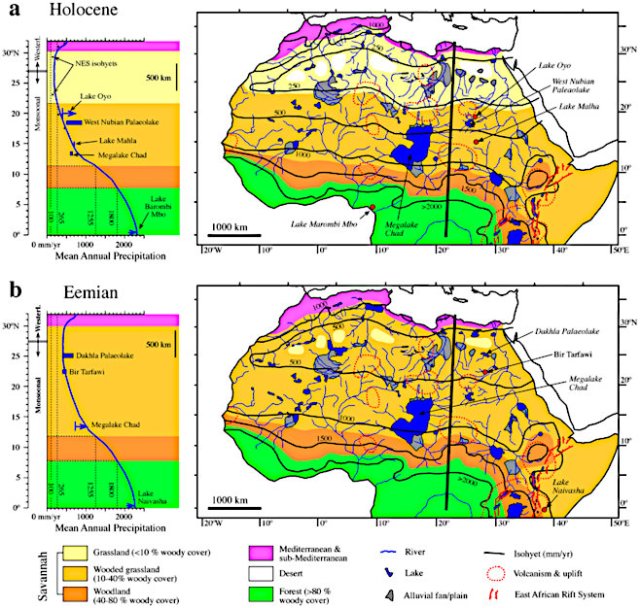
Juan C. Larrasoaña, Andrew P. Roberts and Eelco J. Rohling's Figure 4. Reconstruction of North African vegetation during past green Sahara periods,' from 'Dynamics of Green Sahara Periods and Their Role in Hominin Evolution,' PLOS ONE (October 16, 2013) via Wikipedia, used w/o permission
(From Juan C. Larrasoaña et al., used w/o permission.)
(Wooded grassland (light orange) of the Sahara, 6,000 to 10,000 years ago (top) and 122,000 to 128,000 years back (bottom) from Juan C. Larrasoaña, et al. (2013))

One reason I take climate change, as an idea, seriously is what we’ve been learning about humanity’s long story.

Thomas Wyke's Frost Fair on the River Thames near the Temple Stairs,' detail. (1683-1684) from Thomas Wyke/FT magazine, via Wikimedia Commons, used w/o permissionTake a cold snap that lasted from the 13th to the 17th century, for example. Or maybe it was 15th to 17th centuries. When it started and ended depends on who’s talking at the moment.

François E. Matthes called it the Little Ice Age in 1939, and the name stuck.

Whatever marker’s used to define the Little Ice Age’s span, it was an unpleasant contrast to the Medieval Warm Period: good times from the mid-10th to mid-13th centuries.

The cold, dry weather was a generations-long crisis, but there were occasional bright spots. Londoners, for example, held their River Thames Frost Fairs whenever the ice got thick enough: which wasn’t often, except in the mid-17th century.

Meanwhile, British legislators passed Witchcraft Acts in 1542, 1563, 1604, 1649 and 1735.

The 1563 and 1649 Acts were Scottish, the rest English, and all of them arguably were fallout from Henry VIII’s decision to be head of his very own state church.5

But I suspect that incidents like the North Berwick witch trials, where one of the charges involved alleged conjuring of storms, reflected anxiety over what we call climate change.

Crisis at the Dawn of Civilization?

Avantiputra7's map of the Indus Valley Civilization, Early Phase. (3300-2600 B.C.) Data from 'The Ancient Indus Valley: New Perspectives,'Jane McIntosh (2008); background from Demis.nl; via Wikimedia Commons, used w/o permissionFolks like Herodotus (440 B.C.) and Strabo (23 A.D.) mentioned traveler’s tales of a greener Sahara.

But European scholars didn’t take their accounts seriously.

After all, the Sahara’s name means “the Greatest Desert.”

Then, in 1850, an explorer found petroglyphs in the Murzuq Desert: which showed everyday life in a pleasantly wooded savanna. Not today’s desiccated hell in southwestern Libya.

Folks found more petroglyphs with non-desert themes, László Almásy wrote about a Green Sahara in the 1930s, and paleoclimatology became an increasingly solid science.

I’ve read that ancient Egypt’s civilization probably got started when folks who had been living in the Sahara savanna experienced epic climate change.6

That would have also have been around the time, roughly, when the Indus Valley civilization got going. I talked about the Indus Valley’s story last week.

I’ll be getting back to how we’ve been dealing with Earth’s changing climate — another time.

For now, here’s stuff that’s not entirely unrelated to climate change, doomsayers, science, history and taking care of our home:


1 Assorted advocates:

2 Minnesota is not California:

3 Climates of days gone by:

4 Activists and eras:

5 Recent(ish) events:

6 Sahara: savanna to desert:

Posted in Discursive Detours | Tagged , , , , , , , , | Leave a comment

Pakistan: Blasphemy and Bombs, Death and Dalits; and History

The World Factbook 2021's map of Pakistan, showing major cities plus parts of surrounding countries and the Arabian Sea. Central Intelligence Agency (2021)

I’ll be talking about today’s Pakistan: particularly what it’s like being a Pakistani Christian, Hindu or Sikh.

Or, for that matter, the ‘wrong’ sort of Pakistani Muslim. The list of at-risk Pakistanis depends partly on who’s talking.

A few weeks ago, someone asked me to write about what Pakistani Christians are enduring.

Finding more-or-less current news or information on that general topic wasn’t nearly as easy as I’d hoped. What I did find told me that what’s happening now has very deep roots.

I suspect some of Pakistan’s problems come from being a place that’s been run by foreign rulers since the Vedic period. “Complicated” doesn’t begin to describe the situation.

So I’ve broken this week’s piece into bite-size chunks.


New Nation, Old Land

Photo from CIA World Factbook. The Supreme Court Building, Islamabad, Pakistan. Pakistani government buildings are traditionally decorated and illuminated to celebrate the country's Independence Day, 14 August.
(From CIA World Factbook, used w/o permission.)

As a nation, Pakistan is a very young country. Its 75th Independence Day comes next month: August 14, 2022.

The name is new, too.

“Pakistan” was coined by Choudhry Rahmat Ali’s in his 1933 “Now or Never” pamphlet.

It’s an acronym taken from the names of five British holdings — Punjab, Afghania, Kashmir, Sindh, and Baluchistan — on or near the Indus River.

“Pakistan” also sounds a lot like “Land of the Pure” in Udu and Pashto, languages spoke by many Pakistanis. “Pak,” “پاک,” means “pure” and “stan” means “land” or “place of.”

It’s “Land of the Pure” in Persian, too, which was a court language until 1837. That’s the year when the British East India Company said the region’s official languages would be English and Urdu.1

Early Settlers in the Indus Valley

Rick Potts, Susan Antón and Leslie Aiello's map, showing earliest known spread of the Homo lineage (2014) from Smithsonian Insider (July 2014) used w/o permission

As a place folks call home, on the other hand, the land around the Indus Valley makes America seem as new as a 1950s suburban development.

I figure the odds are very good that folks were living in and around the Indus Valley, Pakistan’s heartland, upwards of 1,700,000 years ago. It’s on one of humanity’s major transcontinental pathways.

Their descendants and those of newcomers have, most likely, been living there ever since.

Granted, we haven’t found much evidence for anyone before the Soanian culture.

We don’t know what folks in the Soanian culture called themselves. They lived long before Sumerians developed pictographs and then cuneiform writing.

Soanian culture is our name for folks who lived in the Siwalik Hills of the outer Himalayas. Sometimes Siwalik is spelled Sivalik or Shivalik, and some folks call them the Churia Hills.

Researchers who first found Soanian tools got the name from their dig’s location: the Soan Valley in Pakistan.

Soanian culture is known for a particular style of stone tools. The folks who made and used them lived from around 125,000 to 500,000 years back. Probably. The Soanian culture’s chronology hasn’t been solidly confirmed. Not yet.

That’s not surprising, or shouldn’t be.2

Living in a Vast and Ancient Universe, Accepting God’s Work
NASA, ESA, and the Hubble Heritage Team's (STScI/AURA) image, detail: NGC 602; a young, bright open cluster of stars. NGC 602 is embedded in nebula N90, a star-forming region in the Small Magellanic Cloud. (2007)

Since 1,700,000 years, or even 500,000 years, is way longer than the 6,024 years and nine months since a particular day in October, 4004 B.C., and I’m not horrified by such big numbers, maybe I should explain why science doesn’t bother me.

Then again, maybe not. But I’ll go ahead, anyway. Feel free to skip ahead to Indus Valley Civilization: Major Player of the Bronze Age.

Bishop Ussher said that God began this creation in 4004 B.C., near the Autumn equinox.

Back in 1650, his exercise in Bible trivia and mathematics was in line with the results folks like Johannes Kepler and Sir Isaac Newton got, using similar assumptions and methods.

Then folks like Kepler and Newton kept collecting and analyzing data.

Folks like James Ussher, the English Archbishop of Armagh and Primate of All Ireland, kept trying to stamp out Papist plots.

By the 1960s, ever-vigilant successors of the Ussher legacy had added communism, evolution and rock music to their list of Satanic schemes. Which eventually led to me becoming a Catholic, and that’s another topic.3

I don’t know how many folks still insist that this universe is just shy of 6,025 years old.

Faith and Reason, Seeking Truth and Seeking God

'Man is but a Worm' cartoon, caricaturing Darwin's theory, from the Punch almanac for 1882. (1981)But I keep running into those who assume that being Christian means believing that scientists must be wrong.

And that humans can’t possibly have been around for more that 6,024 and a fraction years — ‘because the Bible says so.’

I’m a Catholic, so I think we find truth in Sacred Scriptures. That’s one reason we’re expected to study the Bible. (Catechism of the Catholic Church, 101-133)

I also think we find truth in the natural world’s order and beauty. (Catechism, 32, 41, 74, 283, 341, 2500)

So ignoring what we’re learning about God’s world makes no sense. Not to me, because:

  • I should seek truth and seek God
  • Faith and reason work together
  • Faith means embracing “the whole truth that God has revealed.”
  • God creates everything
    • The physical realities studied by science
    • And the spiritual realities that faith pursues
    (Catechism, Prologue, 27, 35, 50, 74, 154, 214-217, 274, 283, 1706, more under Truth in the Catechism’s index)

Seeking truth generally involves learning new stuff.

But that doesn’t bother me. I like living in an era where some of what was I learned in high school science classes is outdated.

Getting back to humanity’s continuing story, assumptions and all that —

Until 1859, thinking that we’ve always been the way we are now made sense. Or could.

For many or most folks, at any rate.

Then Darwin’s “On the Origin of Species” suggested that maybe humanity hasn’t always looked just like we do today.

During the 162 years, 7 months and 29 days since “Origin” hit the press, we’ve confirmed that we’ve changed over the last few million years.

But we’re still missing pages, maybe entire chapters, of our long story. And that’s yet another topic.4

Indus Valley Civilization: Major Player of the Bronze Age

Avantiputra7's map of the Indus Valley Civilization, Early Phase. (3300-2600 B.C.) Data from 'The Ancient Indus Valley: New Perspectives,'Jane McIntosh (2008); background from Demis.nl; via Wikimedia Commons, used w/o permission

Archaeologists have been finding Soanian culture tools in what’s now northern Pakistan and northern India.

Some say the folks making and/or using the tools influenced, traded with, or maybe were the folks who built the Indus Valley civilization. Others don’t agree.

In any case,  from around 7000 B.C. to 2000 B.C., folks living at a place we call Mehrgarh, west of the Indus River, were raising livestock and growing crops. They were among the earliest farmers in south Asia. Earliest that we know of, at any rate.

Some of them moved to places nearer the Indus River and founded the Indus Valley civilization, or they didn’t. The matter hasn’t been resolved yet.

Indus Valley civilization is our name for folks who lived in what’s now northeast Afghanistan, much of Pakistan and western India from around 3300 to 1300 B.C. — 5,300 to 2,300 years back.

Another name we’ve got for them is Harappan civilization, since archaeologists first uncovered their ruins near a town called Harappa.

Charles Masson, AKA James Lewis had been on the lam from the East India Company when he found and described the Harappa site in 1842.

After that, the Harappa site was used as a source of bricks until around 1905. That’s when a new English viceroy of India made archaeology a priority. Maybe not top priority, but at least researchers weren’t competing with bricklayers and railroad construction projects.

Since then, we’ve learned that the Indus Valley civilization traded with folks in Mesopotamia; and through them with Egypt.

We still don’t know if Sutkagan (or Skukagen) Dor was a seaport or a town on a coastal land route connecting Mesopotamia with places like Lothal and Dholavira.

Again, those are names we’ve given the places recently. Lothal, for example, means “the mound of the dead” in Gujarati.5

Good Times, and Then a Drought
Avantiputra7's map of the Indus Valley Civilization, Mature Phase. (32600-1900 B.C.) Data from 'The Ancient Indus Valley: New Perspectives,'Jane McIntosh (2008); background from Demis.nl; via Wikimedia Commons, used w/o permission

By 2600 B.C., the Indus Valley civilization’s villages had grown into urban centers: cities, although not on the scale of places like today’s Delhi and Mumbai.

Those were good times, judging from the scale and amenities of their cities. And evidence we’ve found of thriving Indus-Mesopotamia-Egypt trade.

Then, around the time Pepi I, Merenre, and Pepi II ruled Egypt, what we call the 4.2-kiloyear event started.

It was a drought, lasted two centuries, and may be among the reasons Egypt’s Old Kingdom and Sargon’s Akkadian Empire ended. And, probably, helps account for folks of the Indus Valley civilization abandoning their cities.6

‘There Goes the Neighborhood’ — ca. 1600 to 800 B.C.

ALFGRN's photos of Indus Valley seals from Mohenjo-daro: Indus script characters alongside 'unicorn' (left), bull (center), and elephant (right); from Guimet Museum via Wikipedia, used w/o permission
(From Guimet Museum and ALFGRN, via Wikipedia, used w/o permission.)
(Seals from Mohenjo-daro in the Indus Valley: Indus script and pictures of animals.)

We’d know more about the Indus Valley civilization, if we could read Indus script. And if we’d found more of it. That’s assuming that Indus script is a written form of their language.

Researchers think it looks like some sort of writing; but haven’t deciphered it.

On the other hand, maybe Indus script was their equivalent of calligraphic flourishes.

Maybe descendants of the Indus Valley civilization’s founders would have started rebuilding their cities after the drought finally lifted. But they didn’t.

Immigrants — we call them Indo-Aryans — began arriving from the north toward the end of the drought. Probably.

We’re pretty sure, actually, based on archaeological, linguistic and genetic evidence. But we’re still not sure about details, like exactly why so many folks were on the move.

There were significant climate shifts happening at the time, so a fair fraction of current speculations involve greener pastures: literally.

Maybe some of the Indus Valley’s old families blamed the newcomers for their region’s hard times. Or maybe not. All we’ve got to work with are buildings, tools and bodies archaeologists find: no written records

What does seem certain is that more than the usual number of folks were experiencing violent deaths or dying from diseases like leprosy and tuberculosis.

But life went on. From 1500 to 500 B.C. or thereabouts, folks living in the upper reaches of the Indus Valley were composing Vedic literature. These days, it’s often listed under ‘history of India,’ but current political boundaries didn’t happen until later.7

Foreign Ideas — 535 B.C. to 1707 A.D.

William R. Shepherd's 'Historical Atlas,' the Achaemenid/Persian Empire, ca. 500 B.C.. (1926)

Cities started growing again, starting around 600 B.C., in what’s now northern Pakistan and northern India.

Other places too, but today I’m focusing on the area that’s now Pakistan.

The Vedic folks were Indo-Aryans, descendants of folks who had moved in from the north. Or they had always been in India, which seems unlikely.

At any rate, early Vedic culture’s biggest units were tribes. About three millennia back, they had spread eastward, built towns and established kingdoms.

They weren’t the only ones.

Cyrus the Great’s Achaemenid Empire conquered the land just west of the Indus Valley in 535 B.C., give or take a bit. The united Vedic kingdoms were more like a passel of warring Vedic tribes at that point.

So the Indus Valley was divvied up into five Achaemenid satrapys.

Alexander the Great rolled through the Indus Valley in the 320s B.C. — but his empire didn’t last much longer than he did. When Alexander the Great died, his generals began jockeying for top spot.

Folks like Cyrus and Alexander don’t seem to have been interested in forcing new ideas on folks in their new territories, aside from ‘now we’re in charge.’

But I figure soldiers, merchants and the era’s blue-collar analogs who came along with the top bosses traded ideas with the locals.8 Humans are social critters, which I’ve said before.

Jainism, Buddhism, Hinduism and Maurya’s Empire
Avantiputra7's map of the Maurya Empire. (ca. 250 B.C.) Based on map provided on D. Rothermund's and H. Kulke's 'A History of India,' p.69 (2004) background from Demis.nl; via Wikimedia Commons, used w/o permission

Alexander’s shakeup of the Indus Valley’s status quo, followed by his generals’ infighting, gave Chandragupta Maurya an opportunity to add that region to his empire. Which he did.

Chandragupta Maurya’s biographies vary. But it looks like he gave his throne to his son, retired and became a Jain monk. Or retired and didn’t become a monk.

The Maurya Empire lasted from 322 to 184 B.C., at least as a loose-knit political entity.

Meanwhile, some time around 250 B.C., the two main sects of Jainism formed.

Or maybe Jainism predates Buddhism and Hinduism, having started in the Indus Valley some two and a half millennia before the split. I get the impression that asking five scholars might get six answers.

Buddhism started when Siddhārtha Gautama searched, taught and died: back when Bimbisara ruled Magadha. That’d be around 550 B.C., give or take a few decades.

Hinduism began — we’re not sure, actually. A fair number of academics say Hinduism happened when folks wove together traditions from the Indus Valley civilization and other folks living where India is today.9

Goodby Maurya Empire, Hello Guptan Golden Age

Woudloper's maps of Gupta Empire, ca. 375 and 450 A.D.; from A. Agrawal et al., via Wikipedia, used w/o permission
(From Woudloper, via Wikipedia, used w/o permission.)
(South Asia’s Gupta Empire, Vakataka’s and other holdings, ca.375 & 450 A.D.)

After the Maurya Empire fizzled, folks living in the Indus Valley were ruled by and occasionally joined by folks from Bactria and Scythia, who liked to think they were Greek.

What they, and both the Kushan and Sassanian Empires, had in common was that they came from the north.

That pattern changed in 275 A.D. or thereabouts, when Gupta launched the Gupta Empire. There’s considerable debate over exactly when and where he reigned, but the consensus is that it was late third century A.D. in what’s now northern India.

The years between 300 and 480 A.D. were good times for at least the Gupta Empire’s upper crust, according to the era’s fans in academia.

That’s when mathematicians started thinking about zero as a number and invented the decimal numbering system. Guptans (probably) invented chess, realized that Earth is round and built the Mahabodhi Temple.10

Drama, Death, Decline, a Brahmin Dynasty; Then Caliphates and Mongols

Woudloper's maps of Gupta Empire, ca. 375, 450 and 590 A.D.; from A. Agrawal et al., via Wikipedia, used w/o permission
(From Woudloper, via Wikipedia, used w/o permission.)
(South Asia’s Gupta Empire, Vakataka’s and other holdings, ca.375, 450 & 590 A.D.)

Whether Alchon Huns broke the Gupta Empire, or they succeeded because the Empire was on the skids; Gupta’s good times were clearly over, starting in the 460s A.D.

The Sindh Rai dynasty ruled the lower Indus Valley from 489 to 632 A.D. — the upper part being Alchon Hun territory.

Then drama, death and decline led to the Brahmin dynasty of Sindh. That lasted from  632 to 712, and included much of the upper Indus Valley.

Shifting focus a decade back and two thousand miles or three thousand kilometers north and west, Islam had gotten traction in the Arabian Peninsula.

By 712, Rashidun caliphacy forces were rolling over much of the Indus Valley.

The next several centuries were — complicated.

Basically, and oversimplifying, assorted caliphates kept bringing Islam to India, while assorted Hindi rulers kept defeating the invaders.

The Hindu Shahis held on to part of the upper Indus Valley from 822 to 1026. Ghaznavids, Turkish Muslims, knocked over the Hindu Shahis and ran the territory for 154 years.

Then came the Delhi Sultanate, Chagatai Khanate — AKA Mongol invasion — a whole bunch of other names you needn’t try remembering; and, from 1526 to 1857, the Mughal Empire.11

The Mughal Empire

Antosh.mbahrm's map of the Mughal Empire in 1525, showing expansions by Akbar in 1605 and Aurangzeb in 1707. via Wikimedia Commons, used w/o permission.Zahīr ud-Dīn Muhammad’s name wasn’t easy for his troops to pronounce, so they called him Babur. He took over part of what’s now Pakistan in 1519.

By 1525, he was well on his way to founding the Mughal Empire.

It was a Muslim state, about the same way America is a Christian nation.

The laws were derived from Islam, but enforced with an eye to the reality of dealing with a huge and diverse population of non-Muslims.

Akbar the Great was the Mughal Emperor from 1542 to 1605.

Akbar set up the library for women at Fatehpur Skri, ordered schools for both Muslims and Hindus throughout his realm and helped bookbinding become a high art.

Then he died.

In 1658, regent Dara Shikoh tried picking up where Akbar the Great had left off. Whether his reforms offended defenders of the status quo, or Dara Shikoh was insufficiently diligent about watching his back, results were the same.

A year later, Aurangzeb, another royal, said that he was emperor and made it stick. Then he had Dara, (and, a little later, Sikh guru Tegh Bahadur) executed. Aurangzeb encouraged his subjects to become Muslims, adding Jizya taxes to those who didn’t.

After that, Sikhs militarized and a mess of other folks revolted.

Some historians say Aurangzeb destabilized his empire. Others say he did a wonderful job: building Hindu temples, and employing Hindus in his bureaucracy.

Either way, Aurangzeb eventually died. Without naming a successor. Bahadur Shah I, Aurangzeb’s son, survived a scramble for the Mughal throne.

Bahadur Shah I repealed his father’s religious policies, tried reforming the government, and then he died, too.

The Mughal Empire was on the skids from that point on. Explaining why it fell apart has kept historians writing papers at each other for generations.12

England’s Indian Empire

Archibald Constable and Sons' 'Constable's Hand Atlas of India' map, showing political divisions of England's empire in India. (1893) via Wikipedia, used w/o permission.

I’ll say this for the Mughal rulers. They kept trying. In 1719, their empire was an oligarchic constitutional monarchy. That lasted until 1857.

Bahadur Shah Zafar — “Mughal Emperor of India, King of Delhi” — ruled a realm that included the city of Delhi and property out to Palam. That’s where the Indira Gandhi International Airport is now.

He was crowned in 1837 and stayed neutral on the subject of religion.

The East India Company had long since arrived. They’d been running growing fractions of the Indian subcontinent since 1757, 1765, or 1773: which is when they said their capital was in Calcutta.

Having their lands run by a foreign company didn’t sit well with India’s regional rulers.

Fast-forward to 1857.

A rebellion was in progress. Or a mutiny, or a glorious and doomed war of independence. There’s an ongoing and lively debate over which is the ‘correct’ term.

At any rate, some of the rebels/mutineers/patriots visited Zafar — emperor of a city and a suburb — and said he was emperor of Hindustan. If they’d been successful, that’d be the name of what’s now Pakistan, India and Bangladesh.

Zafar was 81 years old at this point, and had a reputation for staying neutral on religion: which I gather was a huge point in his favor from the rebel viewpoint.

Opinions on how Zafar handled his appointment as Hindustan’s emperor vary.

I figure that whether Zafar’s response was indecisive or reluctant doesn’t matter.

Either way, Zafar eventually said he’d be emperor of the as-yet-nonexistent empire. Then some of his guests killed 52 Europeans, using the front of Zafar’s palace as a backdrop.

In 1858, the whatever-it-was ended. Zafar was tried, convicted and exiled to Rangoon. Seems that the new powers that be didn’t see a point in executing an 82-year-old ex-emperor.13

Slaves, Opium and Change

'A busy stacking room in the opium factory at Patna, India,' lithograph after W. S. Sherwill. (ca. 1850)The East India Company’s control of India could have been worse.

The 1857 rebels/mutineers/patriots might have succeeded in launching their Hindustan Empire, if more folks in India either thought the English overlords were unacceptable, or simply didn’t care who was running the place; as long as they could do business.

Folks who were bought and sold as slaves might have preferred a change in leadership. It depends, I figure, on whether the wannabe liberators wanted to end the slave trade: or wanted a piece of the action.

Slavery had existed in India and in most places long before the English came.

Treating some individuals as if they were property has been a tradition at least since the earliest civilizations began.

It’s also a bad idea and we shouldn’t do it. (Catechism, 2414)

The idea that slavery is a bad idea started getting traction a couple-three centuries back. What astonishes me isn’t so much that many countries have now criminalized slavery, as that open slavery is now unfashionable.

The East India Company’s exports included slaves and opium. I haven’t learned when either commodity was phased out.

The Opium Wars, a Euro-American coalition’s successful effort to force China’s acceptance of opium imports, ended in 1858, the same year that the British Crown took over India’s management from the East India Company.14

Misusing opium, or any other drug, is a bad idea and we shouldn’t do it. (Catechism, 2291)

On the other hand, opium and other drugs aren’t evil by themselves. It’s how we use them. Life and physical health are precious gifts from God. Taking care of them, within reason, is a good idea and something we should do. (Catechism, 2288-2296)

Nine Eventful Decades: The British Raj and Pakistani Independence

Alfred Gale's 'Pictorial Illustration of the Cause of the Great Rebellion' and 'Pictorial Illustration of Abolitionism.' (ca. 1865) via Library of Congress, used w/o permissionThe British Raj, English rule in India, lasted from 1858 to 1947.

Quite a bit happened during those decades.

My country’s northeastern states won a major internal war, so we call it the “American Civil War” or “The Civil War.”

If things had gone otherwise, it might have been the “War of the Rebellion,” “Great Rebellion”, or “War for Southern Independence.” I’m partial to “War Between the States,” and that’s yet again another topic.

Germany, a late starter in the European colonial era, was punished for losing the first phase of a global war.

Crippling economic reparations and political sanctions provided a surprisingly charismatic German politician with talking points that made him an effective fundraiser, chancellor and dictator. I said “effective,” not “good” in the ethical sense.

Nagasaki City Office's photo of Urukami Cathedral, Nagasaki, Japan. (1945)The second phase of the 20th century’s global war ended with a remarkable number of survivors, and an even more remarkable number of national leaders who thought ‘business as usual’ was a bad idea.

What we call World War II ended in 1947.

British India — I’d bet you thought I’d forgotten about that, if I placed bets, which I don’t, and that’s still another topic — Anyway, British India became India, the Islamic Republic of Pakistan and British Burma in 1947.

British Burma became just plain Burma in 1948 and now it’s called Myanmar.

Pakistan was in two pieces, east and west, until 1971. Now the west part is the Islamic Republic of Pakistan and the east bit is the People’s Republic of Bangladesh.15


Pakistan in the 21st Century: It Could be Worse

Reuters photo: Peshawar church bombing. (September 22, 2013)
(From Reuters, via BBC News, used w/o permission.)
(Peshawar, Pakistan (September 22, 2013)
“The attackers struck as hundreds of worshippers left the All Saints church in a busy part of the city”
(BBC News))

Pakistani church bombings got attention in 2013, 2015 and 2017.

Why they happened at approximately two year intervals, and how many churches were attacked before and since: that, I don’t know. I also don’t know whether there’s anything significant about Peshawar, Lahore and Quetta being in central and northeastern Pakistan.

The good news is that apparently many Pakistani churches weren’t bombed in September of 2013.

  • Scores die in twin Pakistan church bombings
    At least 78 people killed as suicide bombers trigger blasts at end of church service in northern city of Peshawar.
    Al Jazeera News (September 22, 2013)
  • Pakistan church blast kills dozens
    A twin-suicide bombing outside a church in Peshawar in Pakistan has killed at least 75 people, in one of the worst attacks on Christians in the country.
    BBC News (September 22, 2013)

And, on the ‘misery loves company’ principle, All Saints Church wasn’t the only place in Peshawar bombed that month.16

Blast kills dozens in Pakistan’s Peshawar
Pakistani officials say bomb in the busy Qissa Khwani market in northwestern city kills at least 40.
Al Jazeera (September 29, 2013)

“…The attack in Peshawar, in northwestern Pakistan, comes a week after two suicide bombers blew themselves up in a crowd of worshippers at a church, killing 85 people.

“On Friday, 19 people died when a bomb planted on a bus carrying government employees exploded in the Peshawar outskirts.

“The Sunni armed group Jundullah claimed responsibility for the church attack, saying it targeted Christians to avenge the deaths of Muslims killed by US drone strikes….”

Death, Destruction, Attitudes and Soreheads

Reuters photo: Peshawar bombing. (September 2013)
(From Reuters, via BBC News, used w/o permission.)
(Peshawar, Pakistan (September 2013))

The Qissa Khwani bazaar/market bomb had apparently been in a parked car, set off remotely. Or by someone in or near the car. I’ve seen it told both ways.

What’s more certain is that many folks abruptly stopped living that day.

The September 29, 2013, Al Jazeera article says nobody had taken credit for the Qissa Khwani market blast. Maybe someone disapproved of that particular market. Or had a grudge against someone who was shopping that day.

Or, since the bomb went off between a police station and a mosque, maybe whoever set it off couldn’t decide whether the police or the mosque was more deserving of destruction.

If Peshawar police were the target, maybe the blast was retaliation for police efforts to interfere with the previous Sunday’s church bombing.

If the target was the mosque, maybe the bomber or bombers felt that Muslims there weren’t the proper sort of Muslims.

The vast majority of Pakistan’s Muslims are Sunni. The others, maybe 10% to 15% of the 96.5% Muslim majority, are Shia.

Branford Clarke's cartoon, from page 21 of Alma White's 'Klansmen: Guardians of Liberty;' Zarephath, New Jersey. (1926)Sunni and Shia Muslims often aren’t trying to kill each other for religious reasons.

But Islam has its soreheads, just as some American Christians have sought to defend their country from people like me.

Happily, America’s soreheads aren’t nearly as proactive as Pakistan’s.

About the September 22, 2013, church attack, seems that it’s America’s fault. Sort of. From a particular viewpoint.

Jundullah, an enthusiastic bunch of Sunnis, said they killed folks at All Saints Church because Americans had killed Muslims with drones.17 Oh, wait. I’m repeating myself. That was in the September 29, 2013 Al Jazeera article I quoted.

From their viewpoint, that may make sense.

Blasphemy in Pakistan

Reuters photo: Peshawar bombing. (September 2013)
(From BBC News, used w/o permission.)
(“The clinic and other Hindu-owned shops were targeted by the mob, witnesses said”
(BBC News))

In fairness, it’s not just Christians being punished for being the wrong sort of Pakistani.

Pakistan vet charged with blasphemy over medicine ‘wrapped in religious text’
BBC News (May 28, 2019)

A Hindu veterinary doctor in south-east Pakistan has been charged under the country’s strict blasphemy laws after allegedly selling medicine wrapped in paper bearing Islamic religious text.

“An angry crowd set fire to his clinic near Mirpur Khas, Sindh province, and other Hindu-owned shops were looted.

“The vet said his use of the paper, apparently torn from an Islamic studies school textbook, was a mistake.

“If he is convicted he could be sentenced to life in prison….”

Life in prison isn’t an ideal outcome, but at least it’s life.

Back in 2017, a bunch of university student Mashal Khan’s fellow-students dragged him out of student housing, beat him, shot him and mutilated him.

I’m not sure whether it was in that order. But that arguably didn’t matter, because Mashal Khan was dead when they were finished.

The university students had a good reason for killing him. Somebody had accused him of blasphemy. Well, good reason from their viewpoint.

The case somehow got into the Pakistani court system. After due deliberation, the court decided that Mashal Khan hadn’t committed blasphemy after all; so one of the students should be executed and five others put in prison for life.18

I am so glad I don’t live in Pakistan.

Pakistani Blasphemy Law: Looks Good on Paper?

Prince.aliabbas's photo: Wadi-e-Hussain Cemetery (Karachi, Pakistan) on a rainy day. (December 8, 2013) via Wikipedia, used w/o permission.

On paper, the Islamic Republic of Pakistan’s blasphemy laws penalize blasphemy against any religion, with sanctions ranging from a fine to death.

In practice, it’s hard to avoid getting the impression that blasphemy is something that offends a Muslim: generally a Sunni Muslim. And that part of the trick in surviving a charge of blasphemy is to not get accused in the first place.

Folks who disapprove of Pakistani blasphemy law say that the law is used to settle grudges between neighbors and punish non-Sunni-Muslims for not being Sunni.

It doesn’t help that about 96.5% of all Pakistani are Muslims, and something like nine out of 10 of those are Sunni Muslims.

Maybe 1.27% of all Pakistani are Christians. It’s an estimate, and estimates vary.

About three out every four Pakistani Christians live in Pakistan’s rural Punjab region.

And most of them are Dalit Christians: descendants of Dalits, untouchables in the Hindi caste system. Today’s conventional wisdom is that they became Christians for economic reasons and to escape their untouchable status.

In any case, Pakistani Dalit Christians are near the bottom of the ladder in Pakistan: limited to jobs like sewer cleaner.

The closest analog in American culture that I can think of is “white trash.” Sorry if that’s an improper phrase these days: but it’s part of my dialect’s vocabulary.19

Living in a Big World

Thomas Nast's 'The American River Ganges.' (May 8, 1871) Anti-Catholic cartoon from Harper's Weekly magazine.I think folks who criticize Pakistan’s blasphemy law have a point, but I’m not a hotheaded member of a religious majority who thinks that what his country needs is fewer folks who aren’t just like me.

Anyway since I’m a Catholic, I can’t attack others for not agreeing with me. That may take a little explaining.

Pursuing truth isn’t just a good idea. It’s something we should all do. By the same token, forcing folks to deny their religious beliefs is a bad idea and we shouldn’t do it. (Catechism, 839-845, 2104-2109)

A few more points, and I’m done for this week.

Everyone is my neighbor. And I should love my neighbor. No exceptions. (Matthew 5:4344, 22:3640; Mark 12:2831; Luke 6:31, 10:2537)
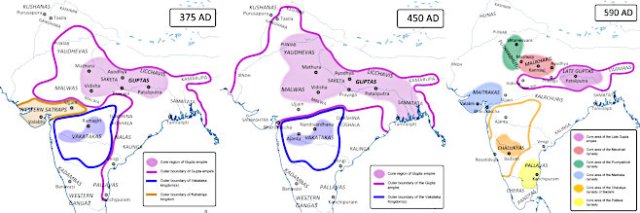
Human beings are people, no matter what we do or where we’re from. (Catechism, 355-361, 1701-1706, 1928-1942, 2258-2283)

Pursuing truth and loving neighbors sounds simple, and in a way it is. But it can also be incredibly difficult. Particularly when a neighbor behaves badly.

There’s much more to say about all this, including and maybe particularly why I’m glad America isn’t a “Christian republic.” But that must wait for another time.

Besides I’ve talked about people, tolerance and making sense before:


1 Pakistan’s recent(ish) history:

2 Beginnings:

3 Religion, science and getting a grip:

4 More science, and why truth doesn’t bother me:

5 Discovedring a forgotten civilization:

6 Climate and civilizations:

7 Pakistan and the Indian subcontinent’s history:

8 Empires and immigrants:

9 Faith and empire:

10 A golden age, for some:

11 Dynasties, caliphates and a khanate:

12 Mostly Mughal:

13 Hindustan, the empire than never was:

14 Opium, slaves and wars:

15 More wars:

16 Three high-profile church bombings:

17 Bomb at a bazaar:

18 Arson, death and blasphemy:

19 Blasphemy and status:

Posted in Discursive Detours | Tagged , , , , , | Leave a comment

This Week: Sunshine, Blue Skies and an Echocardiogram

Brian H. Gill's 'Be Happy.' (2016)

It hasn’t been quite four years since a small patch on my tongue’s underside went numb.

My wife said I should call our town’s emergency room, so I did. I’d long since learned that she’s got common sense.

That was on a Thursday evening: August 2, 2018.

By Friday afternoon, I’d been up close and personal with a CT scanner here in Sauk Centre and the MRI scanner in Saint Cloud, about an hour down the road. And I’d met, at least briefly, maybe a dozen or so folks, of course.

When scan and lab results were done, I had good news. Whatever had happened, it left my brain’s various subsystems working normally.

An image from Brian H. Gill's brain scans in 2018.Well, as normally as they ever work, and that’s another topic.

At least one of the scans showed that I’ve got an atrial septal aneurysm.

“Atrial septal aneurysm” is a five-dollar phrase meaning that there’s something odd about my heart’s atrial septum. It’s the membrane separating my heart’s two upper chambers.

The five-dollar phrase for the numbness I’d experienced is transient ischemic attack, and I talked about that back in 2018.

The heart’s atrial septum is an important bit of tissue. It keeps blood that’s delivered oxygen and is coming back for a fresh supply from mixing with blood that’s been oxygenated in the lungs.

Apparently what I’ve got is a bulge in my atrial septum. One that hasn’t changed in four years, which is good news.

Now and then, folks have a hole in that membrane; which is normal for a newborn. But if the hole doesn’t grow closed promptly, well: that’s not good news.1

My Atrial Septal Aneurysm, Heart Valves and Mostly-Good News

National Heart, Lung and Blood Institute's illustration, showing how echocardiograms are made.A month or so back, my doctor told me it was time to check on my heart, so I went to the clinic this week.

The anomaly is still there, but hasn’t changed. And that, like I said before, is good news.

Happily, the technician — sonographer, I understand, is the proper term — had the computer’s screen on the table’s left side.

Which made it the metaphorical right side from my viewpoint, since that way I could see the images.

And had both a pleasant and an informative chat about the procedure and the pictures.

I learned that each valve makes a different sound. Maybe someone’s composed music based on the heart-valve sounds, and that’s yet another topic.

I also learned that there’s a little backflow or leakage in one of the valves. Nothing serious, well within normal parameters: just not a textbook-perfect situation.

On the other hand, leaky valves can lead to complications ranging from feeling lightheaded to being dead.2

Life, Health, Death and Options

Pieter Claesz's 'Vanitas Still Life.' (1630)I like being alive.

Even if I didn’t, appreciating my life comes with being Catholic.

Human life — all human life — is precious, sacred: a gift from God. So is physical health. Taking care of both, within reason, is a good idea. (Catechism of the Catholic Church, 2288)

Being sick is okay. Being healthy is okay. It’s part of being alive. Getting well, and helping others get well, is a good idea. The same goes for scientific research: about which ethics apply, same as anything else we do. (Catechism, 1410, 1500-1510, 2292-2296)

But staying or getting healthy shouldn’t be my top priority. Putting anything or anyone where God belongs would be idolatry. And a bad idea. (Catechism, 2112-2113)

Anyway, no matter how much of a health nut I am, sooner or later I’ll die.

Death happens. (Catechism, 1006-1007)

But it’s not permanent — which is good news or bad news, depending on what I’ve done with my life. And whether or not I accept God’s love and mercy at my particular judgment. That last item is a sort of postmortem performance review. (Catechism, 991, 997, 1020-1029, 1033-1037, 1042-1050)

Worried? Me? Apparently

Brian H. Gill (2021)I had something other than echocardiograms, heart valves and medical imaging in mind for this week’s topic.

I’d been working on that other stuff until early Wednesday afternoon, when it was time for me to get to the clinic.

Getting the echocardiogram was fun, since I got a chance to see how the tech works and talk about it with the sonographer.

But when I got back home, I realized that what I’d been writing would take several more days to finish: not the two and a fraction left this week.

That happens, sometimes. But when it does, I generally see how to wrap up what I’ve got and still make my self-imposed deadline. This week, that wasn’t happening.

And I realized that I wasn’t nearly as unconcerned about my echocardiogram as I thought. Somewhere, well behind my mind’s front office, I was worried.

So I decided that I’d save my notes and what I’d written to date on what I’ll call topic number one, and start writing this thing. Which I did.

Then, Thursday afternoon, I got the echocardiogram’s results. Results of an analysis of it, actually. The oddity in my heart hasn’t changed — I said that before — and the medications I take will stay the same. Basically, good news.

Let’s see. What am I missing?

Blue skies! Right!

This week’s blue skies, fleecy clouds and sunshine were punctuated by rain and the occasional thundershower. “Thunderstorm,” as the National Weather Service started calling them some time back now.

Sunshine, Lollipops, Rainbows and Me

Gustave Doré's illustration for Poe's 'The Raven.' (1884)This week’s weather and unconscious anxiety, plus my eclectic musical tastes, have had me playing Howard Liebling’s, Marvin Hamlisch’s and Lesley Gore’s 1963 “Sunshine, Lollipops and Rainbows” in my head.

Not the whole song, just the bit I remembered. “Sunshine, lollipops and rainbows, every-something” and repeat.3

It’s among my favorite mood-lifters.

Which have been very useful over the decades. And that’s yet again another topic:


1 Hearts, healthy and otherwise:

2 More about hearts and medical tech:

3 Happy musical memories:

Posted in Being Catholic, Journal | Tagged , , , , , , | 6 Comments